
Here's 5 things you should know at the end of this week:


A New York jury found Donald Trump liable Tuesday for sexually abusing and defaming an American former magazine columnist and ordered the ex-president to pay her $5 million in damages.
The nine jurors rejected E. Jean Carroll's accusation of rape but unanimously upheld her other complaints in the closely watched civil trial, following less than three hours of deliberations.
5 million in damages
- The jury determined that Carroll had proved sexual abuse -- effectively sexual contact without consent -- by a preponderance of the evidence and awarded her $2 million. They also concluded that Trump should pay Carroll nearly $3 million for defamation.Going public - She said it took her more than 20 years to go public because she was "frightened" by Trump. During the trial her lawyers called to the witness stand two other women who testified that Trump sexually assaulted them decades ago.
'Disgrace' - Trump slammed the outcome on his social media platform Truth Social. "I have absolutely no idea who this woman is," he wrote, using all capital letters. "This verdict is a disgrace -- a continuation of the greatest witch hunt of all time.
Other legal woes - Last month, Trump pleaded not guilty to criminal charges related to a hush-money payment made to a porn star just before the 2016 vote -- allegedly to cover up an affair.
Trump is also being investigated over his efforts to overturn his 2020 election loss in the southern state of Georgia, his alleged mishandling of classified documents taken from the White House and his involvement in the storming of the US Capitol by his supporters on January 6, 2021.
Read also: Trump refused to accept 2020 defeat, mocks sexual abuse victim

On Tuesday, as part of Europe Day, a celebration was being held on the market square in Grevenmacher, marking the first time that the town celebrates the day together with its neighbour Trier.
He also expressed his belief that no one really uses the word "border" anymore, given that Europe has become an integral part of daily life in the Greater Region.
What is Europe Day? - The European Union set it as a public holiday for all their employees of the various EU institutions, but not for the individual countries since that is out of their power. Luxembourg is one of few European countries to actually celebrate Europe Day as a public holiday with 2019 marking the first time.
Convinced European - According to Asselborn, Europe is 'part of daily life' in the Greater Region. 'We have to stand up for the community and values that the European Union represents, and of course for freedom of movement.'
Impressive figures - Luxembourg is the largest cross-border labour market in the European union with 225,000 cross-borders commuters. There are also about 25,000 Luxembourgers living in Germany, mainly in the border region. "I think this is where Europe has really grown together", Asselborn says.
More important than ever - Considering the ongoing and unjustified Russian invasion in Ukraine, it is an important moment to reaffirm the European attachment to peace and to show unity and solidarity with the country and the Ukrainian citizens. Asselborn took the opportunity to once again condemn the Russian invasion of Ukraine.

EU lawmakers held a crucial vote Thursday towards setting restrictions on how AI such as ChatGPT can be used in the European Union.
European Parliament committees will set out their position for upcoming negotiations with EU member states that aim to create a law to prevent abuses in the way artificial intelligence is used, while still giving room for innovation.
Long time in the making - Brussels' move towards that goal actually started two years ago, with a European Commission proposal. EU member states came up with their negotiation position at the end of last year.
But the emergence since then of ChatGPT, Midjourney and other AI applications has greatly focused the parliament's attention on the issue, resulting in an avalanche of amendments that have to be considered.
The core of the EU's approach is to have a list of "high risk" activities for AI.
Double-edged sword - While the promise of AI is vast, it is also a double-edged sword as a tech tool. It could save lives by advancing medical evaluations, for instance, or it could be used by authoritarian regimes to perfect mass surveillance.
Known for fakes - Nefariously, though, the tech carries great potential for fakery, to fool people and sway public opinion. That has spurred Elon Musk and some researchers to urge a moratorium until legal frameworks can catch up.
What would the regulations entail? - The commission's proposal already calls for users to be notified when they are in contact with a machine, and requires image-producing applications to state that their output was created artificially.
Outright bans would be rare, and would only concern applications contrary to values dear to Europe -- for example, the kind of mass surveillance and citizen rating systems used in China.
The lawmakers want to add prohibitions on AI recognising emotions, and to get rid of exceptions that would allow remote biometric identification of people in public places by law enforcement.
They also want to prevent the scraping of photos posted on the internet for training algorithms unless the authorisation of the people concerned is obtained.
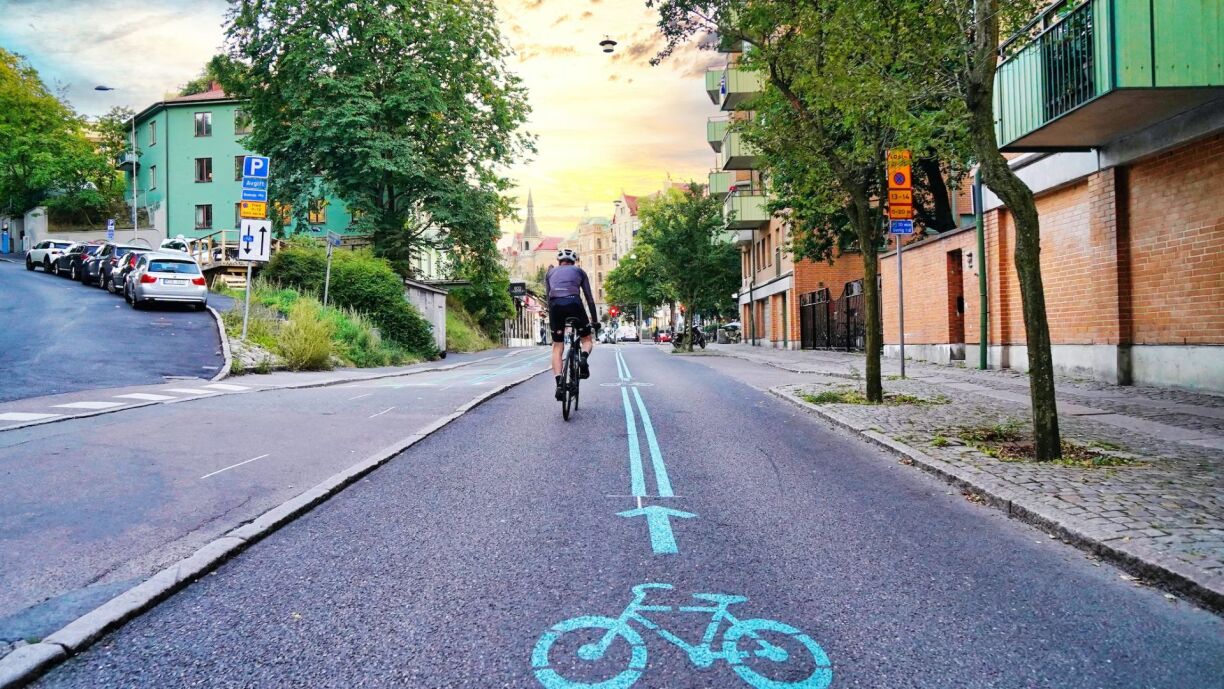
A car-free day, less motorised traffic around the Gare and Grund district, more bicycle lanes? These are among the six out of the seven motions handed in by the Greens in the city council, as well as one together with the LSAP, to make cycling safer in the capital.
One example is drivers not keeping distance to cyclists, with the latter reportedly feeling under pressure when cars are behind them.
Cycling lane on Rue des Aubépines- As an example, LSAP councillor Tom Krieps highlights the flaws in the cycling lane on Rue des Aubépines: "The problem is that at the moment it's a hybrid solution. If there are no cyclists, motorised traffic is allowed to drive on the cycling lane."
He suggests removing the parking spots on the right side of the road and creating a proper, separated cycling lane.
Alderman Patrick Goldschmit (DP), head of mobility, finds the proposal illogical: "The lane goes all the way to Route d'Arlon but then ends there. That would just move the problem to Route d'Arlon or behind the hospital clinics," he says.
No real solution so far - Goldschmit further says reducing motorised traffic is not the solution, as the street in question already forbids cars to overtake cyclists.
Out of sight, out of mind - The Greens are frustrated about slow progress in the case, given it had already been filed in February of 2022.
Greens councillor François Benoy: "We notice that the current majority is putting it in the drawer, because they don't have the political courage to says: I want to set priorities for suitable means of transport in the city."
--The issue of cycling is a much discussed topic not only in politics, but also among our readers.
RTL Today reader David Walker shares his experience and thoughts on the safety of cycling in the Grand Duchy right here. He argued that Luxembourg is good for exercising, but not for commuting by bike.
RTL Today reader Gregory Davies responded to police crack-down on cyclists on the pavement, arguing that more needs to be done to improve safety.
RTL Today contributor Charlotte de Vreeze-Nauta believes cycling as daily transportation is still in the infancy phase, and automobilists remain dominant on Luxembourg's roads.

In March the Luxembourg City municipal council voted in favour of adjusting police regulations on begging to make it illegal in the City centre, Gare, and Bonnevoie between 7am and 10pm.
The decision did not receive unanimous support, with the opposition parties (Luxembourg Socialist Workers' Party – LSAP, Green Party – déi Gréng, and Left Party – déi Lénk) voting against it.
On the other hand, the majority parties (Democratic Party – DP, Christian Social People's Party – CSV) argue that the regulation aims to target organised begging and not ordinary beggars.
Not just from political parties - Our colleagues from RTL Infos discussed the issue with Alexandra Oxacelay, director of the association Stëmm vun der Strooss, which works for the social and professional integration of disadvantaged people.
Shocked - She expressed her shock that the municipality imposed a general begging ban, and questioned whether the next step would be to "ban people from being poor."
She argues that poverty is an increasingly present issue in Luxembourg and should be addressed head-on rather than swept under the carpet. "It bothers me that it bothers people," Oxacelay said, stressing that those in need are part of society and that "we have an obligation as human beings to look after them."
Hiding instead of solving - Oxacelay expressed her disappointment, stating that the municipality's action was an attempt to "hide the problem" without actually solving it.
While it may "solve" the problem for "shopkeepers and some of the customers who go shopping in the city," it essentially "just moves the problem elsewhere."
Business & Tech - Twitter boss Elon Musk on Tuesday put out word that audio and video calls are coming to the platform.
Science & Environment- Activists hurled cake at Volkswagen bosses on Wednesday, as the German carmaker's annual shareholders' meeting was disrupted by protests over human rights and climate change.
Entertainment - Facebook founder Mark Zuckerberg took part in his first jiu-jitsu martial arts tournament on Saturday and went home with silver and gold medals, he posted on social media.
'Civil setback' - The women's section of the Alternative Democratic Reform Party (ADR) issued a statement on Wednesday to condemn the idea of retaining the right to abortions in Luxembourg's constitution.
'Will not be blackmailed' - The electronic healthcare app saga continues between the Association of Doctors and Dentists (AMMD), Minister of Health Paulette Lenert, and Minister of Social Security Claude Haagen. After the AMMD set an ultimatum to both ministers, Lenert responded by saying she would not be blackmailed by the association and its demands, which were 'non-lieu' anyway, she said.
On Monday morning - After months the Ettelbruck-Kautenbach and Kautenbach-Wiltz train connections reopened earlier this week. After being shut for traffic since March, the first train from Luxembourg City arrived in Kautenbach at 6.30am.
22 cold cases of murdered women - The "Identify me" operation is a public appeal to identify 22 female murder victims whose bodies were found in Belgium, Germany and the Netherlands over a 40-year period.

Your Weekly Recap is published every Friday at noon. Read earlier versions.
If you have any comments, questions, concerns on improving the Weekly Recap - contact me at alannah_meyrath@rtltoday.lu





