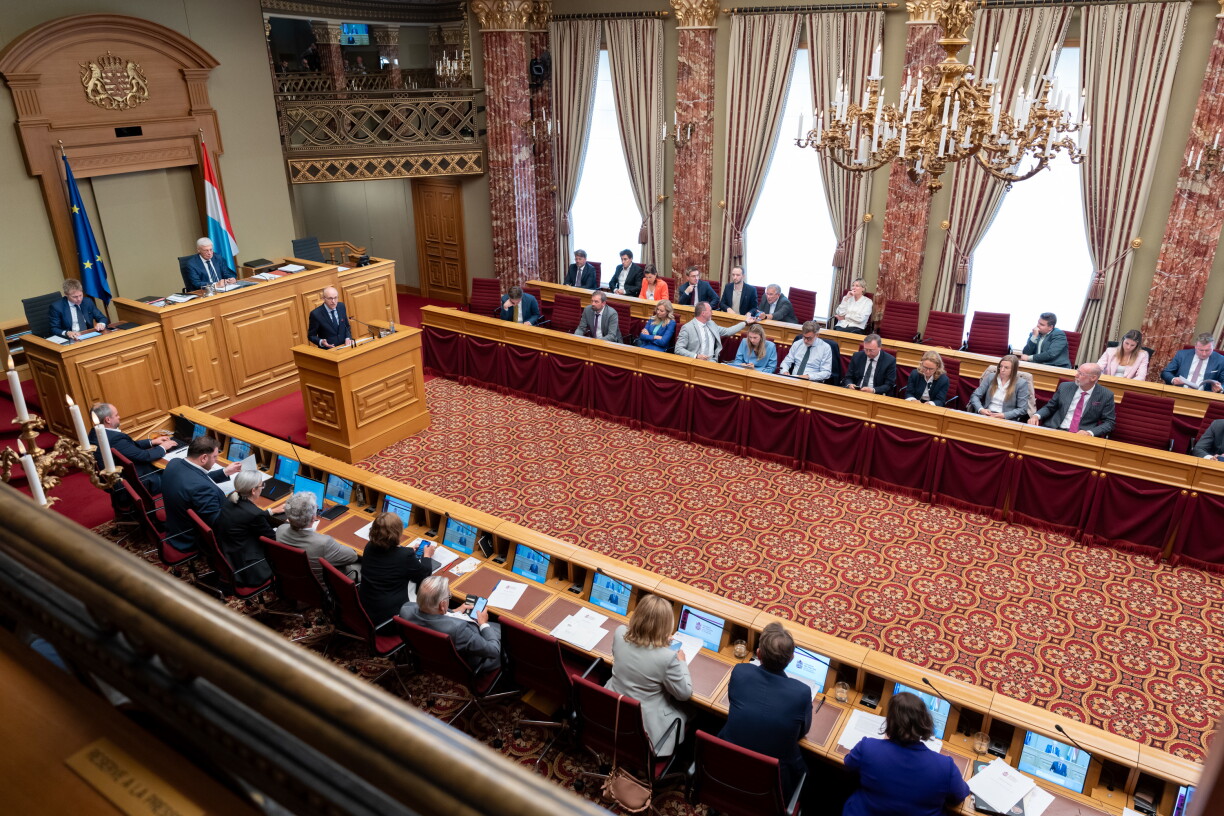
Prime Minister Luc Frieden delivered a statement to the Chamber of Deputies on Tuesday afternoon outlining the recent tripartite agreement reached between the government, employers, and trade unions.
The US-Israeli war on Iran and its subsequent surge in energy prices, Luxembourg's residents have been hit by knock-on effects across the wider Luxembourg economy. The PM argued that the tripartite dialogue was necessary to address a crisis affecting society as a whole, and praised the constructive attitude of all social partners during complex negotiations.
According to Frieden, the agreement is built on three pillars: curbing inflation and safeguarding purchasing power, protecting the economy and jobs, and advancing the ecological transition.
Taina Bofferding, president of the Luxembourg Socialist Workers’ Party (LSAP) parliamentary group, welcomed the agreement as positive for the country overall. However, she expressed hope that social dialogue would become a regular practice, rather than something revived only in crises. On the minimum wage, Bofferding said the proposed increase was a step forward, but not sufficient.
She added that her party wants to make it clear that, instead of a one-off measure, a structural increase in the minimum wage is needed, referring to her party's proposed law to adjust the minimum wage each year in line with wage developments.
Bofferding also voiced reservations about the decision to temporarily curb price increases on fossil fuels. While recognising its necessity in the current context, she warned that this support must remain time-limited to avoid sending the wrong message regarding the ecological transition.
Fred Keup, president of the Alternative Democratic Reform Party (ADR), argued that many elements of the tripartite agreement had already featured in his party's election manifesto, such as lower excise duties on fuel. In his view, this called into question whether such lengthy negotiations were ever needed. However, Keup was critical of the financial impact of the measures, pointing out that the total package would cost €450 million.
"If you divide the €450 million by the population, each resident effectively pays €700 for these measures", argued Keup. "That is a reality, because the money has to come from somewhere. We are taking on debt, and someone will eventually have to pay, most likely future generations."
Keup added that, beyond short-term relief, the government needed to provide answers to the country's structural problems, particularly in the area of housing.
Sam Tanson, speaking on behalf of The Greens (Déi Gréng), insisted that further steps were required to address the ongoing pressure in the housing market.
"Beyond the expansion of public housing, which is being further strengthened, there must also be accountability for property owners who keep homes empty instead of putting them on the market. We need to mobilise vacant properties and unused land, and in our view, this should be a clear priority, which is not the case at present."
On the topic of energy, Tanson added that she would have liked to see an energy-saving awareness campaign launched sooner, noting that such an initiative is only now being prepared.
Marc Goergen of the Pirate Party (Piratepartei) expressed disappointment that electricity prices were not reduced further, particularly as a gesture to those driving electric vehicles.
Marc Baum of The Left (Déi Lénk) took a more sceptical view, suggesting the government now sets its bar for success very low, as it seems that the government is now pleased if nothing else gets broken. While welcoming the minimum wage increase, Baum criticised the fact that the cost would be shouldered entirely by the wider public, rather than employers.
Finally, the Chamber unanimously adopted an LSAP motion to establish a special tripartite commission to oversee follow-up and implementation.





