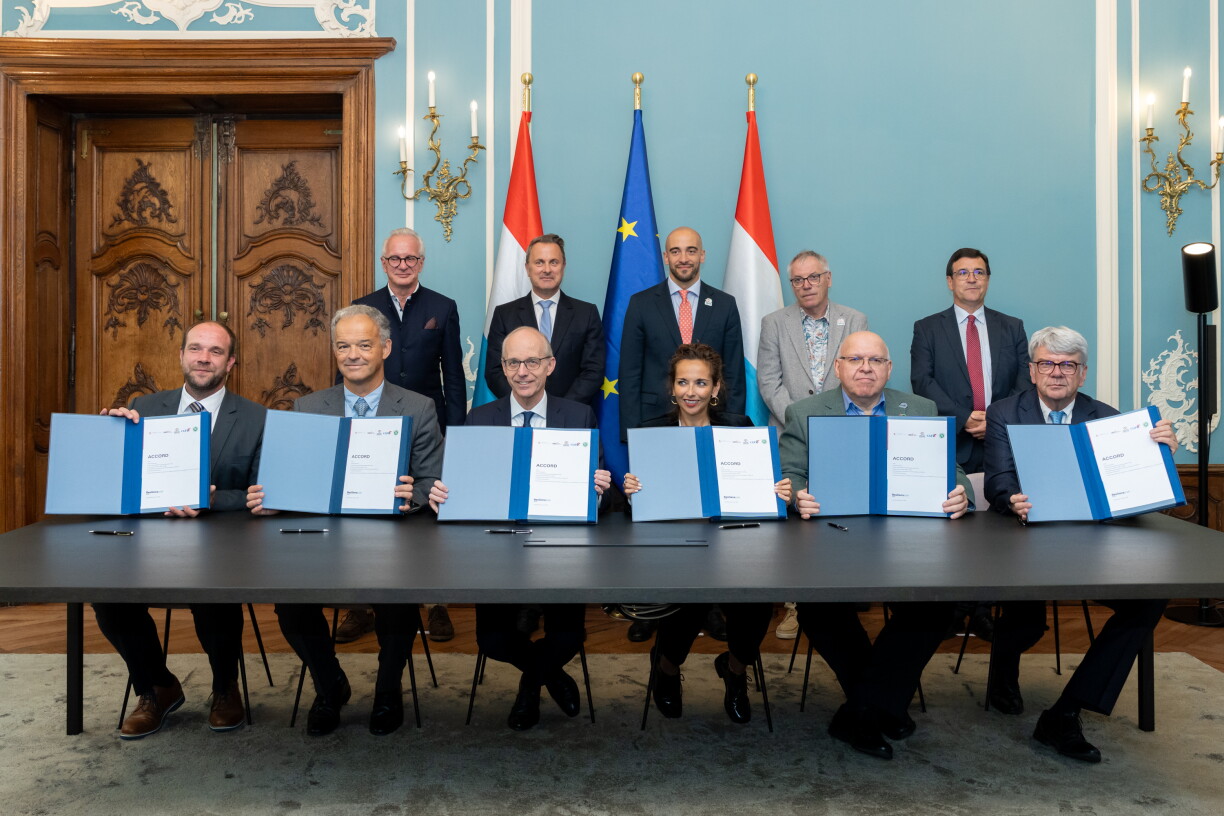
The tripartite agreement has been reached and signed. The final ten-page text was being finalised up until Sunday evening. The resilience package brings together 20 measures aimed at curbing inflation, strengthening purchasing power, protecting jobs and the economy, and pushing forward the energy transition.
The document fleshes out and locks in the measures already trailed on Thursday evening after the fourth round of talks between the government and the social partners.
The context is clear, the text notes, namely the war in Iran and its economic fallout for Luxembourg. Uncertainty is set to grow, the agreement states, since the full impact cannot yet be predicted.
With the Strait of Hormuz, a crucial conduit for petroleum products, still blocked, energy prices remain high and are weighing on households and businesses. The government is therefore looking to pump the brakes on inflation.
The Union of Enterprises in Luxembourg has insisted that a second indexation tranche within 12 months would be too much for many companies to absorb.
To take some of the sting out at the pump, the government will cut excise duties, meaning petrol and diesel will cost five cents less per litre. The measure will apply from 1 July to 31 December and applies if prices rise above the level of February 1 of this year.
From 1 August until the end of the year, residents who use less electricity will be rewarded. Those consuming under 25,000 kilowatt hours per year will be subsidised on a temporary basis to the tune of four cents per kilowatt hour. The measure comes on top of network charges, which the state already partly covers, meaning the price of electricity will be temporarily subsidised by the state by up to 11.3 cents per kilowatt hour.
While the tripartite agreement places real emphasis on the energy transition, households with older heating systems will not be left out either, with the state covering 15 cents per litre of heating oil between 1 August and the end of the year. For gas, a temporary 15 cents per cubic metre will be applied through the network charges.
On Thursday, Prime Minister Luc Frieden and the social partners had set out in some detail how people should be able to keep more of their net income than of their gross. One measure that benefits every working person is a temporary tax credit, paired with an adjustment of the tax scale to reflect a wage indexation. This is set to apply provisionally from July to December, before the tax credit is folded into the scale from January 2027. The agreement does not make any mention of an income-based scaling.
After intensive negotiations, the government, employers and unions agreed to raise the minimum wage by €200 in two steps by July next year, with the bulk arriving on 1 January 2027. The increase will be delivered through a tax credit. Since the social minimum wage tax credit (CISSM) is degressive, it applies to salaries up to €3,600. The design is meant to ensure that people earning just above the minimum wage are not penalised.
To reduce dependence on fossil fuels and on third countries, the government and social partners want to give a stronger push to renewables. The Prime Minister had not put concrete figures on this aspect last week.
Under the resilience package, anyone buying a heat pump will receive an extra €2,000 from the state. The top-up applies retroactively from 1 January 2026 until 30 June next year. Over the same period, energy advice will also be available at a reduced cost, with the state covering €300 of the bill for a single-family home, or €500 for a block of flats.
For energy renovations, the state's contribution will rise from 15% to 20% until 30 June 2027.
The government has also announced that it will introduce social leasing for electric cars, which will come into effect from January 1, 2027. However, the agreement does not provide details on who it will apply to or how it will be implemented.
The social partners and Prime Minister Luc Frieden said last week that the success of the tripartite talks had breathed new life into social dialogue. They want to ride that momentum by meeting more regularly in the bodies set up for the purpose.
Unions, employers and the government have committed to engaging constructively once again within the Permanent Committee on Labour and Employment (CPTE). In the wake of the social crisis, the Independent Luxembourg Trade Union Confederation (OGBL) and Luxembourg Christian Trade Union Confederation (LCGB) had stopped attending its meetings. With the situation on the labour market and unemployment a cause for concern, the CPTE wants to keep a close eye on developments and look for solutions.
A tripartite monitoring committee is also being set up. The government and the social partners want to track the measures agreed at the tripartite and how they are being put into practice, as well as keeping tabs on how the economy is developing.
The committee will also look at how sectoral reclassification units could be set up, to support workers affected for example by technological change who want or need to switch sectors. At the other end, the focus will be on companies looking for staff, with attention to training, qualifications and recruitment.
The monitoring committee is to meet quarterly, with its first meeting due to take place no later than October 2026.
State support for businesses under particular financial strain because of energy prices and the wider uncertain economic outlook is being structured differently from the aid for households, likely due to EU competition rules. The text of the tripartite agreement states that state aid frameworks adopted by the European Commission will serve as a model.
A particular focus is placed on support for agriculture, with the Chamber of Agriculture having taken part in the tripartite talks. This year, farmers are to receive state aid to offset higher fertiliser costs, again within the bounds of European rules. Among other things, the option of paying direct aid as an advance is to be examined.
Within the EU framework, regional produce is to continue being promoted in state canteens, and biogas installations are to receive better support. Diesel will also be cheaper for agricultural businesses, including winegrowers, on the same terms as the heating oil rebate for households, namely 15 cents per litre.
Unions, employers and the government see housing as one of the biggest political and economic challenges. They are setting up a housing monitoring committee to track market developments and design new measures, with at least two meetings a year.
The civil servants' union pushed especially hard for one specific measure, unless the European Commission raises objections, namely that those buying or renovating their home should see the VAT refund available from the state via the super-reduced rate doubled, from €50,000 to €100,000.
At the same time, the age limit of 40 years is being scrapped so that contributions into a home savings contract can be deducted from tax twice over in order to make these contracts attractive to a wider pool of people.
The government is expected to sign the tripartite agreement with the social partners on Monday in the late afternoon at the Ministry of State. The OGBL and LCGB committees have given the text unanimous backing, as has the civil servants' union. The Union of Enterprises in Luxembourg and the Chamber of Agriculture are also expected to give the text their green light.
The agreement does not say how much the 20 measures will ultimately cost the state. So far, a figure of €450 million over two years has been put forward.





