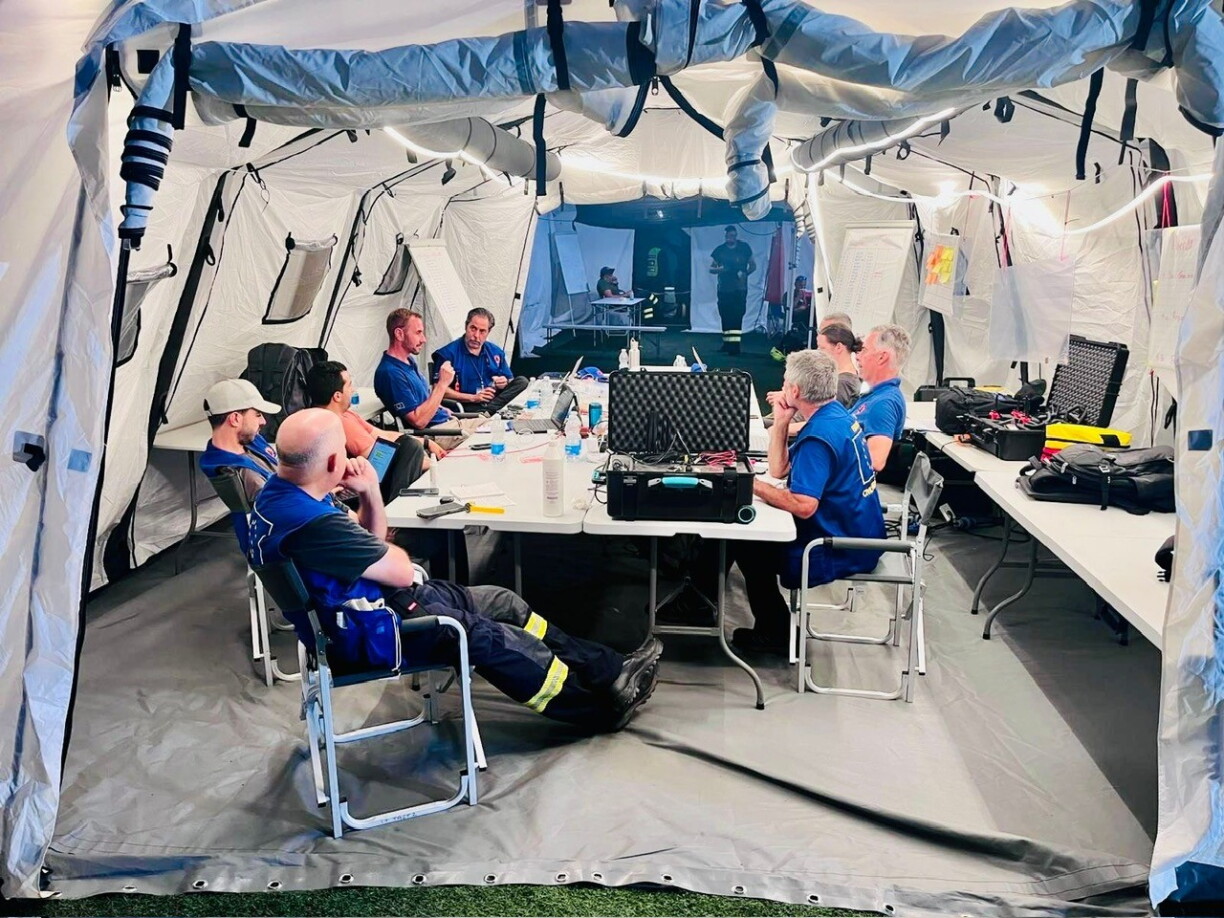
Almost a week after the deadly earthquake in Venezuela, seven Luxembourg experts are coordinating rescue and relief efforts in the areas that were hardest hit.
The response was very swift. On the third day after the devastating natural disaster, Andrea and Fabio Nicoletti arrived in the Venezuelan capital Caracas late in the evening, together with Brice Tavernier. From there they pushed on to one of the worst-affected areas, namely La Guaira.
The mission is the fourth deployment to a disaster zone for both of them. The scene that greeted them was one of overwhelming destruction.
Fabio Nicoletti, a member of the Grand-Ducal Fire and Rescue Corps (CGDIS) currently working for the EU Civil Protection Mechanism, explained that La Guaira sits closer to the water, on sandy ground. According to the experts on site, he said, the shaking during the earthquake was so intense that the sand liquefied, which is why most of the buildings in La Guaira collapsed.
The seaside city can effectively be regarded as Ground Zero of the twin earthquakes. Buildings along the shore collapsed in on themselves over several kilometres. Thousands of people are still missing there, and aid operations are in high gear.
The coordination effort is currently at its peak, said Andrea Nicoletti, and taking place in extreme heat and very high humidity, which is making life difficult not just for the rescue dogs but also for the teams themselves.


The residents of La Guaira are gradually coming to terms with the fact that many family members and friends can no longer be saved. At the same time, life is being pieced back together among the ruins. Water and food are being handed out, and whatever is available is being shared, warmly, including with rescue teams from around the world.
Six days after the earthquake, the rescue phase of the operation is now drawing to a close. The focus is now on survivors and the many injured.
As members of the EU Civil Protection Mechanism team, the mission of the three CGDIS staff from Luxembourg is to coordinate assistance.
Andrea Nicoletti explained the approach as follows. The team first looks at what the country needs most urgently, starting with rescue teams, sniffer dogs, firefighters, and people to reach those still trapped in the rubble. The second part involves identifying the technical equipment required to manage the crisis. Once that assessment is complete, the EU team returns to Brussels with the full picture of needs.
EU member states, together with the ten countries taking part in the EU Civil Protection Mechanism, then offer up the capacities and specialists who will subsequently be deployed on site.
Seven Luxembourg experts are helping directly on the ground in Venezuela. Three are members of HIT, a CGDIS unit deployed for the EU Civil Protection Mechanism. Two others are Luxembourg nationals coordinating on behalf of the United Nations agency, while two more men are on site with the emergency.lu communications module.





