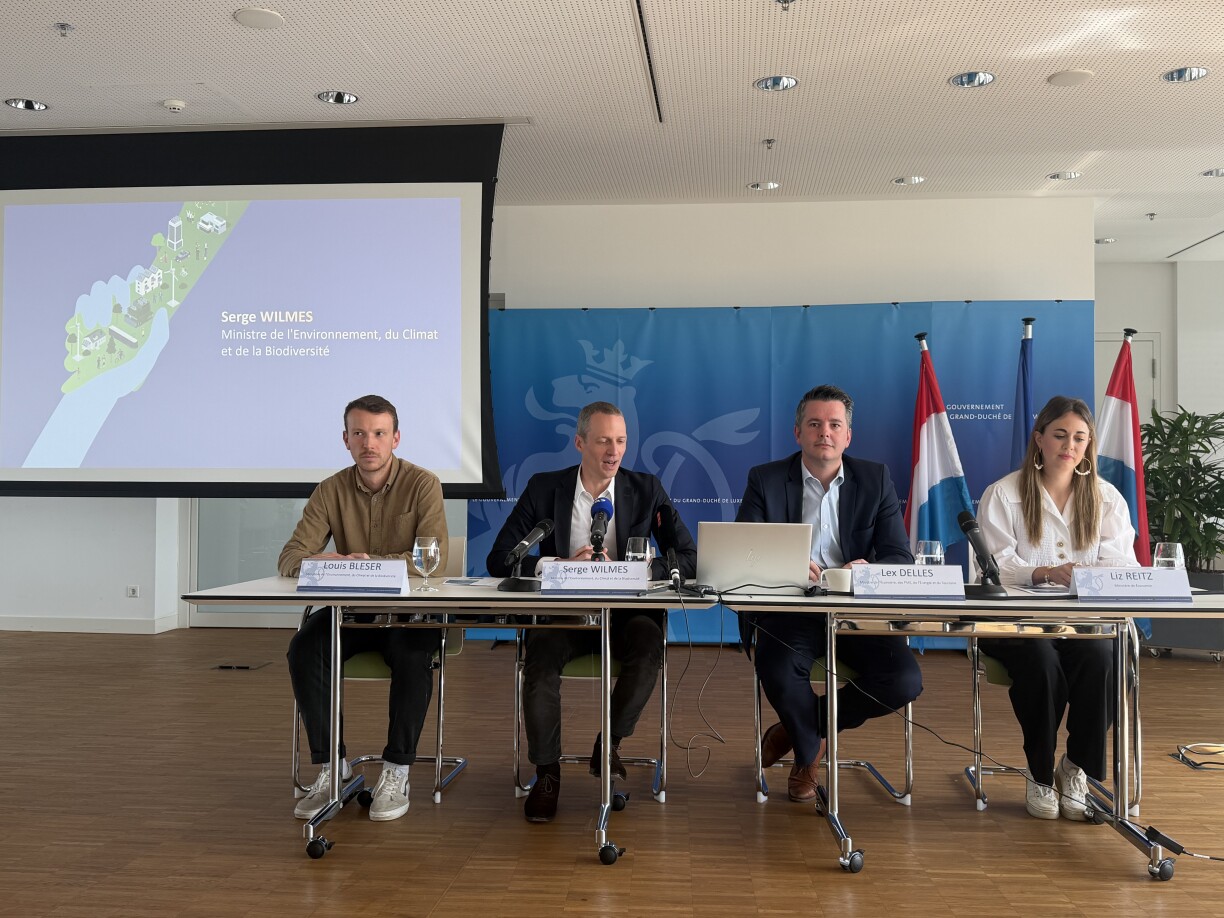
As part of an EU requirement for all member states to adopt a Social Climate Plan, Luxembourg has unveiled its strategy to support households and businesses through the cost of the energy transition, presented on Friday by Environment Minister Serge Wilmes and Economy Minister Lex Delles.
Luxembourg's plan is based on two main approaches: providing financial support to offset rising costs and introducing measures to make the shift to more sustainable solutions easier.
Around €230 million per year has been allocated for this in Luxembourg. According to Delles, the plan includes measures designed both to compensate for the cost of fossil fuels and to support households and micro-enterprises in becoming less dependent and more resilient in the medium to long term.
Alongside existing measures such as tax credits and energy subsidies, new and more targeted support schemes are set to be introduced. In particular, work is underway in the mobility sector on a social leasing model for electric cars, aimed at making climate-friendly transport more accessible.
Similar schemes are also being considered for heat pumps and photovoltaic systems. Louis Bleser, project manager of climate change initiatives at the Environment Ministry, explained that the idea is to build on studies already carried out on social leasing for cars and, once the system is in place, extend it to other technologies such as heat pumps and solar installations.
At the same time, other areas are also being addressed. A pre-financing model for solar panels is set to be expanded to include electric vehicles and heat pumps.
The Klimabonus Mobilitéit, a government subsidy for low-emission transport, will be extended, while a new "right to a charging point" aims to make it easier to install charging stations in apartment buildings.
Housing-related measures will also remain in place: the Klimabonus Wunnen, a government subsidy for energy-efficient housing improvements, will be extended until 2030, and new solutions are being developed to bring vacant properties back onto the market, according to Delles.
In this context, Delles said that a call for projects will be launched targeting owners of vacant or renovation-needed properties. The state would cover part of the costs, on the condition that the housing is made available to a social landlord for a longer period, he said.
The plan also targets small businesses. Measures are foreseen to reduce administrative barriers, alongside interest-free loans to support investment in sustainable solutions.





