
The Council of Europe released its annual penal statistics on Tuesday, counting 1,107,921 people behind bars across 46 member states as of January 2025. After a decade of declining rates, Europe seems to be entering a new upward phase of rising populations following a sharp COVID-era dip.
The Grand Duchy held 749 people in detention on 31 January 2025, translating to a prison population rate of 109.8 per 100,000 inhabitants, sticking close to the European median of 110. The 20% jump is striking in comparison with the other countries, though when read against longer-term trends, the rate has actually fallen by 28% since 2005.


However, the study is careful to stress that changes in the general population, such as growth driven by immigration, could be a factor behind the growing incarcerations figures.
As for what is driving people into detention, theft-related offences stand out sharply at 26.2%, whereas drug offences and homicide follow at 16.7% and 14.1%, respectively.
Regarding profile, Luxembourg's prison population skews younger than the European median: The average inmate age lies at 37 compared to the European median of 39, with 19% of inmates being between 18–25 years old, 66% aged 26–29, 12% aged 50–64, and 2.9% aged 65 or over.
The overwhelming majority of detainees is male, with only 5.2% of total inmates being women.


While Luxembourg's prison statistics generally sits close to the European median, it stands out with the fact that 78.1% of inmates are foreign nationals compared to the European average at 26%. Of those 78.1%, almost half are EU citizens.
Luxembourg's numbers reflect a structural reality shared across Western Europe, which the Council terms the "European immigration paradox": countries that serve as destinations or transit hubs for highly mobile populations tend to bear a disproportionate share of the consequences. In addition, Eastern European nations have been facing consistent population declines since the 2000s and may therefore see lower proportions of foreign detainees.
At the same time, Luxembourg is one of only 16 prison administrations to disclose the legal residence status, reporting that 37% hold legal resident among foreign inmates, above the European average of 26%. Given how few countries provide this data, the comparison should be treated with caution.


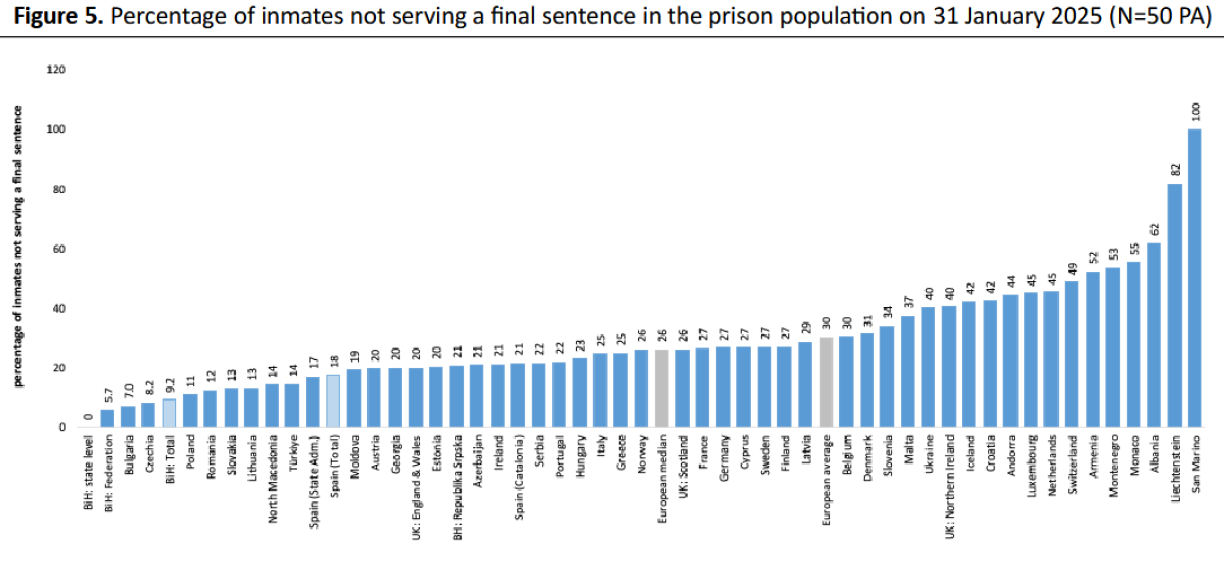
Almost half of Luxembourg's prisoners (45%) have yet to receive a final verdict, against a European median of 26%, placing Luxembourg in the "very high" category. Judicial systems vary widely across the Council of Europe's member states, and the report cautions against drawing direct conclusions from cross-national comparisons.
Nonetheless, a high pre-trial rate may indicate slow court procedures, or an excessive reliance on detention as a precautionary measure rather than as a last resort.
On prison conditions, Luxembourg performs well, with low prison density, high staffing levels, and a high budget.
Its prisons operate well below capacity at 78.5 inmates per 100 available places, at a time when 32% of prison administrations across Europe face overcrowding. The prison administration operates with a budget of €134 million for a total of 749 inmates, working out to roughly €179,000 per inmate per year. With roughly one staff member per inmate (0.9), Luxembourg also boasts one of the continent's highest staffing ratios, and recorded no prisoner suicides in 2024.
One figure that complicates the picture is an escape rate of 120.2 per 10,000 inmates, roughly 50 times the European median of 2.4. With under 750 inmates, this reflects a small absolute number of incidents. The report also notes that the meaning behind "escape" varies widely and could include unauthorised absences from open prison regimes.






