
Here are five things you should know at the end of this week:


On Wednesday Minister of Social Security Martine Deprez reiterated that she was not ruling out any options when it comes to the pension reform debate.
Deprez drew criticism not only from the trade unions, but also from the opposition parties and many wondered if the government will enter discussions with an open mind.
Context – The ongoing controversy stems from a parliamentary question posed by Marc Baum of The Left, inquiring about the effects of eliminating the cap on contributions to the general pension insurance scheme (CNAP).
The cap being discussed refers to a limit on pension contributions for certain employees, specifically regarding how much individuals in different pension schemes are required to contribute.
Unified pension system –While many politicians support a unified pension system, DP’s André Bauler cautioned against conflict with the civil servants' union, indicating further internal party discussions are needed.
The ADR is willing to challenge the civil service on funding, emphasising the need to identify savings and address perceived injustices for all pensioners.
The Greens' Djuna Bernard advocates for unity between the two pension systems and refrains from taking a firm stance on the cap.
Is the government prepared? – Deprez noted that potential changes could cost the state around €400 million, without confirming if the government would cover this expense.

The latest 'Sunday Question' poll, carried out by Ilres on behalf of RTL and Luxemburger Wort, shows that people's satisfaction with the Frieden administration has suffered in the six months since the CSV-DP coalition has taken office.
When compared to the October 2023 election results, both the Christian Social People's Party (CSV) and the Democratic Party (DP) would each lose one seat in the Chamber.
It appears that the past months of upheaval in the Pirate Party have not gone unnoticed by voters: all three of the seats won in October would be lost, if people headed to the polls on Sunday.
Sinking ship – In recent months the Pirate Party has suffered from internal disputes, most notably between MPs Sven Clement and Marc Georgen.
New MP Ben Polidori, who was elected to Parliament in October last year, announced his resignation in July, citing the party's functioning as a key reason for his departure. He is currently sitting as an independent MP.
Steven Curfs, a municipal councillor in Mondercange, announced his resignation from the party but will remain in his role as an independent.
Shortly afterward, Vincenzo Turcarelli, a Käerjeng municipal council member, also announced he would leave the party.
Coalition deemed unsatisfactory – But the Pirates are not the only party feeling voters' ire. The CSV would lose around 1% of votes, but would remain the strongest party with around 29%. Their coalition partners, the DP, would also lose a marginal amount of votes - however, it would be enough to remove a seat in the Chamber from each of the ruling parties, bringing the CSV to 20 MPs and 13 for the DP.
Gaining popularity –The other opposition parties have grown in popularity. If elections were held next Sunday, the Greens would win two seats, restoring their fractional strength lost in the last election.
The LSAP would win 13 seats, same number as the DP. LSAP would actually be slightly stronger in percentage terms.
The Alternative Democratic Reform Party (ADR) would also win a percentage point, bringing them to 10.7% of votes. This would represent six seats in the Chamber, an increase of one from their current standings, delivering the party's best results since winter 2021.
Read also:Clement or Goergen, who is the real bully?

On Thursday morning, minister Léon Gloden presented the new warning system LU-Alert – under the motto "Early Warning – Early Action" – which has been in the works for the past few years.
The new system is available in several languages and will be launched on Thursday, accompanied by a testing phase.
This means the LU-Alert will be tested on the first Monday of every month, Gloden confirmed, using either text messages or the app. The sirens will also continue to be tested as usual.
From yellow to purple –The new system will have varied warning levels from yellow to red, as well as different channels to reach the public. Yellow refers to low-risk, for less alarming situations, while orange is medium-high risk. Red would correspond to a high-risk situation such as the 2021 floods.
There will also be a fourth level meaning "danger imminent", which would require immediate action from the public. One example of this would be a case involving toxic gas emissions, with advice for people to close their windows.
The lowest level is green, which refers to purely informational messages without any direct danger. For example, this could include product recall notices.
Warning channels –Different methods can be used to reach the public depending on the warning level. For example, nationwide text messages can be sent for red and orange risk levels.
Cell broadcast is not a new technology, but nevertheless, it is new for the Grand Duchy. This permits messages to be sent directly to mobile phones, but crucially, not via SMS.
Instead they depend on whether the phone is situated in a particular geographical area. The mobile phone will react by making a loud noise, regardless of whether it is on silent mode. It will also vibrate and the torch will flash, alerting the user to the warning.
This should make it clear that action is required, explains Christine Bastian, of the General Department of Civil Security. However, these cell broadcasts can only be received by up-to-date smartphones.
In the necessary scenario, there would be sirens, as well as fire engines and police cars driving through towns with megaphones, says the Ministry of the Interior's civil security director, Alain Becker.
Test phases starting now –As the system is still not complete, the Ministry encourages feedback from the public. It will also aim to carry out a publicity campaign and will issue municipal councils with leaflets to inform residents.

The European Central Bank cut interest rates again Thursday, upping the tempo at which it is lowering borrowing costs as inflation in the eurozone cools faster than expected and the economy loses steam.
The Frankfurt-based institution reduced rates by a quarter point, following a cut of the same size at its last meeting in September.
From its peak of four percent, the ECB has lowered rates three times since June, leaving its benchmark deposit facility at 3.25 percent following the latest cut.
Step by step –The ECB had not achieved "complete victory" over inflation but declining price pressures were a positive sign, President Christine Lagarde said at a press conference.
Time of crisis –The ECB cranked rates up higher and faster than ever before in response to soaring inflation in the wake of the coronavirus pandemic and the Russian invasion of Ukraine.
Possible change? – Thursday's cut could represent a "pivot point", Deutsche Bank Research analyst Mark Wall said
Lagarde refused to give an indication of what the thinking was among rate-setters ahead of the ECB's next meeting.
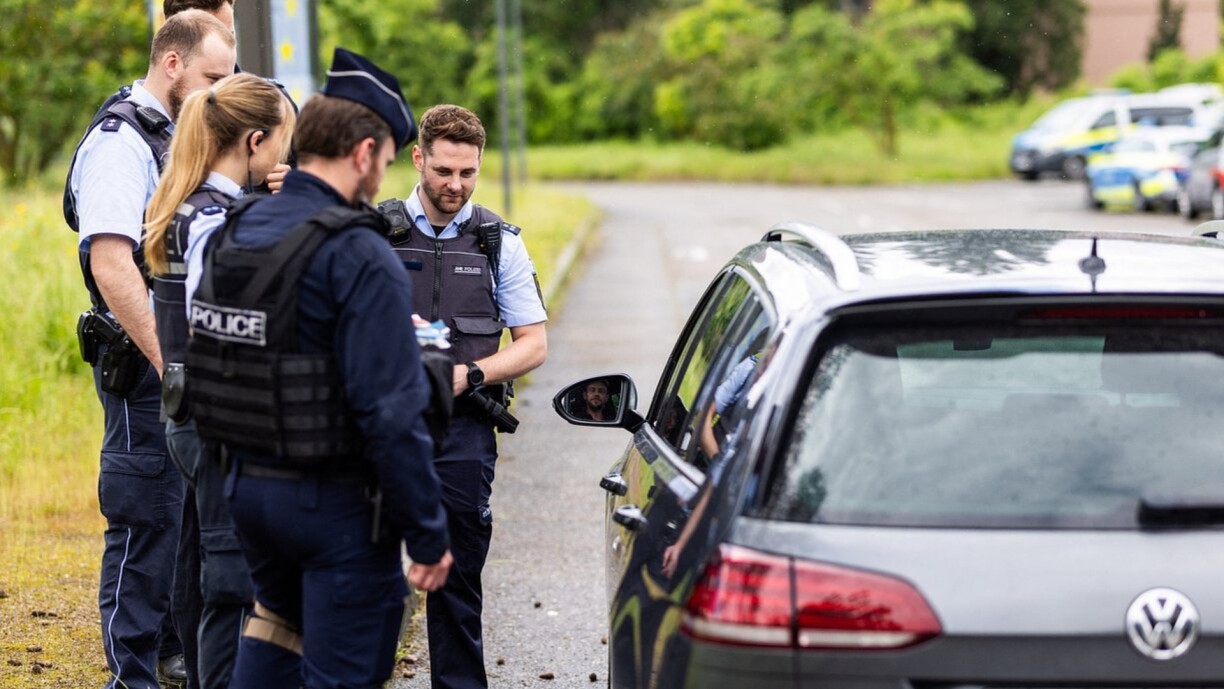
France has informed the EU Commission that it will once again perform border controls with six neighbouring countries, from 1 November 2024 until April 2025.
The EU summit in Brussels on Thursday saw heated discussions on migration policy with Luxembourg Prime Minister Luc Frieden pushing for stronger cooperation and open borders within the Schengen Area.
Frieden expressed his concerns about the border controls, stating unequivocally that he does not believe they are "a good idea."
Not the first –France is following Germany's example, citing security risks as the reason, with an emphasis on preventing terrorism and illegal immigration – which is a major talking point at the current EU summit.
Other countries are following suit: in Austria, temporary controls on the borders with Slovakia and Czechia have been taking place since Wednesday, and countries such as Norway, Sweden and Denmark will also strengthen their border controls until mid-2025.
EU summit – Frieden noted that President Macron appeared more receptive to his arguments than Chancellor Scholz. Following their conversation, Frieden and Macron agreed that the interior ministers of Luxembourg and France would hold further discussions this week.
Mass immigration – Another key topic at Thursday's EU summit was the need to strengthen the bloc's external borders to curb illegal migration. Leaders agreed that individuals who are not recognised as refugees, or who have entered the EU illegally should face deportation.
Earlier this week, EU ministers rejected Switzerland's proposal to limit immigration from the bloc as part of ongoing negotiations to update their complex bilateral agreements, a sticking point that could hinder efforts to stabilise relations by the end of the year.
Business & Tech – US authorities have hit Lufthansa with a record $4 million penalty after finding the airline discriminated against more than 100 Jewish travelers by blocking them from boarding a flight in 2022, officials said Tuesday.
Science & Environment – Inaction on the water crisis could put more than half of the world's food production at risk by 2050, experts warned in a major report published Thursday.
Entertainment – Former One Direction singer Liam Payne has died at age 31 after falling from a hotel balcony in Buenos Aires, local police confirmed Wednesday.
New details come to light – The employee involved in the 61 million euro embezzlement scandal at Caritas allegedly confided in an online clairvoyant with links to an organised crime ring in Bulgaria.
Statistical insights – The National Institute of Statistics and Economic Studies (STATEC) has published the 2024 edition of "Luxembourg in figures", offering a statistical overview of the country and its society.
Sighting of suspicious young person – Authorities on Tuesday morning were called to investigate an armed attacker alarm triggered at a secondary school in Redange/Attert, leading to a substantial police presence at the site, though no threat was identified in the end.

Your Weekly Recap is published every Friday at noon. Read earlier versions.





