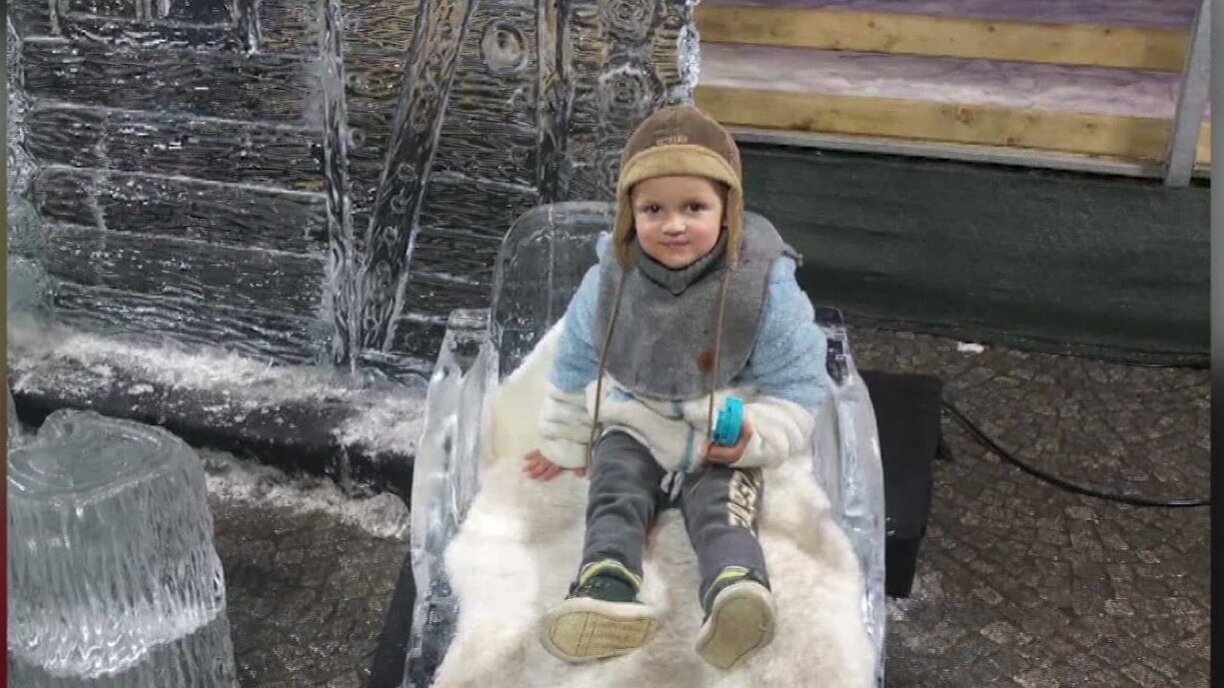
Four days passed before the parents of Emran – the young boy killed by a collapsing ice sculpture at the 2019 Christmas market in Luxembourg City – were heard in court.
On Thursday, it was the parents’ turn to testify. They spoke with great dignity about the day of the accident and the time that followed.
Alisa Hamza introduced herself to the court by saying: “I am the mother of Emran, who died on 24 November 2019.” She began by noting that they were a family “like all other families with two children.”
In detail, Hamza recounted how the family – including grandparents, an uncle, an aunt, and cousins – travelled to the Christmas market in the capital because the city offered “something special” in the run-up to Christmas. After parking their car, the family first visited the funfair section of the market.
At first, Emran was with his mother, while his older brother – then nine and a half years old – stayed with her husband, Ragbet. “It was a wonderful evening,” Hamza said, recalling how Emran was mesmerised by the many lights and everything around him.
At some point, the older boy expressed a desire to go ice skating, and the parents decided to swap which child they were each looking after. Hamza accompanied her eldest to the ice-skating rink. On the way there, Emran spotted the yellow-and-red McDonald’s sign and shouted “Chips!” His father fulfilled his son’s wish.
Half an hour later, the father and Emran joined the others at the rink. “Emran was fascinated like never before in his life”, his mother recalled.
However, it was getting late, and the family decided to go home. Hamza skated towards the exit of the rink. It was at that moment that she heard a noise – “as if something had fallen.” Her niece shouted: “It’s Emran, it’s Emran.”
Hamza quickly went through the barrier, took off her skates, and ran to the other side. “He was on the ground. There was blood next to him. I knew he was dead”, she told the court.
Her older son also saw the scene. “His brother, dead on the ground. I gave him a final kiss”, Hamza recounted. She stated that there are many pictures and videos of that day. It was supposed to be a special day for the whole family, “but we went home without Emran.”
Hamza expressed the hope that the trial would also help rebuild her trust in the local council and the state. “That’s all”, she said to the judge, “Thank you, and good luck.”
Her husband, Ragbet, was unable to speak at length about the accident itself, as the memories remain too painful. “I was there to look after the little one – and I failed”, he said.
In court, he spoke mainly about the period following the accident. He recounted how he was unable to continue managing his business, which delivered playground installations to municipalities. “The shock paralysed me. I was lying in bed and couldn’t get up anymore – everything imploded”, he told the court.
After his business went bankrupt, he was refused unemployment benefits on the grounds that he had been self-employed. This also meant he was excluded from social security. One day at a pharmacy, he was told that he was no longer affiliated with the National Health Fund (CNS).
Ragbet Hamza is an engineer by profession and, through his work, is familiar with the legislation governing installations open to the public. For this reason, he said he is angry, criticising what he described as a very unprofessional approach for a capital city. "Why are there standards and laws if we don't apply them? These are things that get on my nerves", he told the court. He added that he had asked every designated worker and all health and safety delegates of Luxembourg City where they had been. "I mean, I don't just have something installed on my grounds without going there and checking it", he said.
The parents' lawyer has declared a total of 11 family members as civil parties to the trial and has requested around €750,000 in damages. The largest single amount would be for the bankruptcy of Ragbet Hamza's company.
The representative of the prosecution spoke next. He began by stressing that the entire country is aware of the "ice sculpture accident" and has seen the images. He noted that the case had generated significant public resonance and that the key question in the room is how this could have happened.
He also explained why it took so long for the case to come to court. Notably, the Covid-19 pandemic began only a few months after the incident. This major international event coincided with personnel changes at the public prosecutor's office. With that context established, he said that two questions now need to be answered: How could the giant sculpture collapse? And why was there no barrier if a risk existed?
In the view of the prosecution, the answer to the first question lies squarely with the lead sculptor, who was hired by the Luxembourg City Tourist Office (LCTO). The prosecution's representative noted that the pallets on which the sculpture stood were broken and not equal in height. He pointed out that the sculpture – which was only 25cm deep but 2 metres wide and 2.5 metres high – was not fully positioned lengthwise on the pallets, meaning that part of it was hovering in midair. He went on to say that because temperatures were too warm that day, the ice melted quickly and no longer adhered to the carpet onto which it had been frozen. He also noted that the lead sculptor did not bring a mason's level or wedges to compensate for the slope of Place Guillaume II.
The prosecution is seeking a 12-month fully suspended prison sentence and a fine for the lead sculptor. In the case of the second sculptor, who assisted with the installation and remained on site until the end, the prosecution has requested a six-month fully suspended sentence and a fine. The prosecution argued that the second sculptor had also seen that the sculpture was wobbly and that no security staff were present when they drove away.
Conversely, the prosecution is seeking an acquittal for the third sculptor. He was neither involved in the installation of the sculpture on the defective pallets nor present at Place Guillaume II until the end of the process, and therefore had no connection to the steps that led to the accident.
As for potential safety measures on site, the prosecution lays most of the blame at the feet of the LCTO staff member who selected and commissioned the sculpture. While the director and president of the LCTO were the ones to sign the quote, the prosecution argues that the quote made no mention of what the sculpture was going to look like. Aside from the sculptor, only this staff member knew that a 2.5‑metre‑high backdrop was to be delivered.
In his own court testimony, the staff member stated that he did not share this information with anyone – neither with his colleagues at the LCTO nor with his contacts at the municipality. When one of the latter asked what they should expect, he replied that the sculptures would be similar to those at past Christmas markets, most of which were significantly shorter. As a result, the prosecution believes that the other LCTO staff members and the municipality did not have the necessary information to evaluate the risks or plan potential safety measures.
For this reason, the prosecution is seeking a nine‑month fully suspended prison sentence and a fine for the LCTO programming official. "He had the obligation to submit a request for a safety concept", the prosecution's representative said. Because the staff member acted on behalf of the LCTO, the prosecution is also seeking a fine for the non‑profit association.
For all remaining defendants, the prosecution has requested an acquittal.
The trial is set to continue on Monday with the pleas of the defence.





