Following the first part of the Sunday Poll, which examined how Luxembourg's political landscape would look if elections were held on Sunday, this Wednesday brings the second part of the survey conducted by ILRES on behalf of RTL and Wort.
It focuses on six current issues put to voters.
Fuel prices remained particularly high throughout the summer in Luxembourg, with diesel reaching €2.123 per litre on 11 September, and even €2.16 on 16 September – close to its all-time record. Prices rose to the point that cross-border commuters preferred to fill up in France.
Filling up remains a major concern in Luxembourg, where the government responded in early July by introducing a five-cent reduction on petrol and diesel until the end of December to give all motorists a helping hand.
In our survey, conducted between 22 September and 2 October, 76% of respondents said that the five-cent-per-litre relief should be extended if fuel prices remain high. That is still the case in mid-October, with diesel continuing to cost more than €2 per litre.
Support for the measure is strongest in the north of the country, at 80%, while voters living in the centre are somewhat less enthusiastic, at 68%.
Voters from every party broadly agree. This applies to the major parties – 75% for the Christian Social People's Party (CSV) and 78% for the Democratic Party (DP) and the Luxembourg Socialist Workers' Party (LSAP) – as well as the Alternative Democratic Reform Party (ADR) at 82%, and smaller parties like Déi Lénk (The Left) at 74%, The Pirate Party at 92%, and even 100% among voters of the Communist Party (KPL).
Only 55% of Déi Gréng (The Green) voters support extending the measure.
Following the hottest summer ever recorded in Luxembourg, the damage caused by repeated heatwaves and drought remains clearly visible. With more than 80% of trees in poor health, Luxembourg's forests are in serious danger.
The ground remains very dry, raising fears of flooding if heavy rain falls. Authorities therefore recently issued a warning to residents about the risks.
The survey also puts Environment Minister Serge Wilmes under pressure: 90% of voters believe the state should invest more to help the country adapt to climate change.
Luxembourg City Mayor Lydie Polfer has already vowed to making the capital greener. The solutions include planting trees, creating more green spaces, and restoring waterways to a more natural state.
The response reflects broad agreement among younger and older voters alike, wherever they live and regardless of their political affiliation. Among voters of The Greens, 98% want the government to act.
Drought and intense summer heat also contributed to numerous wildfires across Europe during the summer of 2026, including in France – such as the megafire in Gironde – and Spain, north of Madrid. Fires also broke out closer to Luxembourg, in North Rhine-Westphalia and in the High Fens, a large wooded nature reserve in Belgium, where 3,000 hectares went up in flames in mid-August, and smoke drifted over Luxembourg from across the border.
77% of respondents now believe the Luxembourg state should invest in helicopters or water-bombing planes.
In late August, Home Affairs Minister Léon Gloden acknowledged that the risk of wildfires has increased in Luxembourg and said the government was exploring several ways to protect against future vegetation fires. The minister said that discussions were under way between the Grand-Ducal Fire and Rescue Corps (CGDIS) and Aquarius Aerial Firefighting – a Cargolux subsidiary – to finalise an operational agreement for the deployment of water-bombing aircraft.
Voters are therefore widely in favour, particularly young people aged 18–24, at 82%, and those aged 65 and over, at 81%.
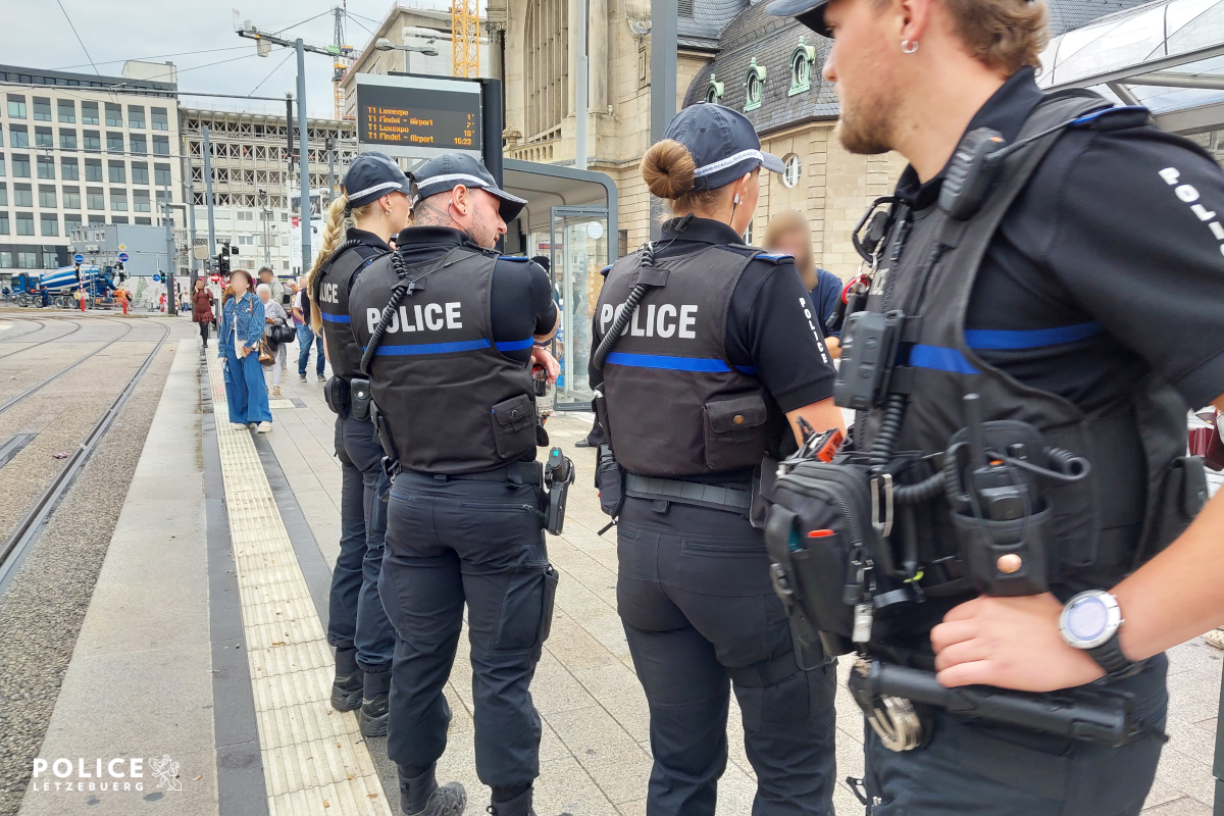
Since July and the strengthening of the 'Platzverweis' law, Luxembourg police have been able to remove people causing public disorder, using force if necessary, and bar them from an area for 48 hours or even 15 days. And proposals to install more surveillance cameras in Luxembourg City and Esch-sur-Alzette to improve safety in troubled neighbourhoods are making headlines again this autumn.
An overwhelming majority of voters – 87% of respondents – believe that institutions, including the state, police, and judiciary, should generally take a much stricter approach to people causing public disorder in Luxembourg's cities.
This demand is equally strong across all age groups and regions. Among CSV voters – the party of the home affairs minister – 93% want a further crackdown. The figure is 91% among DP voters.
This reinforces Léon Gloden's position and Luxembourg City Mayor Lydie Polfer's repeated calls over the past ten years. Among ADR voters, the figure reaches 96%.
Whether in France, Belgium, or Germany, immigration is regularly at the centre of electoral debates. Immigration policy, managing migration flows, asylum rights, and giving priority to nationals are among the issues driving discussion.
Luxembourg, recently shaken by a major illegal immigration case, has seen immigration figures fall since the CSV–DP government took office.
"Within the government, we have stepped up returns. There are more voluntary returns than before. There have also been forced returns", Prime Minister Luc Frieden told RTL in July.
The survey reveals that 60% of voters believe immigration should be restricted further in the coming years. The issue clearly divides voters, however.
ADR voters, at 90%, and déi Konservativ (The Conservatives) voters, at 89%, are strongly in favour. Among CSV voters, 69% want tighter immigration restrictions, compared with 60% of DP voters.
LSAP voters are more divided: 49% oppose restrictions, 45% support them, and 6% are undecided. Among Green voters, 55% oppose restrictions, as do 65% of Left voters.
Only 47% of the youngest voters, aged 18–24, support further restrictions, compared with 66% of those aged 55–64.
There are also substantial regional differences. In the north, 64% believe immigration should be restricted further in future, compared with just 54% in the south.
As of 31 March, 160,116 Luxembourg citizens were living abroad. According to calculations by the Chamber of Deputies, this represents 30.2% of all Luxembourg nationals.
Nearly 77% of them are adults. Although they live outside the country – and even if they have never lived in Luxembourg – they can vote in parliamentary elections.
The Chamber of Deputies is currently examining voting rights for expatriates as part of its work on electoral law reform.
The survey result is clear: 65% of voters oppose allowing their fellow citizens living abroad to vote in Luxembourg without residing there.
This view is shared across all age groups and by most voters across party lines, including the CSV, DP, LSAP, and ADR. Only among Green voters is the split closer: 49% oppose it and 46% support it.
This survey was conducted by ILRES between 22 September and 2 October 2026, by telephone and online, among 1,829 people of voting age. A total of 1,149 interviews were conducted by telephone and 680 online.
Full details are available on the website of Luxembourg's Independent Audiovisual Authority.