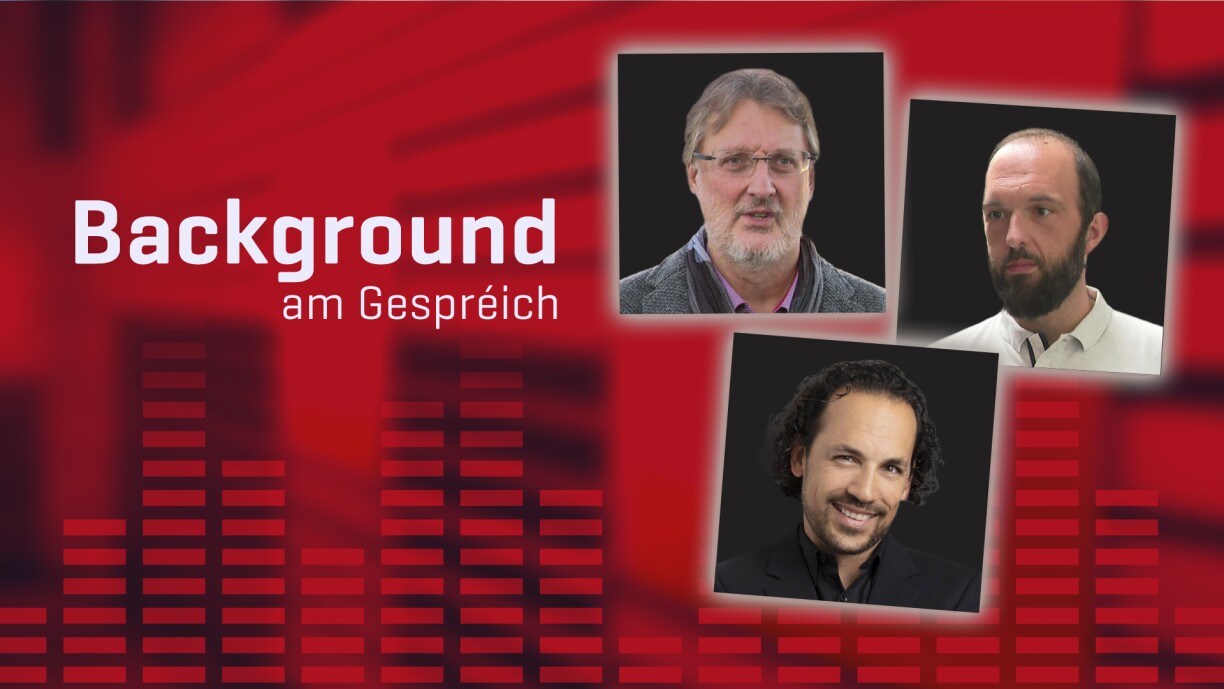
The guests were Marco Boly, the director of the Inspectorate of Labour and Mines (ITM), Luc de Metteis from the Independent Luxembourg Trade Union Confederation (OGBL), and Tom Scharfe from the Association of Health and Safety Coordinators (ACSSL).
OGBL member Matteis stressed the importance of informing workers in a way that helps prevent work accidents in the first place.
ITM Director Boly agreed, stating that all parties should strive to address the issue, particularly seeing as just in the past few weeks, three accidents left workers severely injured.
Between 2015 and 2019, there were an average of 20,000 work accidents per year, of which an average of 21 were fatal. Due to the pandemic, the numbers in 2020 and 2021 were lower.
While safety cannot be guaranteed for free, Matteis argued that the money spent should be regarded as "an investment." Tom Scharfe from the Association of Health and Safety Coordinators agreed, pointing out that accidents are also costly, so it is worth investing in safety.
While Boly confirmed that most accidents occur in the construction sector, he stressed that many fail to mention "professional diseases" when discussing the issue. This includes, for example, cases of burn-out in the insurance and banking sectors, according to the ITM head.
Matteis stated that mental health challenges also play an important role in the protection of people's health, which is why the OGBL seeks to raise awareness about these risks and, above all, take action against them. Matteis thinks that policy changes are needed, for instance when it comes to the redeployment of employees who are no longer capable of performing their previous job as a result of an accident. According to the trade unionist, the decision on how best to support workers in situations like these needs to be taken faster.
Accidents often happen when employees may not be aware of the danger. Scharfe stressed that "We have always done it this way" is a mindset that "desperately needs to change."
In this context, Matteis noted the importance of training people in advance, "especially employers," who should be "educated and made aware of the issue so that they can develop the right reflexes." In response, ITM Director Boly said that employees also have obligations. This is why he thinks that coordination between the different actors needs to be improved. Companies "should not wait for the ITM," but instead conduct their own internal checks and push for the implementation of health and safety measures.
Scharfe added that there are also notable differences between large and small companies. During inspections, it often becomes clear that smaller companies tend to be more lax about health and safety.
ITM Director Boly did not want to comment on whether Luxembourg is doing worse than other European countries. "We have to look after ourselves," and take a proactive approach by educating and raising awareness, he said. Scharfe agreed that too often, things change only after an accident has occurred, stating that "we shouldn't let it come to that."
Temporary workers, in particular, often lack proper training. This can be a problem on construction sites, for instance if people are unfamiliar with certain machines. According to Scharfe, the widespread time pressure in the sector is a problem that compromises safety.
OGBL member Matteis pointed out that the "extremely high performance pressure" and resulting overtime and exhaustion exacerbate the issue further. Working time is an essential factor, the trade unionist argued, adding that working in shifts or having a long commute can also cause workers to become exhausted.
On the subject of time, ITM Director Boly remarked that companies often do not take the necessary time to properly explain tasks and safety precautions. In the aftermath of an accident, workers frequently tell ITM inspectors that they were not made aware of something or assumed that everything was in order. "But it's not about assuming or believing something; it's about knowing something for a fact," Boly stressed.
Matteis thinks that health and safety training should be made mandatory, which is not the case at the moment. Stricter rules could also help reduce the number of accidents, which is why politicians have a responsibility to adapt the laws accordingly, according to the OGBL member. Scharfe agreed, adding that the communication between the different actors on this issue is critical.
For the ITM, it is not always easy to judge whether there are too many or not enough checks, Boly stated. He stressed that it is not the ITM's goal to "harass employers," but the authority also has "a social mandate." In the eyes of the OGBL, there can never be enough checks. In order to do this, the ITM would need the necessary resources, and Boly agrees that the Inspectorate should recruit more staff.
Scharfe added that health and safety coordinators often have to deal with time constraints. He also regrets that clients' financial budgets limit what the coordinators can do for the company.





