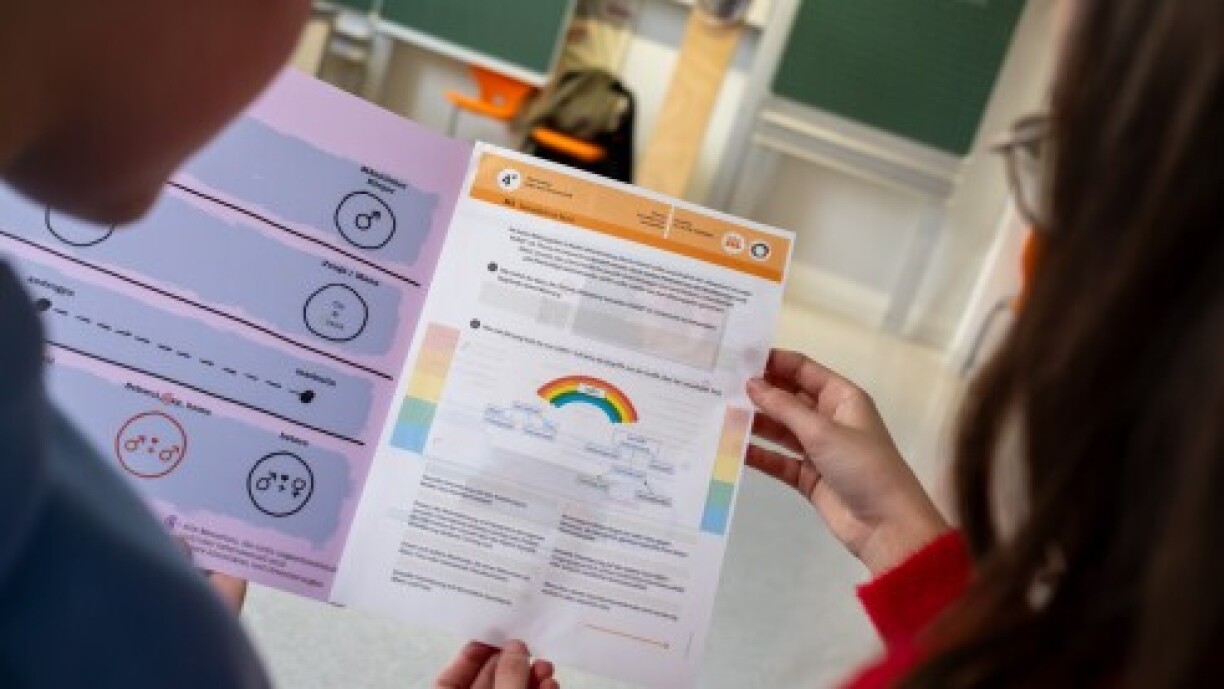
What are students really learning about LGBTQIA+ topics in schools? The question of how schools should address LGBTQIA+ issues came into sharp focus in the Chamber of Deputies in 2024. Two major petitions, each gathering over 4,500 signatures, prompted a parliamentary debate.
The first petition called for the exclusion of LGBTQIA+ topics from education. The second, launched in reaction, demanded the opposite: that these subjects be given more prominence.
When MPs debated the issue in January 2025, a majority agreed that LGBTQIA+ topics have a place in education, provided the content is adapted to students' ages.
But what does this mean in practice? What are children and young people actually learning about LGBTQIA+ issues in Luxembourg’s classrooms?
The national school curriculum is developed by the Service for the Coordination of Pedagogical and Technological Research and Innovation (SCRIPT) within the Ministry of Education.
SCRIPT Director Luc Weis told RTL that LGBTQIA+ topics are formally included. He explained that the subject falls under the broad heading of "Sexual and Affective Education", which is addressed repeatedly from nursery school through to secondary school. The goal, he said, is to foster respect and tolerance for the diversity of genders and sexual identities.
“The methods used to achieve this are left up to the teacher”, Weis clarified.
This autonomy was echoed by Liz Engel, who teaches “Life and Society” at Lycée Aline Mayrisch. She noted that teachers are not "forced" to cover the topic. However, at her school, all teachers in her department collectively decided on the subjects that would be included, aiming to ensure every student encounters the same core themes.
Seeking a clearer picture of classroom instruction, RTL asked the Ministry of Education for permission to film a lesson on LGBTQIA+ topics in a primary school. The request was denied for both primary and secondary schools on the grounds that filming would be "pedagogically inappropriate."
Instead, RTL interviewed a Cycle 4 primary school teacher at his home. He described frequently discussing sexuality, diversity, and gender identity in his lessons.
However, a few days after the interview, he withdrew his consent to be featured. He cited pressure from parents who object to their children being exposed to the subject. The teacher has since decided to avoid the topic in his classroom altogether.
Steve Schmitz, a parent of two children, supported the parliamentary petition calling to exclude LGBTQIA+ topics from schools. He stresses that his objection is not to the subject itself, but to its prominence in education.
“It's not that it's problematic”, Schmitz says, explaining that he tried to convey to MPs that he believes children should learn about these issues “but from a certain age.” He clarifies that this means an age when children have the “cognitive understanding” to process the topic appropriately. In his view, such education should begin around year six, “but it shouldn't become the main topic in school.”
The petitioners also argue for greater transparency. They feel parents should be better informed about what children are learning, citing a current lack of clear communication from schools. “Parents are in a fog right now, they're in the dark”, Schmitz says, adding “They don't know what's coming for them, nor what's coming for their children.”
Caroline Pull, a psychologist at the Family Centre, suggests that parents can also benefit when these subjects are taught in school. “Sometimes, as parents, we're lucky and our children bring something home to us that we didn't know yet”, she says. In her view, “it can also be good when there's a bit of a shake-up of the system.”
Her colleague, David Velazquez, emphasises the importance of approach. “It's not about shoving anything in people's faces”, he explains, “It's simply about people getting the necessary information so that they can understand themselves, understand what's happening around them, put it into context, and then move on.”
According to Pull, the instruction should be factual and non-influential. In her view, the school’s primary role is to “pass on facts.” She warns that excluding these topics could exacerbate existing discrimination, which she says remains prevalent.
“If you come out as a trans person, the likelihood of being bullied is simply there”, Pull states, “The question isn't: Will you be bullied? The question is: When will you be bullied?”
According to Pull, a crucial component is currently missing: a standardised curriculum that explicitly outlines LGBTQIA+ education. “And it would actually be great if curricula were developed so that every school teaches the same thing”, she says. She compares it to core subjects like maths or grammar, noting, “There aren't 25 different versions of that, where the teacher can decide: do I want to teach this or not?”
This view is shared by the National Teachers' Union (SNE). The union points to the diverse religious and cultural backgrounds of students as a potential source of conflict. “This heterogeneity can put the teacher in an uncomfortable situation, particularly if there are parents who do not want their children to be confronted with such topics,” they stated. To protect educators from such pressure, the SNE argues that teachers “must operate within a regulated framework with official guidelines.”
The experts and teachers consulted by RTL agreed on a central point: students should learn about sexual and gender diversity in an age-appropriate manner to combat discrimination and reflect contemporary society.
Despite this consensus, the subject remains optional rather than obligatory. Although the Ministry of Education has developed related textbooks and offers teacher training, instruction is not mandated.
Consequently, pressure from parents or a lack of institutional support can lead educators to avoid the topic entirely. Without clear national guidelines, the teaching of sexual and gender diversity remains inconsistent, varying significantly from school to school and from one teacher to another.





