For the third year running, the Centre for the Luxembourgish Language (ZLS: Zenter fir d'Lëtzebuerger Sprooch) has named the word of the year. For those who wish to learn more about Luxembourgish and get a grip on the basics, we would be remiss not to take this opportunity to remind you about our Learn Luxembourgish series.
The first edition of the Luxembourgish Word of the Year saw 'corona' taking home the top spot, followed by #bleiftdoheem (#stayathome), Heibleifskärchen (to have a staycation or holiday at home), lockdown, and Geste-barrièren (hygiene measures), so all five contenders were coronavirus-related.
The second edition was similarly (though not quite as) dominated by the virus, with the top word of 2021 being boosteren (booster shot), followed by CovidCheck, sheesh (also used in English, it expresses surprise or excitement), Solidaritéit (solidarity), and finally Schwurbler (someone prone to lying or make things up).
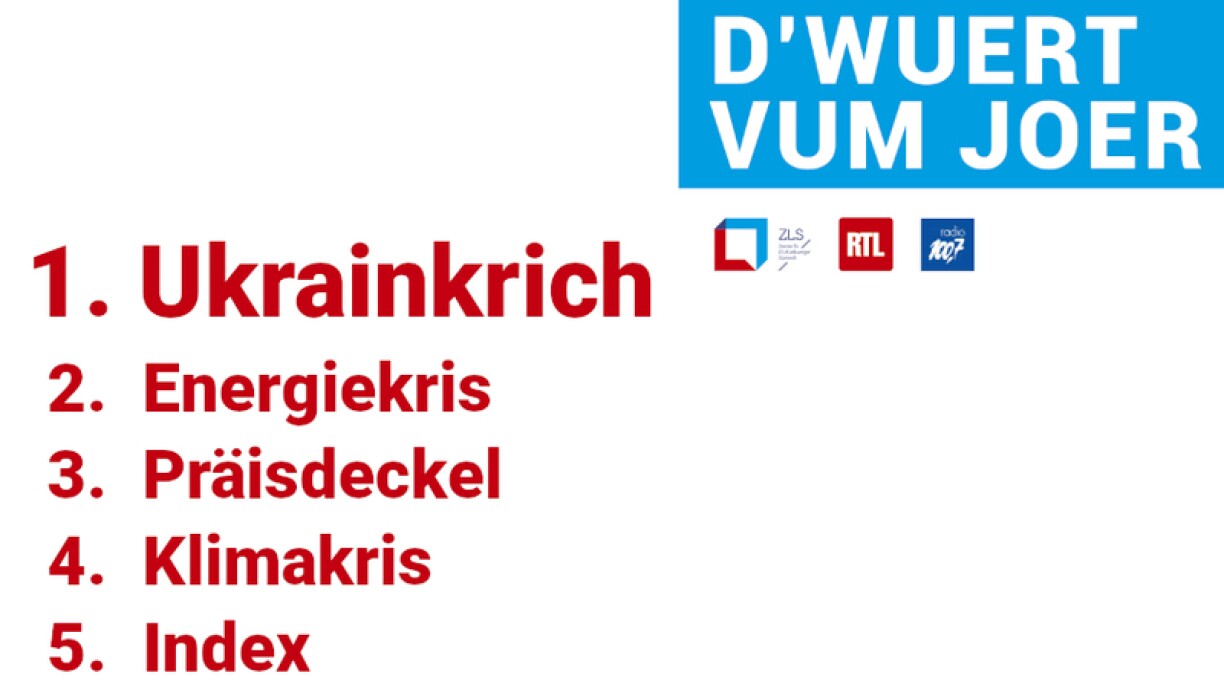
Moving on to this year, after the jury's deliberation, the top-5 words of the year for 2022 are:
Members of the public were invited to nominate words that they thought deserving of the title between the end of November and 12 December. Around 335 nominations were made, including a total of 170 different words. The ZLS worked to whittle this long list down to a final list of 20 contenders, which were presented to the jury who in turn decided on the final list of the top-5 words and their respective order.
The jury consisted of the commissioner for the Luxembourgish Language Marc Barthelemy, the President of the Council for the Luxembourgish Language (CPLL) Myriam Welschbillig, the programme director for Radio 100,7 Yves Stephany, RTL Journalist (and our beloved colleague) Andy Brücker, an Dr. Sara Martin from ZLS.
Looking at the nominations received from the public, the actual meaning of each word generally held more importance than its originality. Here is how the jury explained its final selection:
1. Ukrainkrich – Ukraine war
The Russian invasion of Ukraine marked the year more than any other event. For that reason, the jury decided that the portmanteau 'Ukrainkrich', consisting of the country name Ukraine and noun 'krich' (war), be the word of the year. This is also in line with the trends seen in public nominations, where Ukrainkrich, Ukrain, Krich, and Spezialoperatioun (special operation) were common. Only Index saw more nominations.
2. Energiekris - energy crisis
One of the most immediate impacts of Russia's war in Ukraine could be seen, beyond the borders of Ukraine, on the cost of energy. The artificial reduction in resources has been used as leverage, with energy seen as part of the arsenal in the war and used to influence both the aggressor and the level of support seen from third parties for Ukraine. It also underlines how important the question of energy supply is for the future of humanity.
3. Präisdeckel - price ceiling
The third word, like the first two, is a portmanteau of two words - price and 'deckel', which means cover or lid, but better translates as a phrase to price ceiling in English. Energy prices, whether for electricity, gas, diesel, or petrol, have climbed substantially over a short period of time. To ensure that this trend does not spin out of control, a price ceiling was introduced to limit the price inflation of this important resource.
4. Klimakris - climate crisis
Another crisis in the top-5, this one at least as global an issue as that of energy supply, and two concepts are certainly interlinked. The impact of climate change and the ongoing climate crisis on humanity and life on Earth is becoming ever clearer, even if its coverage has been somewhat overshadowed by the more immediate crisis in Ukraine.
5. Index
The fifth and final word is Index, which needs no translation as the word is the same in English. The jury decided to opt for just "index" rather than the co-nominated "index-tranche," which would refer to a particular index delineation, as index can refer to the entire salary indexation mechanism rather than a particular increase in salaries.
In Germany, the council for the German language opted for "Zeitenwende" or "turning point" as the word of the year, as the Russian invasion of Ukraine marks the turning point of a new era.
In Austria, meanwhile, Inflation is the word of the year (it came in 6th place in Luxembourg and just missed out on making the top-5).
Switzerland opted for Strommangellage, which means power shortage.
Looking to English, we have a few different words to choose from.
The Oxford Dictionary decided on goblin mode, which is defined as "a type of behavior which is unapologetically self-indulgent, lazy, slovenly or greedy, typically in a way that rejects social norms or expectations."
Merriam Webster went for Gaslighting, defined as "the act or practice of grossly misleading someone, especially for one's own advantage."
Collins Dictionary opted for permacrisis, which is defined as "an extended period of instability and insecurity."
And finally, dictionary.com said that the word of the year is woman, which you will not be surprised to hear is defined as "an adult female person," a word chosen to highlight both how "the intersection of gender, identity, and language dominates the current cultural conversation" and to draw attention to the many ordeals faced by women across the world.