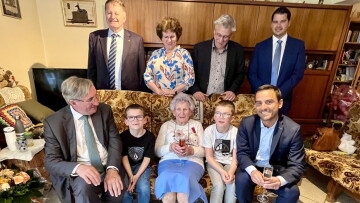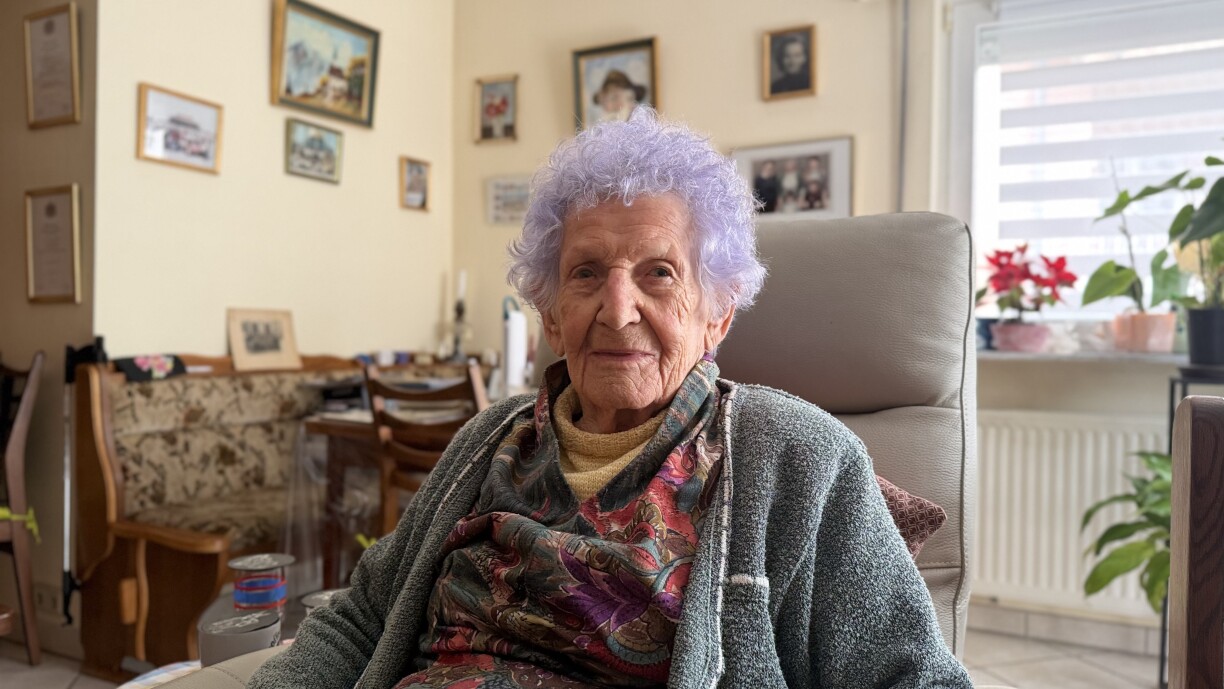
Maisy Ginter-Bonichaux, turning 102 in April, is far from unknown in Luxembourg. For more than 80 years, she has been committed to keeping alive the memory of the Second World War, in particular the fate of young women who were forcibly recruited. She herself was conscripted in 1943, first into the Reich Labour Service and later into the war auxiliary service.
Born on 17 April 1924 and raised in Niederkorn, Ginter-Bonichaux recalled having had a happy childhood. She smiled as she remembered sneaking off with friends to the wash basin to clean their nutcrackers, only to be scolded by their mothers afterwards for coming home soaking wet. "We were told off, of course, but it was far too much fun splashing around in the water", she recalled, laughing.
Everything changed when she was 16. War had reached Europe, and German troops invaded Luxembourg.
Ginter-Bonichaux remembered cycling to school in Pétange with her classmates, not believing the rumours that school had been cancelled. When they returned home, German soldiers were already advancing towards them with machine guns raised, she said. She recalled that at the Porte de Lamadelaine, they quickly turned off the main road and realised the situation was real. Evacuations followed, she recounted, as fear became part of everyday life.
Despite seeing photographs of concentration camps, Ginter-Bonichaux recounted that she and her peers struggled to grasp that human beings could be capable of such cruelt. She explained that what weighed heavily on them was the atmosphere of repression: French words were banned, people were discouraged from gathering, and conversations were constantly monitored. She recalled how isolated and mistrustful daily life became, never knowing whether a neighbour could be trusted. That last of trust, she said, was the hardest part.
Ginter-Bonichaux said that even when Gauleiter Gustav Simon announced compulsory military service for Luxembourgish youth, many still refused to believe it, until the summons letters arrived. In her experience, there was hope that the war would soon end, but it dragged on for years.
Ginter-Bonichaux received her call-up order: the first was delayed by six months thanks to her employer, but the second left no room for appeal, she said. She still recalls her anger today, particularly because a former schoolmate, then secretary to Damian Kratzenberg, president of the Volksdeutsche Bewegung, denounced her as "politically unreliable", claiming she needed to be "re-educated".


Alongside the uncertainty about her own fate and that of her family, one of the most traumatic moments for her, who had been strictly raised by nuns, was being forced to undress in front of men during medical examinations.
"You can't imagine it. You can't explain it unless you've seen it", she said with concern. Ginter-Bonichaux recalled that she had not even been allowed to speak to boys before. Being forced into that situation was terrifying, but refusal was not an option, she said. "You just had to go through it", she said, because disobedience meant punishment.
What sustained her during that time was the hope that it would all be over soon, she said. According to Ginter-Bonichaux, during her time in the Reich Labour Service, she only learned what German authorities allowed people to know. Later, while working in a factory as part of the war effort, she came into contact with French workers who were allowed to listen to French radio. Through them, the Luxembourgers at least received some information about how the war was really progressing, but they had no knowledge of their families.
"We sometimes went to the cinema together", Ginter-Bonichaux recalled, adding that "of course it was propaganda, but it was something different from the camp. The French workers would sit behind us and tell us what was really happening, because the Germans didn't understand French."
Ginter-Bonichaux returned to Luxembourg on 25 May 1945. Unlike in many families, she never found it difficult to speak about her experiences. Her father had been part of the resistance, and she herself was recognised early on as one of the "forcibly recruited". She has spent decades campaigning for the recognition of forcibly recruited women, who for a long time received little acknowledgment, according to Ginter-Bonichaux.
"I am still the same", she said with pride, "I am still fighting for the girls, whatever the cause". One of her greatest wishes is to see a full list compiled of all the women who died on the other side, including the circumstances of their deaths. She hopes such research could one day be displayed in a museum.
Reflecting on today's conflicts around the world, Ginter-Bonichaux believes self-defence can be necessary but warns against reckless sacrifice. She asked what would have become of Luxembourg if everyone had fled and been killed. "Who would be living here now?" she asked.
Ginter-Bonichaux met her husband in 1946. He too had been forcibly recruited. Together they had two daughters, Mady and Annita, and settled in Rodange in a house her husband built himself. As a trained car mechanic, he owned a car early on, allowing her to fulfil a lifelong dream of travelling. She recounted that as a young girl, she had wanted to go abroad on a religious mission. Instead, after the war, she travelled across Europe by car and tent.


Over the years, the 102-year-old Ginter-Bonichaux also visited countries such as Australia, Japan, and Egypt. Although she no longer travels due to Covid and back problems, her memories remain vivid. Italy, she said, is the most fascinating country she has known. Her husband had been sheltered by an Italian family during the war, and Italy became the destination of their first major journey together.
"We were so warmly welcomed", she recalled. She recounted further: "We travelled all over Italy, every year to a different place. In the smallest church, you can find the most beautiful painting. And Venice is a unique experience. I've been there twice."
In 1988, tragedy struck when her husband died at the age of 64 due to a medical error, Ginter-Bonichaux recounted with sadness. Sixteen years later, one of her daughters died at 52 from two tumours. She spoke of this loss with restraint, saying that when a child is suffering, one must not be selfish. Though the pain remains, she said there was nothing more that could be done. Her younger daughter and grandchildren helped her through the loss, and she even moved temporarily to Belgium to help care for them, she said.
Asked how she is doing today, Ginter-Bonichaux laughed and said she had the occasional ache, but thankfully not all at once. Despite declining eyesight and hearing, and the need for more rest, she still lives largely independently, with only a cleaner visiting once a week. With her family living in Belgium, she said she has no choice but to manage on her own.


She believes this independence is part of why she has stayed so fit. She said she has no secret formula, only the need to check the needs of the body, avoid what does not suit it, and accept limitations. She worked hard, raised her daughters, and ran her household alone well into her nineties, Ginter-Bonichaux said with pride. She also expresed gratitude for being staying healthy.
To stay active, Ginter-Bonichaux walks as much as she can, even though she now needs support. She also meets friends regularly at a nearby restaurant in Pétange to chat and socialise. For her, staying active is as much about willpower as physical ability.
"You have to have the willpower", she said. "Even when it's hard, even when you're tired. You can't just say, it hurts here, it hurts there, I can't do it. You have to stay active, then the body stays active too."
Today, Ginter-Bonichaux expresses gratitude for the fact that she was able to return home after the war, build a life with her family, and see so much of the world. Even if she jokes that she could have done with a bit more money, she says she is content with the life she has lived.