A number of PhD students at the University of Luxembourg have stated they felt obligated to sign a recent open letter in support of the institution.
The letter, published Wednesday, was presented as a show of support for 'the University community' and its mission. It garnered between 250 and 300 signatories and was framed as a reaction to recent media reports on internal problems. While acknowledging that some individuals have had difficult experiences, the signatories expressed concern that public debate was defining the university solely through its conflicts.
In a Thursday morning interview with Radio 100,7, the letter's initiator, Skerdi Zanaj, stated it was not disseminated through official channels, arguing it was therefore impossible to calculate what percentage of staff had signed. At that point, signatories included a third of professors and roughly 5% of PhD students.
However, questions have arisen about the letter's origins. As first reported by the Luxembourg Times – which has extensively covered the university's issues – doubts persist over whether it represents a genuine grassroots movement. These doubts stem not only from the fact that Zanaj was nominated for her role as Gender Equality Officer by the Rector, but also from internal communications seen by RTL.
According to these communications, several PhD candidates felt pressured to sign because they received the letter from their direct supervisors. An email from a student delegation representative notes: "Some students reached out to me that they felt obligated to sign this letter. Because it was sent by their supervisors." Other messages show PhD students contacting professors with similar concerns, while some faculty members reportedly signed to avoid conflict with colleagues.
RTL information indicates the 'grassroots' letter followed at least two prior attempts to organise support from the top down. After initial reports by RTL Today late last year regarding promotion procedures and allegations of harassment and bullying within the Faculty of Law, Economics and Finance (FDEF), Law Department head Dirk Zetzsche drafted a statement of support for the Rector on behalf of the entire department.
The draft statement affirmed that the department's discussions and activities were "guided by principles of due process, compliance, and the integration of diverse views and values." Members were asked to approve it during a video conference. However, the department head was alleged to have counted more votes in favour than were actually cast. Exchanges seen by RTL show several professors resisted what they viewed as a problematic procedure.
In response to the series of negative headlines, the university's senior management convened on 13 January. During the meeting, Georg Mein – President of the University Council and former Dean of the Faculty of Humanities, Education and Social Sciences (FHSE) – proposed a letter he had drafted with Law Department head Dirk Zetzsche.
While containing positive affirmations, the draft also conveyed clear disapproval of staff bringing internal matters to the press. It emphasised the need for staff to trust that their concerns would be heard internally, but also stated:
“...trust, that anyone who, after open discussion and appropriate participation, does not get their concerns across, will not express their disappointment publicly and in a distorted way form to the detriment of the university and all employees.”
Another passage read:
“We support thorough and credible review processes wherever specific concerns have been raised. A university must be able to critically examine itself, improve its procedures and learn from its mistakes. At the same time, we are convinced that this must be done responsibly – with respect for privacy, procedural fairness, without public speculation about individual cases and without the pressure to replace consitutional procedures with a dynamic of prejudgement in the media based on anonymous sources.”
This draft, intended to be issued on behalf of all department heads, deans, interdisciplinary centre directors, and the University Council President, was circulated on a Friday afternoon. The accompanying instruction stated that anyone who did not object by Monday lunchtime would be giving their “tacit agreement.” Faced with resistance from several recipients, the attempt ultimately failed.
These successive letters have one thing in common: they forced university members to take a position. For those holding dissenting views, this created an uncomfortable climate. According to RTL information, Rector Jens Kreisel concurred during the January meeting with the remark that individuals who publicly criticise the institution "do not deserve to work at the University." The meeting also included discussions on the potential merits of taking legal action against journalists or their sources.
The various letters, which refer broadly to "concerns" and "difficult situations," are viewed by critics as downplaying the severity of the problems that have driven individuals to contact the press. It should be noted that the sources in these reports are not anonymous to RTL and are protected under legally enshrined journalistic source confidentiality.
Appearing alongside Vice-Rector Simone Niclou and Minister of Higher Education Stéphanie Obertin, Rector Jens Kreisel emphasised that no systemic issue exists, framing the matters as difficult but isolated individual cases. He characterised the university environment as inherently competitive, a situation not unique to Luxembourg. To illustrate his point, Kreisel presented statistics: since 2018, only 60 out of 190 candidates at the University of Luxembourg had received a promotion. He noted that merely four of the 130 unsuccessful candidates had resorted to legal action, a figure seemingly intended to suggest widespread acceptance of outcomes. However, this presentation conflates two distinct and legally separate promotion tracks, effectively comparing apples and oranges. The first track involves a standard competitive procedure where, by legal quota, only 25% of candidates can succeed. The second is an individual promotion track, where a candidate’s performance is measured against their specific, contractually defined objectives by a committee of external experts. Success on this latter track – with far fewer total candidates – has been markedly higher, at 73%. It is within this second track that the four individuals who filed legal complaints are situated. They represent half of the unsuccessful candidates from this specific promotion pathway. These are the same four FDEF employees reported on by RTL Today last November, who allege their contractually defined objectives were not respected by Faculty Dean Katalin Ligeti.
During the same parliamentary committee hearing on 27 January, Rector Jens Kreisel informed MPs that he had cancelled a recruitment procedure due to identified conflicts of interest. According to information obtained by RTL, the cancelled procedure was for an Assistant Professor position in Public International Law and Space Law advertised several months ago – another case within the FDEF. The cancellation followed a formal complaint by one of the 50 candidates to the university's Office for Academic Affairs (BAP). An investigation by the BAP determined that the chair of the six-member recruitment committee – Faculty Dean Katalin Ligeti – had failed to report conflicts of interest to the BAP as required by university regulations. While such conflicts are not uncommon in specialised academic fields, the established rules for managing them were not followed in this instance. The BAP’s official response to the complaint stated: “In conclusion, the shortlisting process for the position in question is subject to two confirmed irregularities concerning ROI 260 (Conflicts of interest, Ed.) on the one hand, and the duty of the committee chair to inform the BAP of any reported conflict of interest as defined in the Academic Recruitment Procedure on the other.”
The investigation also found that the criteria used by the committee to shortlist candidates for interviews did not align with the official recruitment procedure. Instead of screening candidates strictly against the requirements outlined in the job profile, the committee used a weighted scoring grid that included a vague “Adequacy for the position” criterion. This effectively served as a catch-all category that allowed for subjective assessment. Specific profile requirements, such as teaching experience, were given less weight in the grid.
The BAP noted this discrepancy, writing in its response: “The assessment in question cannot, however, be considered in strict accordance with the applicable provisions of the recruitment Procedure. [...] With respect to the shortlisting process for the International (Space) Law position, I have pointed out the lack of accordance of the used criteria and rules [...]”
While the Rectorate was informed of these procedural breaches – prompting the rector’s decision to cancel the hire – Vice-Rector Simone Niclou assured the parliamentary committee that the university applies uniform selection criteria across all its departments.
Although Rector Jens Kreisel announced the cancellation of the recruitment procedure during the parliamentary committee hearing on 27 January, this decision was not communicated to the faculty until almost a week later, on 2 February. This notification came only after RTL had enquired whether the interviews scheduled for 4 February had been called off. The university declined to specify when the candidates and the external committee members – some of whom were expected to travel from abroad for the interviews – were officially informed of the cancellation.
Additionally, the university chose not to answer whether Dean Katalin Ligeti, who as committee chair was responsible for the procedural errors, and Department Head Dirk Zetzsche would be involved in the re-advertisement of the position. This question is particularly significant for candidates from the initial round, whose prospects for fair treatment in a renewed procedure could reasonably be called into question.
These incidents do not appear to be isolated. RTL is aware of at least one other concerning procedure at the Luxembourg Centre for European Law (LCEL, the former Max Planck Institute), where a candidate’s doctoral thesis supervisor served as an internal member presiding over the recruitment committee.
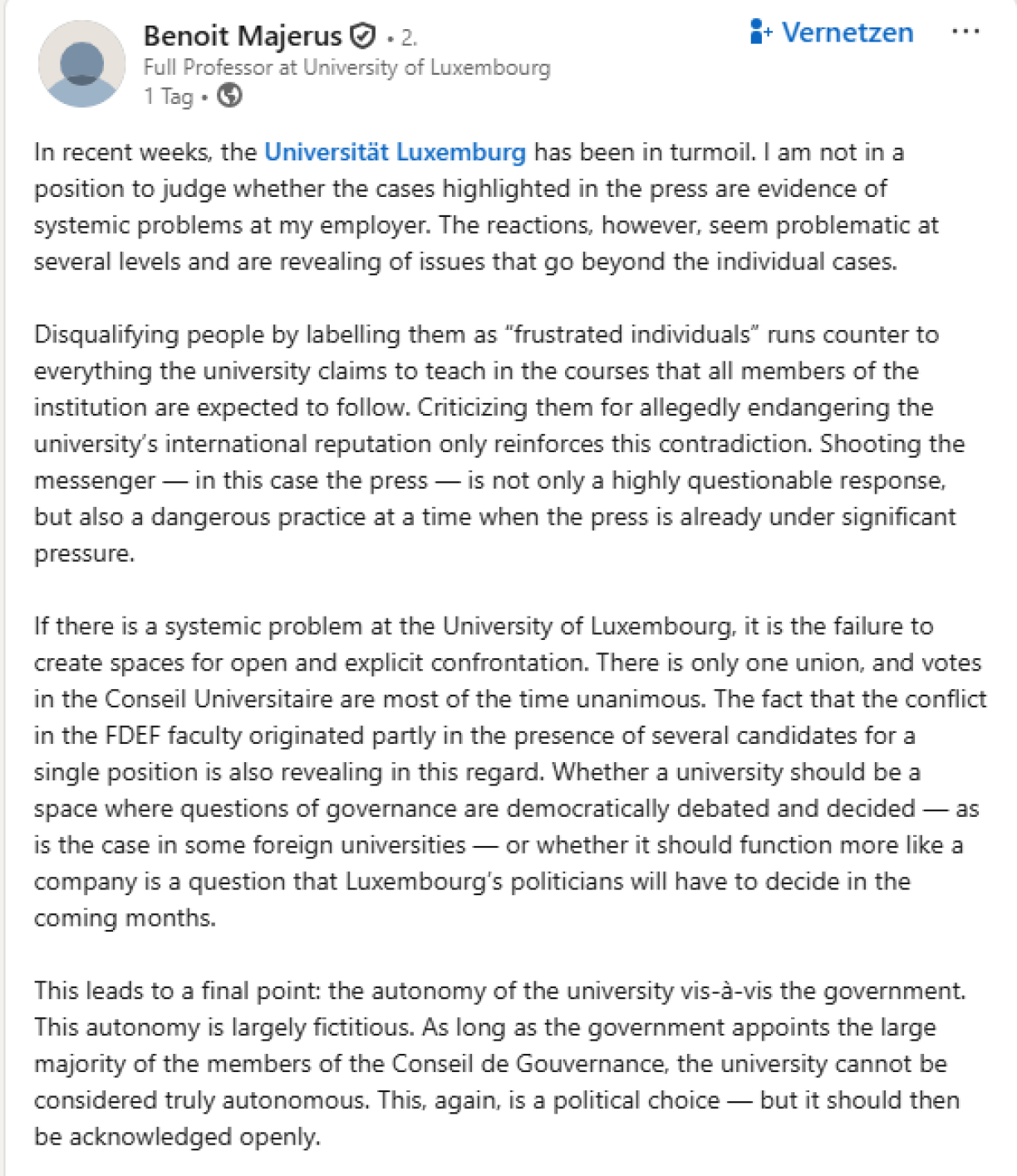
Alongside the coordinated letters of support for the university’s leadership, a counter-movement of criticism is also taking shape. On Friday, history professor Benoît Majerus from the Centre for Contemporary and Digital History (C2DH) publicly criticised the institutional response in a detailed post on LinkedIn. While stating he could not judge whether the reported cases prove a systemic problem, he argued the university's reactions were themselves problematic.
"Disqualifying people by labelling them as ‘frustrated individuals’ runs counter to everything the university claims to teach," Majerus wrote. He further criticised the suggestion that public criticism damages the university's reputation as contradictory, and condemned "shooting the messenger" as a "highly questionable" and dangerous practice given broader pressures on the press.
He identified a potential systemic failure: the lack of spaces for open confrontation. Majerus noted the presence of only one trade union and predominantly unanimous votes in the University Council. He also pointed to a revealing detail: the initial conflict was sparked when several FDEF candidates stood for election to that same council. The four employees now in court attribute their blocked promotions to this political move within the university.
This resistance is now organising online. A group operating under "Organise Uni.lu" has published a manifesto from a "concerned group of students and academics." Its aim is to foster self-organisation through channels independent of the rectorate.
"Our power comes from our solidarity as we share the same reality within the university," the manifesto states. It alleges a pattern of reprisals: "Many students, academics and administrative staff members have been reprimanded, pushed out, or thrown out for not being in step with the rectorate. Many of us have had to make choices due to being pressured by the rectorate to leave, which, in turn, puts our future, our families' well-being, and/or our careers at risk."
According to information obtained by RTL, a meeting of the Faculty of Law, Economics and Finance has been called for 11 February.
*The author was enrolled as a student at the University of Luxembourg in the academic year 2021/2022.





