This is an opinion article. The views expressed belong to the author.
Last Sunday, women and men filled the streets to mark International Women's Day. Balloons floated above the crowd, music echoed through the city, and banners carried messages of equality, dignity, and justice. It was vibrant, creative, and powerful, the kind of moment that reminds us why people march together.
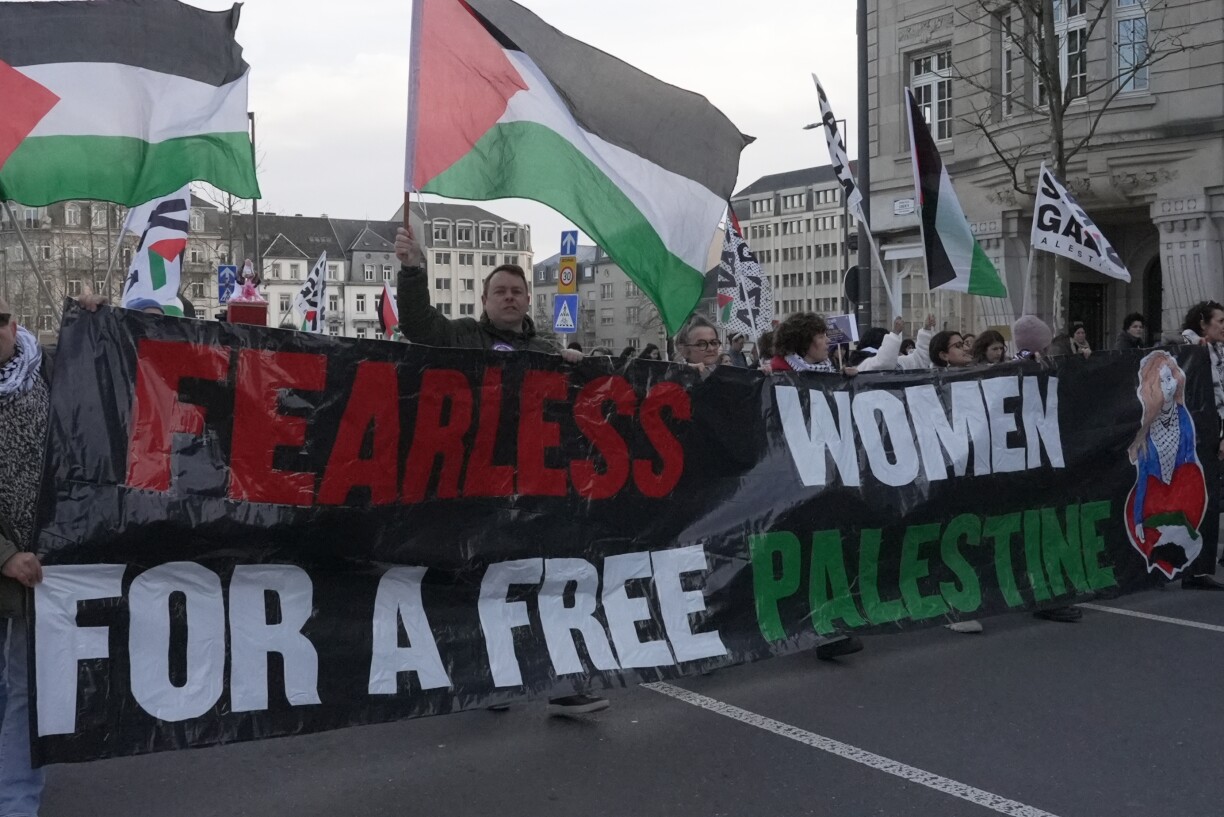
Every bloc had prepared carefully, bringing creativity and conviction to the causes they wanted to highlight. Among them was the Palestinian bloc.
For three years, this group has marched with the same demands: an end to occupation, an end to unjust imprisonment and torture, an end to any system of apartheid, an end to genocide, and an end to the daily violence and humiliation that define Palestinian life.
These are not abstract slogans. They describe the lived reality of women.
The group was among the first to arrive and the last to leave. Not surprising, these are the same activists who have gathered in Luxembourg every Saturday for three years, calling for freedom and an end to the devastation in Gaza and Palestine. Week after week, they have stood in public spaces, refusing silence. Persistence like that is rare and admirable.
Yet their presence at the feminist march disturbed some people. Not the many who marched alongside them, but a small few. A few questioned whether certain struggles belong in a feminist space. A few seemed less troubled by the reality Palestinian women face than by the flag the bloc carried.
But if a feminist march cannot make space for women living under occupation, then what exactly is it marching for?
Women do not stop being women because their oppression is politically inconvenient. Palestinian women give birth at checkpoints, visit loved ones in prison, raise children under siege, and sometimes pull their own children from the rubble. Yet they continue to resist and survive under unimaginable conditions. Their struggle for dignity is inseparable from their struggle as women, and it cannot be fully captured in a single article.
Solidarity that depends on comfort is not solidarity at all. Feminism, if it is to mean anything, must confront the structures that shape women’s lives, whether they exist in homes, workplaces, courts, prisons, or military checkpoints. A feminism that welcomes women only when their struggle is easy to acknowledge becomes something smaller than it claims to be.
But the story of Sunday does not belong to the few who tried to draw limits. It belongs to the many who marched anyway. At the end of the march, people gathered around the Palestinian bloc to sing "Bella Ciao" and "We Shall Overcome", songs that have accompanied struggles for freedom across generations.
For the majority, the message was clear: solidarity does not weaken when it crosses borders it grows.
Luxembourg has long prided itself on fairness and openness. Sunday's march showed that these values are not just words. They are practiced in the streets, in moments of collective courage, and in the simple refusal to exclude women whose struggle may be uncomfortable to acknowledge.
That is the Luxembourg that marched on Sunday. That is the kind of feminism worth defending. And we will be there next year too, alongside and in support of all the blocs.





