Hydrogen is a dangerous gas. And its production requires a lot of energy. Even so, hydrogen is expected to play a crucial role in decarbonisation and the energy transition.
The EU aims to achieve climate neutrality by 2050. This means that by then, we'll essentially need to stop using fossil fuels like natural gas, oil, and coal and find alternatives.
Hydrogen is one of them. It has many uses:
Most importantly, it can be produced in an environmentally friendly way. Maybe you remember the reaction from school: through electrolysis, water is split into hydrogen and oxygen using an electric current.
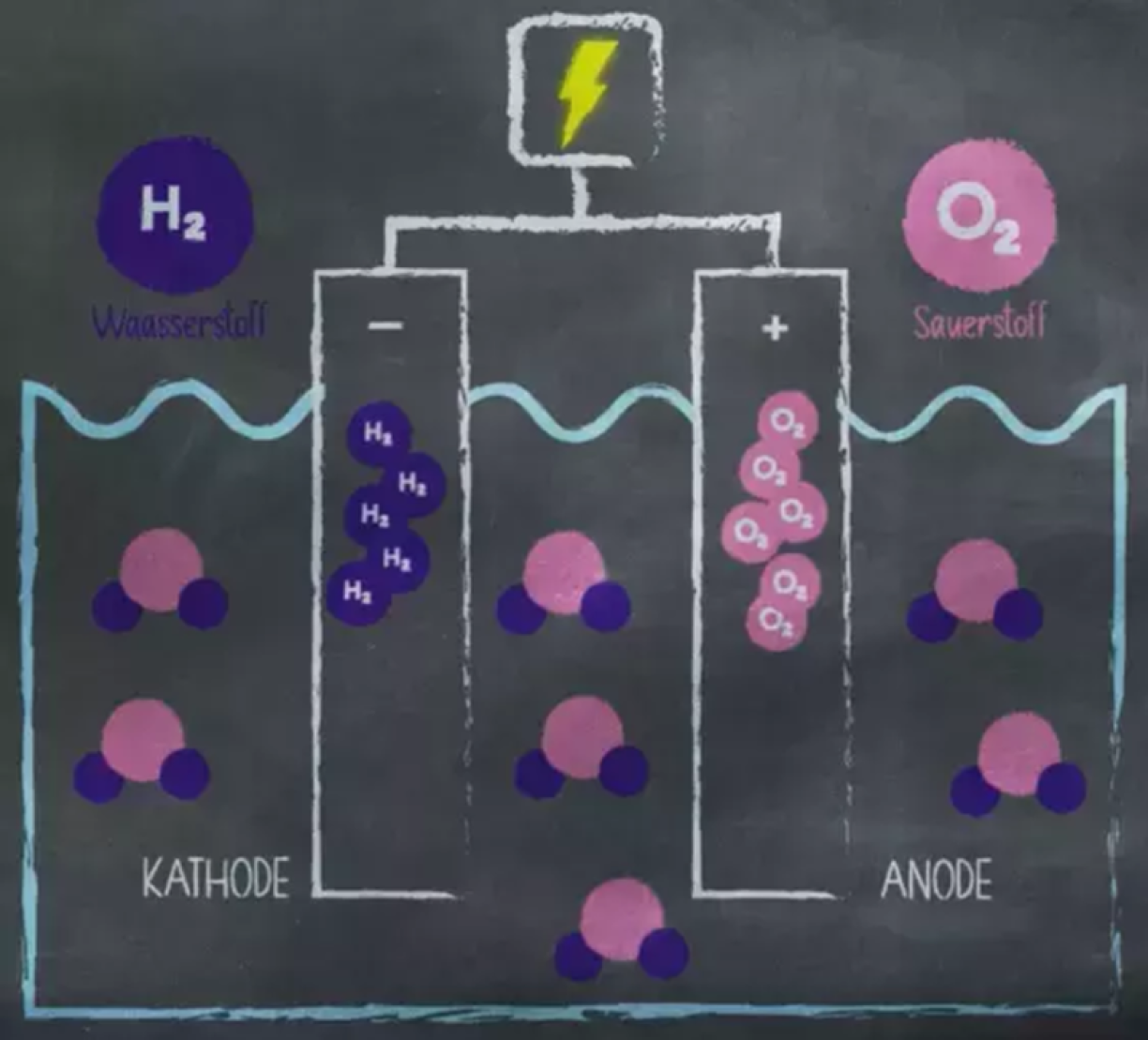
If renewable electricity is used, the production process emits almost no CO 2. This is known as green hydrogen.
To harness the energy in hydrogen, we can either burn it or use it to generate electricity through fuel cells. This is essentially the reverse process of electrolysis. And the only by-product from each process is water. This means green hydrogen remains clean even when burned or used: there are no CO 2 emissions, just water.
All of this seems perfect. So in the future, will we be driving hydrogen-powered cars, flying hydrogen-powered planes, heating our homes with hydrogen and storing electricity?
Nicolas Boscher, a researcher in the field of hydrogen, and Thomas Gibon, a researcher in the field of Life Cycle Assessment, both working at LIST (Luxembourg Institute of Science and Technology), shared their insights for this article.
Hydrogen isn't an energy source like natural gas, oil, or wind that we can simply tap into. It is merely a means of storing energy, and a rather inefficient one at that. It first needs to be produced, which requires a lot of energy. (Yes, there are efforts underway to tap into underground hydrogen sources, but unfortunately, it's still unclear if they will be successful.) To store hydrogen, it needs to be compressed to about 700 bar in tanks and/or significantly cooled. And to retrieve the energy, it has to be converted back. With each conversion, some energy is lost.
It's always more efficient to use renewable electricity directly. For example, heat pumps use electricity directly to provide heating. But if you take the detour of using hydrogen as a fuel, you end up losing a whopping 80% of the original electricity in the process.
Interim conclusion 1: while green hydrogen is indeed a climate-friendly energy storage option, it's more efficient to use renewable electricity directly.
But electricity can't always be used directly. That's why we also need energy storage systems. This is where hydrogen competes with batteries. For example, should we store the excess electricity from a home photovoltaic system as hydrogen? No! Because batteries are far more efficient.
When comparing hydrogen cars with electric cars, you'll find that hydrogen cars use two to three times more electricity than electric cars.
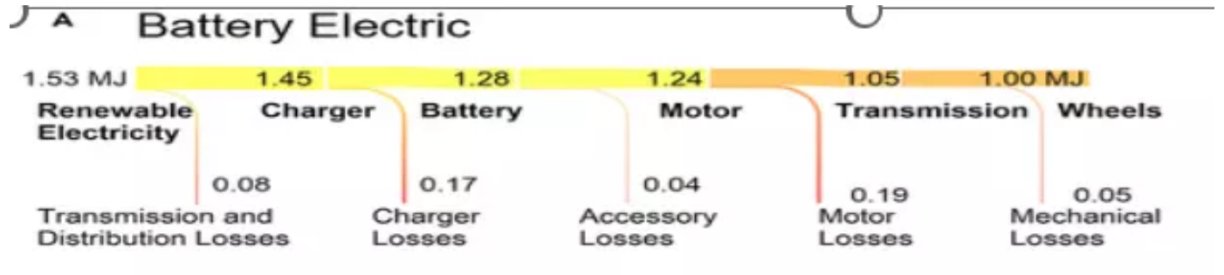
For electric cars, electricity goes through the charger into the battery and from there powers the motor. Only a small amount of energy is lost during these steps.
If we put it in numbers: to get 1 megajoule of energy to the wheels, you need about 1.53 megajoules to start with. So roughly a third of the energy is lost.
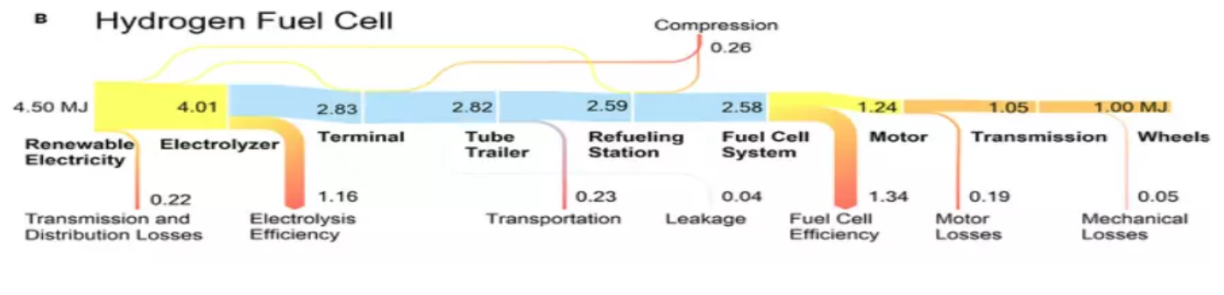
In hydrogen cars, there are two scenarios: the hydrogen can either be combusted, similar to a traditional combustion engine, or it can be converted to electricity using fuel cells. In this case, it operates similarly to an electric car. And it's more efficient.
So let's compare this type of hydrogen car with an electric car. There are a lot more steps involved here. First, the renewable electricity goes to an electrolyser, which produces hydrogen. At this stage, 25 to 30% of the original energy is already lost. Next, the hydrogen has to be transported to the filling station, pumped into the car's tank, and stored there, with each step causing additional energy loss. Then the hydrogen is converted back into electricity using a fuel cell, resulting in an energy loss of nearly 50%. From this point onward, the process is the same as for electric cars.
However, taking the hydrogen route means you need 4.5 megajoules to get just one megajoule of usable energy on the road. This means almost 80% of the initial energy is lost.
Electric cars are therefore far more efficient.
What's more, the infrastructure for electric cars is constantly improving, batteries are becoming cheaper and more efficient, and a recycling market is emerging.
This is why most experts agree: hydrogen cars are not a priority at the moment.
Yes, because batteries also have limitations: they can't store energy as long as hydrogen can. This makes hydrogen a good option for seasonal energy storage when dealing with large quantities of energy.
Batteries also have a lower energy density compared to hydrogen: they take up a lot more space. For larger vehicles and long distances, you would need massive, very heavy batteries. That's why hydrogen shows potential for applications like large cargo ships, and possibly for lorries or buses.
E-fuels might also play a role here, but we'll get back to that later.
Interim conclusion 2: for many purposes, compared to batteries, hydrogen is less efficient. However, there are specific cases where it has advantages.
And what about planes? The use of hydrogen in aviation is seen as risky. An alternative could be e-fuels. This involves combining hydrogen with CO 2 to create larger molecules that are liquid and can be used to fuel aircraft. But now, brace yourselves: if we wanted to make the current European aircraft fleet climate-neutral, we would need around 1.3 times the total electricity produced in the EU in 2020, and all of it would have to be green electricity solely for aviation.
It's a Herculean task. We don't have enough alternative energy sources to produce all this hydrogen. There is therefore unanimous agreement among experts.
Interim conclusion 3: we need to prioritise.
Where do we start?
On this point too, experts are mostly in agreement: priority should be given to the sector that already uses the most hydrogen today: industry.
Globally, 100 million tonnes of hydrogen are consumed worldwide, for example
The problem: at present, practically no green hydrogen is used. Instead, no less than 99% of hydrogen comes from fossil fuels, mainly from natural gas. This is what's known as grey hydrogen. In Europe alone, grey hydrogen from the industrial sector is responsible for 70 to 100 million tonnes of CO 2 emissions per year. In Luxembourg, it accounts for over 5,000 tonnes of CO 2 emissions per year.
The goal is to replace this grey industrial hydrogen with green hydrogen as quickly as possible. This could significantly reduce CO 2 emissions.
But it's a massive challenge. Green hydrogen is currently around three times more expensive than grey hydrogen. We still lack the necessary infrastructure, and we need a lot more renewable energy, namely the same amount of electricity that France currently produces annually, but in the form of green electricity.
In addition, industrial processes should, where possible, be modified to replace fossil-based chemicals with hydrogen. This would save additional CO 2.
One example where this is possible is in steel production, where hydrogen can replace coke as a reducing agent.
If we want to move away from oil, gas, and coal, we need hydrogen. But we're only at the beginning of this journey, and there are significant hurdles to overcome.
Before green hydrogen can be used on a large scale, we first need to establish a hydrogen infrastructure and significantly increase the production of renewable electricity. This will require major investments and a lot of time. It's a big challenge. In the meantime, we need to set priorities.
Ziel mir keng! is broadcast on Sunday evenings after the programme Wëssensmagazin Pisa on RTL Tëlee and is a collaboration between RTL and the Luxembourg National Research Fund. You can also watch the episodes on RTL Play.
Author: Jean-Paul Bertemes (FNR)
Co-author: Michèle Weber (FNR)
Advice: Nicolas Boscher, Thomas Gibon (LIST)
Video: SKIN
Translation: Nadia Taouil (www.t9n.lu)





