
Thousands of new satellites are being launched into orbit to power global internet networks. These megaconstellations promise faster connectivity around the world, but not without a cost.
It does not take an astronomer to notice the change. By now, almost everyone has seen that swarm of lights drifting silently across the sky. I still remember the first time I saw one. It was a clear April evening, shortly after sunset. I was walking through the fields of Mamer and, as is often the case, looking up at the first stars appearing in the twilight, when I noticed it.
It was a silent procession of bright points, moving one after the other in a straight line. They followed the exact same path across the sky, evenly spaced, moving silently through the constellations. It felt almost unreal.
For a moment, I’ll admit, all sorts of explanations came to mind. But a quick search on my phone was enough to bring me back to reality. Today, most people know those lights are satellites. More specifically, they are part of a new generation of orbital networks known as megaconstellations.
Over the past few years, the number of satellites orbiting Earth has increased at an extraordinary pace. For large periods of the space age, the satellite population remained modest. From Sputnik in 1957 to the early 2000s, only a few thousand operated in orbit.
Today, the picture has changed completely.
Large commercial projects are now launching satellites by the hundreds, building vast constellations designed to provide global broadband internet coverage. The best known is Elon Musk’s Starlink, operated by SpaceX, but it is far from alone. OneWeb has already deployed hundreds of satellites, and others are being developed in Europe, China, and elsewhere.
From a technological point of view, it is hard not to be impressed. These networks promise reliable internet access in places where this was once impossible: remote villages, ships at sea, even aircraft crossing oceans.
In many parts of the world, that kind of connectivity could be truly transformative. But progress always comes at a cost. And beyond the price of the service itself, there is another one, less visible but increasingly hard to ignore: the night sky.
Satellites in low Earth orbit typically travel between 300 and 1,200km above the Earth. In simple terms, they remain lit by the Sun long after darkness has fallen on the ground below. Against the night sky, they appear as slow-moving points of light drifting across the stars. Nothing unusual. Careful observers have been spotting them for decades.
What is new is their sheer number.
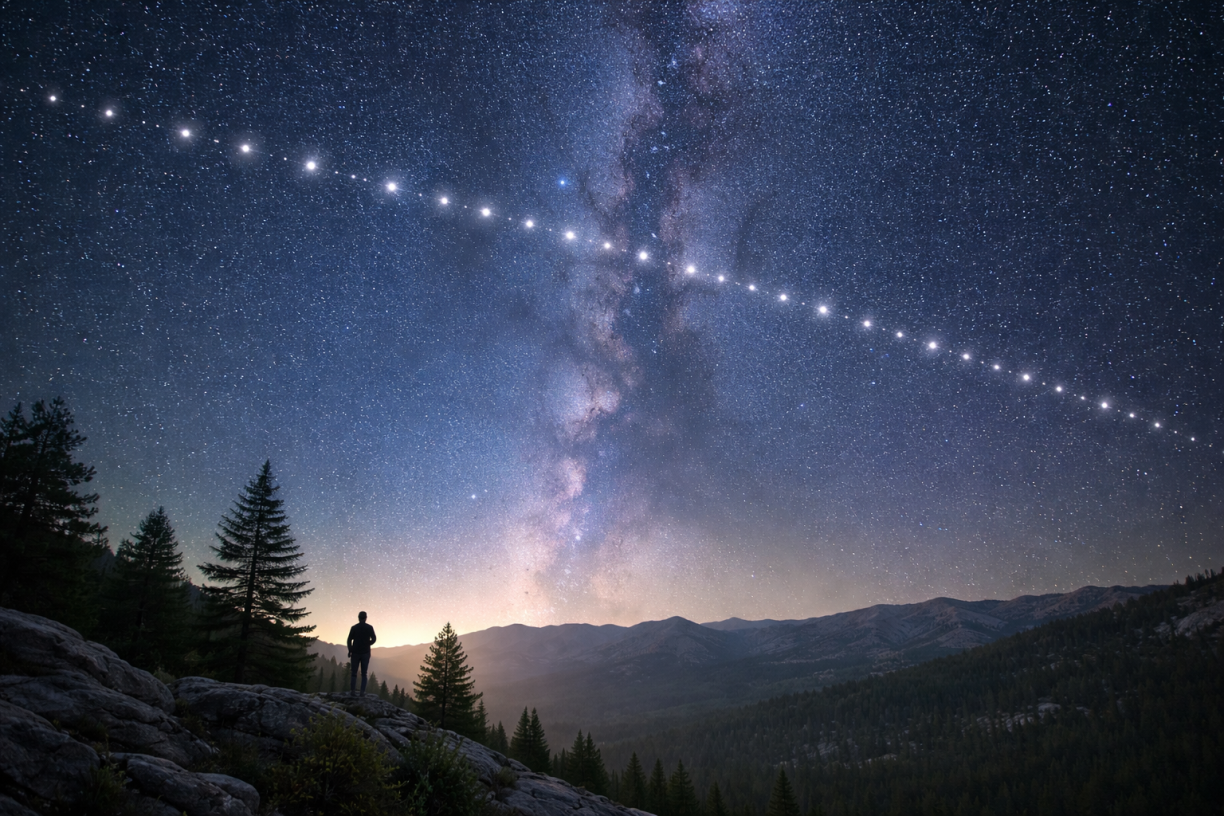
Well over 10,000 satellites are already active in orbit, with tens of thousands more proposed, authorised, or planned. For casual stargazers, the sight can be fascinating. For astronomers, however, the growing number of satellites is becoming a major challenge.
Modern telescopes are built to detect extremely faint light from distant galaxies and nebulae. When a bright satellite passes across the sky, it leaves a luminous streak across the image, interfering with the data. Large sky surveys are especially vulnerable. Facilities such as the Vera C. Rubin Observatory repeatedly image huge portions of the sky, looking for supernovae, near-Earth asteroids, and other transient events.
As satellite numbers grow, these observations face an increasing risk of contamination from bright trails crossing the field of view. This problem is serious and has led astronomers to work with satellite operators on mitigation plans.
Some satellites are now designed to reduce their brightness, while others adjust their orientation in orbit to reflect less sunlight toward Earth. But even with these efforts, the problem remains. And as more constellations are launched, it is only expected to grow.
Satellites themselves are not the problem. They play an essential role in modern life, supporting navigation, weather forecasting, environmental monitoring, and global communications.
The main challenge now is finding the right balance.
Low Earth orbit is not an unlimited space, and as more satellites are launched, careful coordination will become increasingly important. Scientists, regulators, and satellite operators are already working together to develop guidelines aimed at reducing brightness, managing orbital traffic, and protecting astronomical observations.
The sky above us is changing, faster than many people realise. And yet, the stars are still there. Constellations continue to rise and set as they always have. Planets wander slowly across the sky, and meteor showers still flash briefly through the darkness.
For anyone who takes the time to step outside and look up, the night sky remains one of the most powerful reminders of our place in the universe. The challenge now is to ensure that, as our technology expands into space, we do not lose sight of the stars that inspired it in the first place, or the sky that connects us to them.





