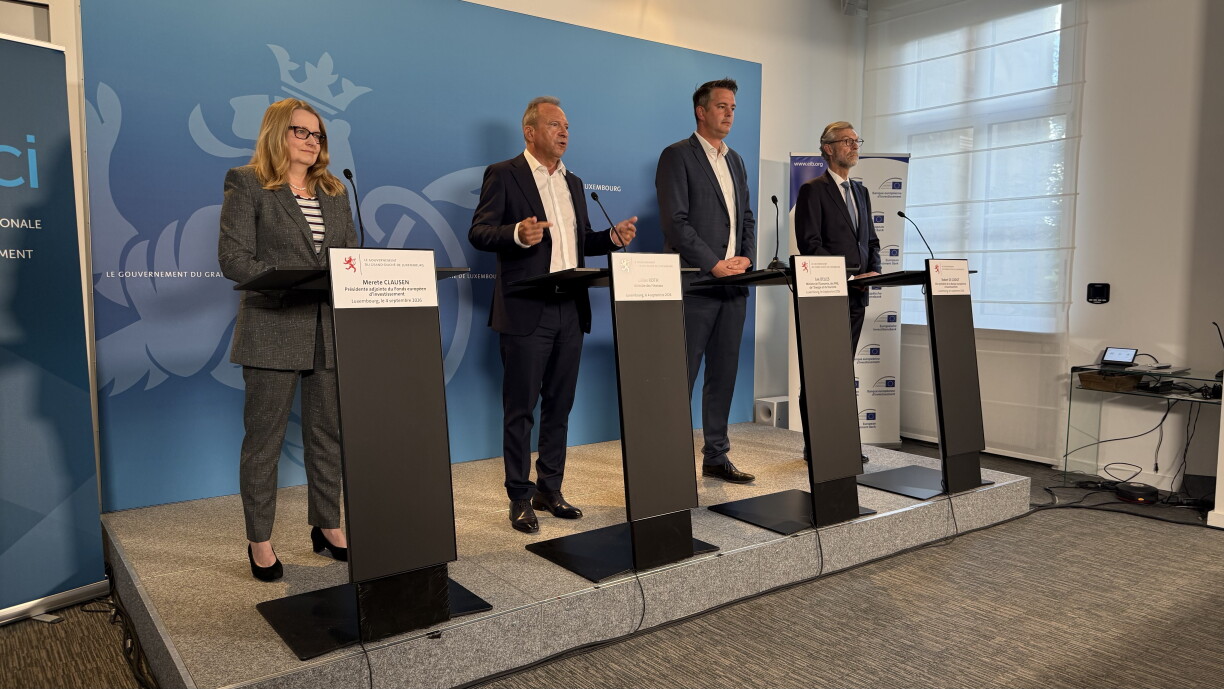
The Luxembourg government launched the third edition of its Luxembourg Future Fund on Friday, with €270 million available to support investment in innovative and growing businesses.
The Luxembourg Future Fund 3 (LFF 3) brings together the National Credit and Investment Company (SNCI) and the European Investment Fund (EIF). Of the total funding, €180 million will come from the SNCI and €90 million from the EIF.
Rather than investing directly in individual companies, the programme operates as a fund of funds, investing in venture capital, private equity and private debt funds. Those funds can then provide financing to start-ups, scale-ups and small and medium-sized businesses.
Finance Minister Gilles Roth said the aim was to improve companies' access to financing while supporting sectors considered important to Luxembourg's future.
"This allows investment in venture capital, private equity and debt funds", Roth said. "The programme focuses on specialised, but above all multisectoral, funds, with priority given to high-growth sectors that are crucial to the future of our country and that provide clear added value for citizens."
Priority areas include cybersecurity, deep tech, financial technology, health technology, property technology, space technology, green and clean technologies, as well as transport and logistics.
The government also wants the programme to strengthen Luxembourg's domestic economy. It will primarily support investment funds established in the country, particularly those whose investment teams are already based in Luxembourg or commit to establishing a presence there.
The third edition also changes how the programme is managed. While the European Investment Fund managed the first two Future Funds, the SNCI will now take a more active role in the investment process and invest in its own name.
Roth said this would allow the SNCI to strengthen its direct links with the market and build up its own expertise, while continuing to benefit from the EIF's experience.
Over the past ten years, around €263 million has been invested through the first two editions of the Luxembourg Future Fund.
Economy Minister Lex Delles pointed to Hydrosat as one example of a company supported through the second fund. The Luxembourg-based company uses thermal satellite imagery to measure water stress in agriculture, helping farmers manage irrigation more precisely and respond to the effects of climate change.
Hydrosat has established its headquarters in Luxembourg and employs more than 40 people in the country, around half of its total workforce, most of them scientists and engineers.
Delles described the new fund as a strategic tool for diversifying Luxembourg's economy by attracting innovative activities, specialist expertise and highly qualified jobs.
The ministers were unable to say how many companies had so far received support through the Future Funds or provide an overall assessment of the results of those investments. They said, however, that greater transparency would be provided in future.