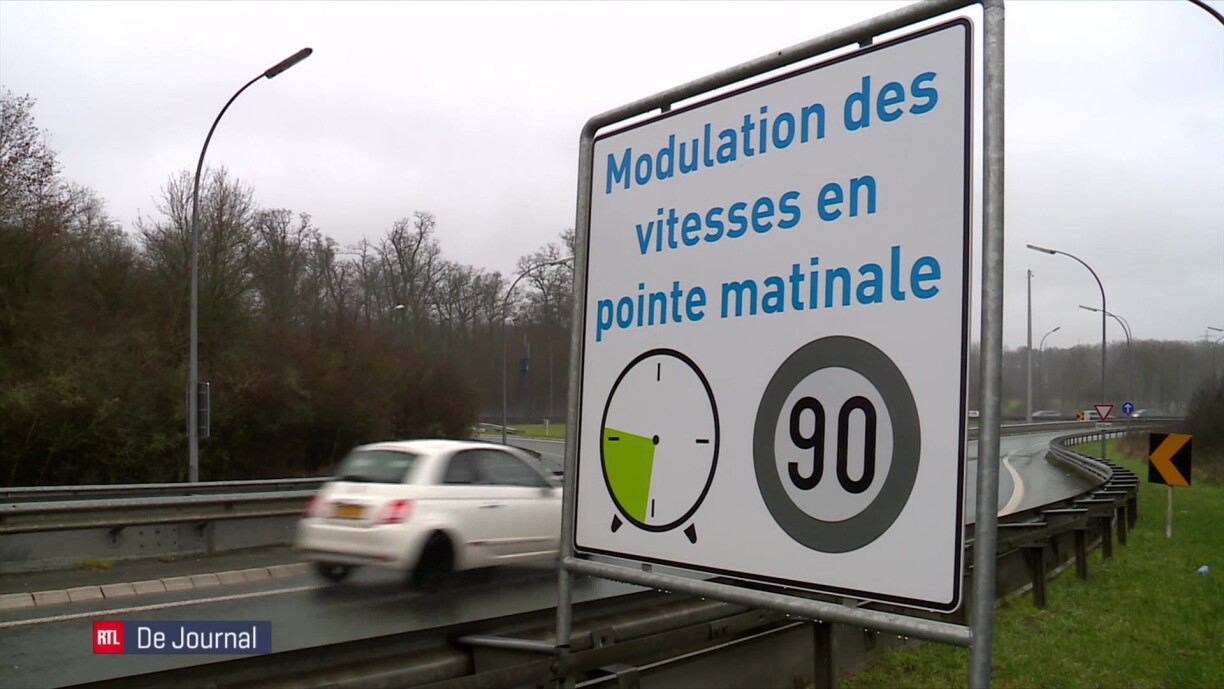
The entire A6 motorway and the A1 section up to the Kirchberg exit are affected by the 90 km/h speed limit during morning rush hour. Over the past four years, traffic has increased by 10% on this stretch while accidents have decreased.
This is an experiment that authorities now wish to extend to the entire Luxembourg City bypass, and potentially even beyond. The limitation would only be applied during rush hour. Similar models have already proved their worth in France and Germany and could therefore be extended to other Luxembourgish motorway sections.
Even if a large majority of motorists respect this measure, some have still not understood the new system. "They arrive at full speed as if nothing had happened before braking like savages a few hundred metres further on", laments Roland Fox, director of the Bridges and Roads Authority.
Braking suddenly at high speed generally increases the risk of accidents and therefore of congestion. The limitation is activated every morning between 6.45am and 9.15am, but authorities want to also use it at other times of the day if necessary.
However, the technical side is still a problem as the CITA system (control and information of motorway traffic) does not yet allow for automation. Thanks to sensors installed above the various lanes, the system counts the number of cars on the road, measures the overall speed, as well as the saturation of the section.
The system dates back to the 1990s and is due to be updated in the next few years.
"Once the new A3 is completed, we would like to use this system throughout the country. I assume that it will take another four to five years of planning and hard work to get there," argues Fox.
Motorists thus still have to wait a little longer before the new system can be used during the morning and evening rush hours throughout Luxembourg.





