
Here are five things you should know at the end of this week:


Luxembourg's new policy, prioritising women, children, and vulnerable individuals for accommodation, has left many male asylum seekers without immediate shelter, causing controversy as they resort to informal camps.
Makeshift camps - Luxembourg's revised refugee policy, implemented by Minister of Immigration and Asylum Jean Asselborn, has sparked debate by altering the reception process to prioritise vulnerable groups, such as women and children, for immediate accommodation. This change has resulted in a significant number of single male asylum seekers, particularly those who have already applied for asylum in another EU country, being placed on waiting lists.
Without access to the Initial Reception Centre, many find themselves without shelter, leading to the creation of makeshift camps in Luxembourg City, such as the one under Pont Adolphe, where they face harsh conditions with limited resources.
Capacity limits - The situation has brought to light criticism from various organisations and activists who argue that Luxembourg has not learned from past refugee crises, particularly that of 2014, and lacks a proactive strategy to deal with the current situation. With reception facilities approaching their maximum capacity, and support services like street aid and free meal providers under strain, there is a clear concern for the welfare of those left to fend for themselves.
Winter preparations - In response to the burgeoning crisis, the Luxembourg government is taking steps to mitigate the accommodation shortage. Minister Asselborn has highlighted the forthcoming opening of Hall 7 at LuxExpo, which will temporarily add 600 beds to the system, and mentioned ongoing efforts to finalise other housing solutions, like the ones in Schimpach.
These plans are intended to alleviate the immediate shortfall in housing and support the 27 men currently on the waiting list for shelter. The goal is to provide these individuals with safe lodging as the winter approaches, even as the government navigates the broader challenges of refugee integration and support.

Fines for using mobile phones while driving in Luxembourg are set to increase from €145 to €250 while the penalty points have already doubled from two to four.
Drug screening procedures for drivers have been streamlined, and enhancements have been made to electronic communication methods.
Vehicle registration numbers now attach to individuals instead of vehicles, personalised plates have quadrupled in cost, and the 4-digit plate waitlist has been eliminated.
Deterrence - The updated Road Traffic Atc introduces a more stringent approach to curbing mobile phone usage while driving, a common contributor to road accidents. The fine for this infraction will soon rise significantly from €145 to €250, a clear deterrent aimed at reducing distracted driving. Additionally, the consequences for driving license points have already intensified, with the previous penalty of two points now increased to a loss of four points.
Drug controls - In an effort to more efficiently identify and penalise driving under the influence of drugs, the legislation outlines a revision of the drug screening process. This includes the implementation of less resource-intensive testing methods, likely to facilitate quicker and more cost-effective roadside testing by authorities.
Moreover, the law specifies improvements to electronic communication, which could refer to better data handling and sharing between different branches of law enforcement, thus enhancing the overall efficacy of the drug control system and ensuring that information related to drug offences is processed more effectively.

Luxembourg MEP Monica Semedo is challenging a ten-day suspension from the European Parliament for alleged bullying through legal action, claiming procedural issues with the sanction imposed in April 2023.
Semedo, who had previously faced a 15-day suspension for similar allegations in 2021 and left the Democratic Party as a result, has taken her case to the Court of Justice of the European Union.
She is seeking to have the latest disciplinary measure annulled, arguing that the accusations do not fulfil the specific criteria to be classified as bullying, with the court's decision still pending.
Legal recourse - Monica Semedo, a Member of the European Parliament from Luxembourg, is contesting a disciplinary action that resulted in a ten-day suspension due to allegations of bullying. This action was decided upon in April 2023 and has prompted Semedo to pursue legal recourse. She contends that there are flaws in the legal procedures that led to the enforcement of this sanction.
Repeat allegations - The context of Semedo's challenge is coloured by her history with such allegations; in 2021, she received a 15-day suspension from the European Parliament on similar grounds. The recurrence of these allegations has had significant political repercussions for Semedo, leading to her departure from the Democratic Party

Israeli ground forces have completed the encirclement of Gaza City amid ongoing conflict with Hamas, as US diplomat Antony Blinken arrives to discuss minimising civilian casualties.
International concern grows as Israeli strikes in Gaza reportedly claim over 9,000 lives, mostly civilians, while Blinken pushes for concrete steps to protect non-combatants amidst global protests and warnings from the UN about potential war crimes.
In the meantime, foreign nationals and wounded Palestinians have begun evacuating Gaza through the Rafah border crossing into Egypt.
Urban warfare - Israeli military operations have intensified in the Gaza Strip, particularly around Gaza City, a focal point of the month-long conflict with Hamas. The Israeli encirclement marks a significant escalation towards urban warfare, which poses severe risks to the half-million civilian residents trapped within.
Prime Minister Netanyahu has praised the military's achievements, despite acknowledging losses. Meanwhile, US Secretary of State Antony Blinken's arrival in Tel Aviv underscores the urgency of the situation, as he aims to discuss strategies to mitigate the harm to civilians caught in the crossfire.
Potential war crimes - The conflict has resulted in a high number of civilian casualties, with the Gaza health ministry reporting over 9,000 deaths due to the Israeli bombardment, a figure that includes a significant number of women and children. These figures have not been independently verified, but they have led to a surge in international outcry against Israel's military tactics.
Antony Blinken's statements prior to his departure for Israel suggest a focus on reducing civilian harm. Nonetheless, Israel and its ally, the United States, have resisted calls for a comprehensive ceasefire, arguing that it would allow Hamas to replenish its forces. The severity of the situation is reflected in international reactions, including several countries recalling their ambassadors and Bolivia cutting diplomatic ties with Israel, while UN monitors have raised concerns about the bombings constituting potential war crimes.
Glimmer of hope - Amidst the chaos, there has been a limited exodus from Gaza as foreign passport holders and injured Palestinians have been allowed to leave for Egypt through the Rafah border crossing. The opening of this crossing is a glimmer of hope for those seeking respite from the relentless conflict.
Concurrently, humanitarian aid is trickling into Gaza, although it falls short of the vast needs on the ground as reported by aid agencies.
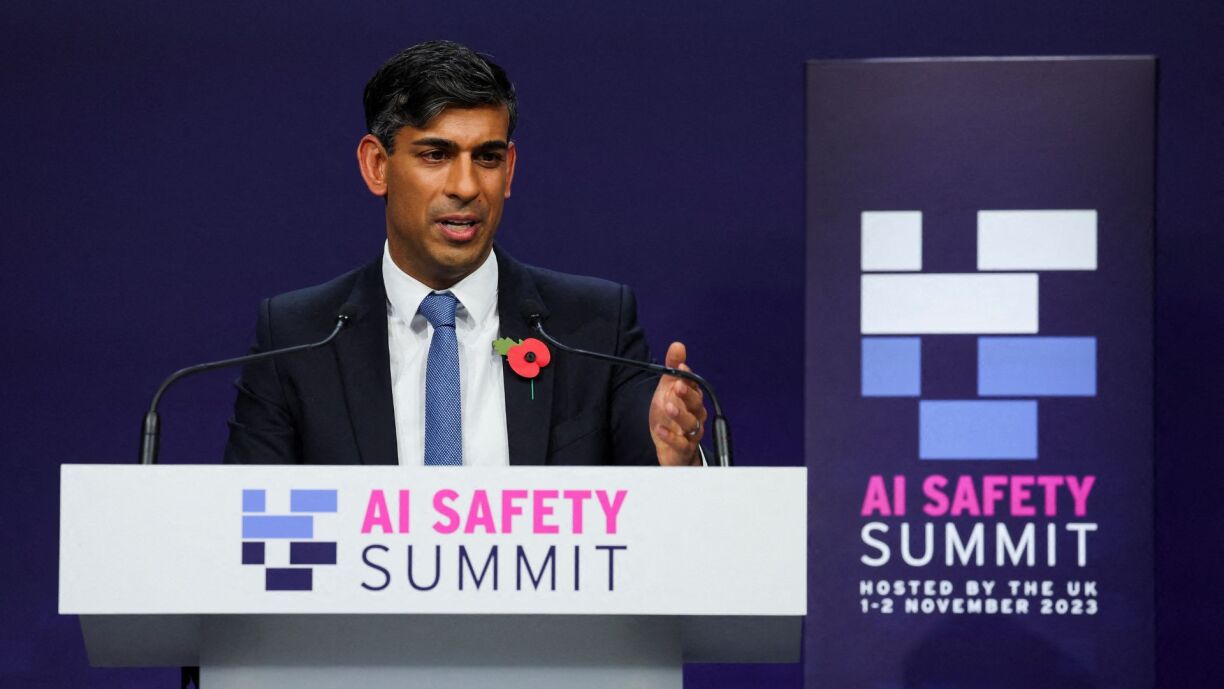
UK Prime Minister Rishi Sunak is hosting a global AI safety summit at Bletchley Park with political and tech leaders, aiming to discuss and manage the transformative risks and opportunities presented by AI technologies.
The summit has brought together international figures, including US Vice President Kamala Harris and representatives from the EU and UN, to forge a path on understanding AI risks, though China is notably excluded from sensitive discussions on the second day.
While the G7 countries have agreed on a non-binding code of conduct for AI, no global legislation blueprint is expected, with further summits and the establishment of institutes to evaluate AI risks planned in South Korea, France, the US, and the UK.
First of its kind - The inaugural global AI safety summit organised by UK Prime Minister Rishi Sunak represents a significant step toward international collaboration on the governance of artificial intelligence. Held at the historic Bletchley Park, the summit has gathered key political and technological stakeholders to discuss how AI will shape our society.
The goal is to collectively address the profound changes and challenges that AI technologies like ChatGPT pose, from job displacement to ethical considerations, and set a precedent for global responsibility and cooperation in managing such advancements.
China excluded on day two - The gathering is marked by its high-profile attendees, highlighting the importance of AI on the global stage. US Vice President Kamala Harris, EU Commission President Ursula von der Leyen, and other dignitaries have joined to deliberate on the policies and principles that should guide AI development over the next five years.
The absence of Chinese representatives on the second day underscores geopolitical tensions and concerns over sensitive technological issues. This selective participation indicates a careful approach to discussing the strategic and security aspects of AI advancements.
Ongoing dialogue - Finally, the G7's recent consensus on a non-binding code of conduct for AI represents a move toward establishing ethical standards for AI development, but it stops short of creating a concrete legislative framework. The summit itself is not intended to yield specific regulations, but to catalyse a better understanding of "frontier AI" risks.
The commitment to ongoing dialogue is reinforced by plans for future summits and new research institutes in the US and UK. These steps reflect a global acknowledgment of the need for vigilance and strategic foresight in the evolution of AI, balancing innovation with safety and ethical considerations.
Business & Tech - Sam Bankman-Fried, the one-time cryptocurrency golden boy accused by US prosecutors of stealing billions of dollars of his customers' money, was found guilty on Thursday on all counts, and now faces up to 110 years behind bars.
Science & Environment - Ten people were killed as Storm Ciaran battered Western Europe on Thursday, bringing record winds as high as 200 kilometres per hour, floods, blackouts and major travel disruption.https://today.rtl.lu/news/world/a/2066108.html
Entertainment - The cast of "Friends" said in a joint statement Monday that they have been left "utterly devastated" by the sudden death of their co-star Matthew Perry.
Remembrance Day - The Anglican Church of Luxembourg will commemorate Remembrance Day with a solemn service at the Konvikt Chapel on Sunday, 12 November, inviting the public to join in honouring those who sacrificed their lives in global wars and conflicts.
Defence support - The Ministry of Foreign Affairs confirmed Luxembourg will donate 100 generators to Ukraine, worth €335,000, in the coming weeks.https://today.rtl.lu/news/world/a/2066108.html
Be aware - Recent months have seen an increase in the number of phishing scams targeting Luxembourg residents.

Your Weekly Recap is published every Friday at noon. Read earlier versions.





