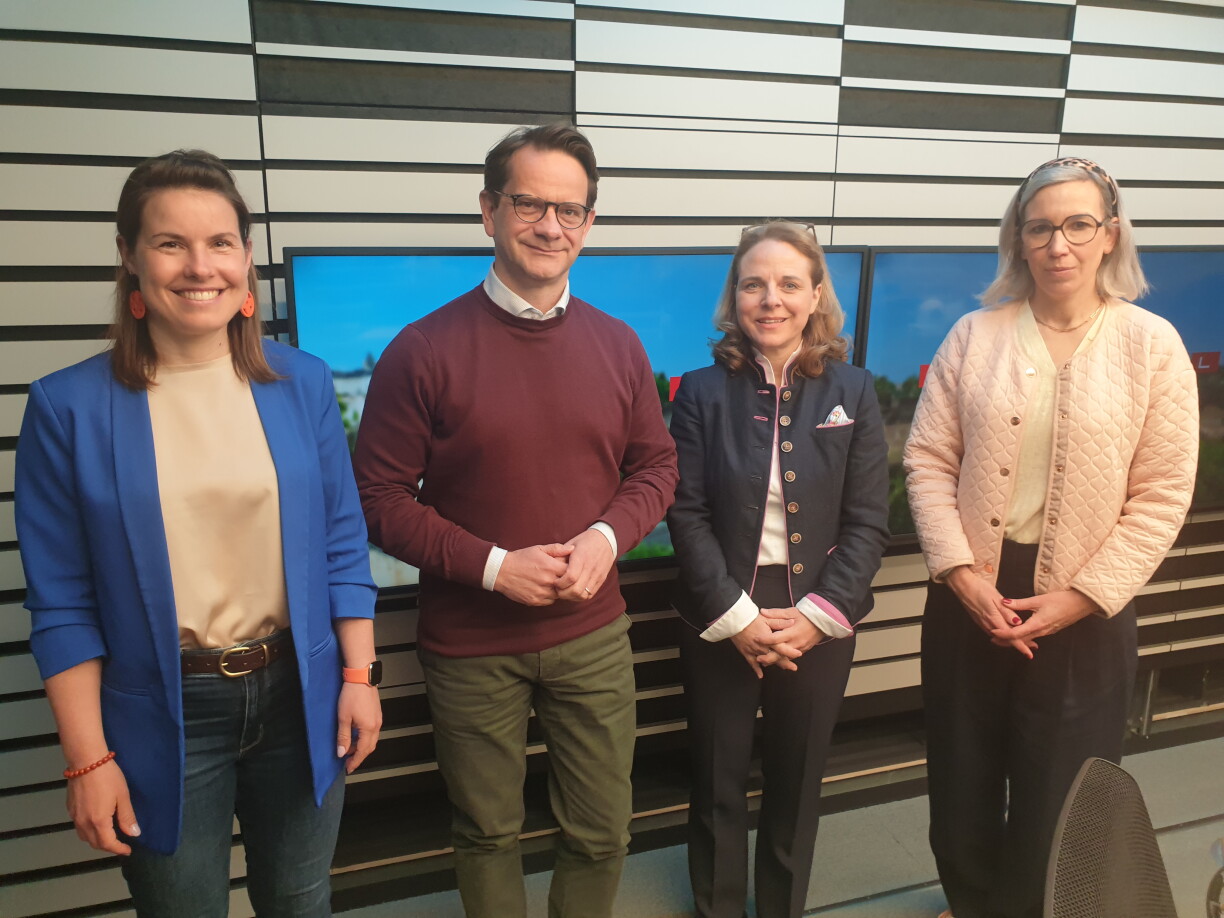
On Saturday, our colleagues from RTL Radio hosted a roundtable discussion ahead of Prime Minister Luc Frieden's State of the Nation address. The panellists were Laurent Zeimet, parliamentary group head of the Christian Social People's Party (CSV); Corinne Cahen, an MP for the Democratic Party (DP); Alexandra Schoos, party president of the Alternative Democratic Reform Party (ADR); and Sam Tanson, an MP for the Green Party (Déi Gréng).
The housing crisis remains one of Luxembourg's most pressing political issues. During Saturday afternoon's discussion, the debate centred on the roles of the state, municipalities, and private individuals.
Laurent Zeimet of the CSV defended municipal autonomy, cautioning: "I do not know whether imposing things from above is always the best method." He argued that new residential neighbourhoods only work if infrastructure keeps pace. "We need the schools, the crèches, and the roads first," he said.
Sam Tanson of the Green Party, by contrast, called for stronger state intervention. She specifically criticised tax advantages for investors, stating: "We cannot steer the price on the private market. We can only steer it for affordable housing."
The issue of empty homes also drew significant discussion. Tanson spoke in favour of an empty property tax, arguing: "It cannot be that houses stand empty while so many people have difficulties finding accommodation." Alexandra Schoos of the ADR was more cautious, pointing out that many empty houses are in urgent need of renovation – a task that she said would overwhelm many property owners.
Corinne Cahen of the DP highlighted the problem of bank loans. "People are currently no longer getting loans from the bank," she explained. Many projects, she noted, are ready to go but are not progressing due to a lack of funding.
The debate showed that nearly all parties agree on the seriousness of the housing crisis. However, opinions diverge significantly on how to solve it.
The discussion also revealed widespread concern over international crises and their impact on Luxembourg. Zeimet emphasised that "we are living in uncertain times" and that Luxembourg, as a small country, is highly dependent on the international context. He also spoke of a "crisis of confidence," with many people questioning whether Luxembourg can still take its destiny into its own hands.
Domestic problems were also addressed. Tanson warned of a societal divide, explaining that "inequalities are really not decreasing." She stressed the importance of "bringing society closer together again." Schoos focused primarily on the situation of young people, saying that many "no longer have any prospects" because housing and the cost of living have become too expensive. "You go to work, but in the end there is nothing left," she said.
The Tripartite was also a central topic. Cahen said that what matters most now is "that something comes out of this Tripartite." The opposition, meanwhile, criticised the government for waiting too long to respond to the crises. Overall, the discussion showed that there is considerable uncertainty in the country and that politics faces major social and economic challenges.





