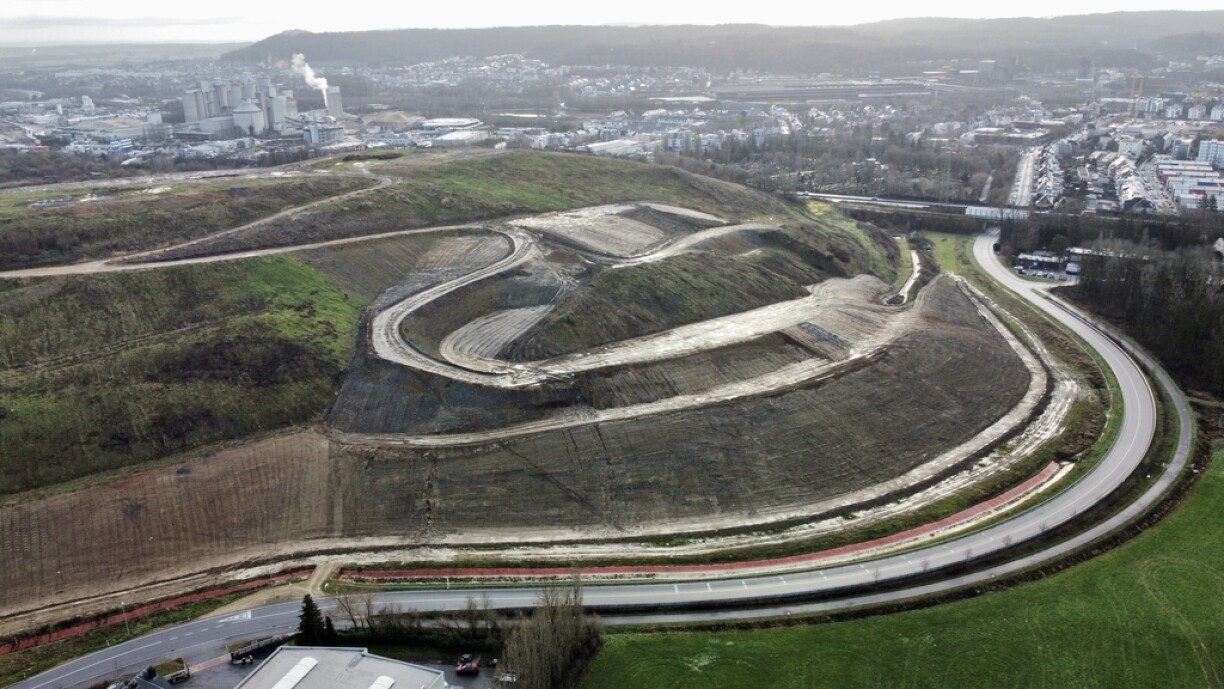
In the medium term, the two hills that contain slag from the steel industry and building debris will be sealed and converted into a solar park. However, implementing this plan has proved more challenging than anticipated, resulting in significant delays. Jeannot Fürpass, the mayor of Mondercange, is now pushing for progress.
Fürpass points out that authorities now know that rising groundwater and heavy rainfall were the cause of the landslides in 2014 and 2018. A "deep drainage" pipe was installed on the north side during a previous renovation. Fürpass confirms that "water is constantly running through there," which means that the drainage system is working.
According to an agreement between the construction waste company Cloos, site owner ArcelorMittal, the state, and the municipality, the site must also be secured from the top down. The plan requires 1.3 million cubic metres of soil. To avoid disturbing local residents, a maximum of 200 lorries per day are permitted to dump soil.
After one year, 200,000 cubic metres of soil have been delivered, with 1.1 million still lacking. According to the mayor of Mondercange, this is why he is concerned about making progress.


Fürpass currently hopes that the 'Crassier' site will be sealed by 2025. The larger part, for which the municipality of Mondercange is responsible, will receive a top layer of clay. ArcelorMittal will be responsible for sealing the smaller part of the site with a layer of bentonite.
The mayor of Mondercange also urges the municipality of Esch-sur-Alzette to address the hazardous waste water that has contaminated the Kiemelbach stream east of the 'Crassier' site. The toxic waste water partly originates from the industrial zone op Monkeler in Esch. The municipality of Mondercange proposes the purchase of a pump station to clean the Kiemelbach.
Solar plants could be installed on a surface area of 6.5 hectares after the 'Crassier' site is entirely sealed, with the first plans currently in the making. This plan, according to Fürpass, would ensure that the hills "at least serve a meaningful function." The mayor of Mondercange says that at the moment, the site is like an "ulcer" that needs to be covered. But even in the future, "it must always be monitored […] It will remain a problem."
The A4 motorway, the 'Minett' compost site, the road between Esch and Mondercange, and a nature reserve all surround the 'Crassier' site, slowing down the plans.
The full report by RTL Télé (in Luxembourgish):





