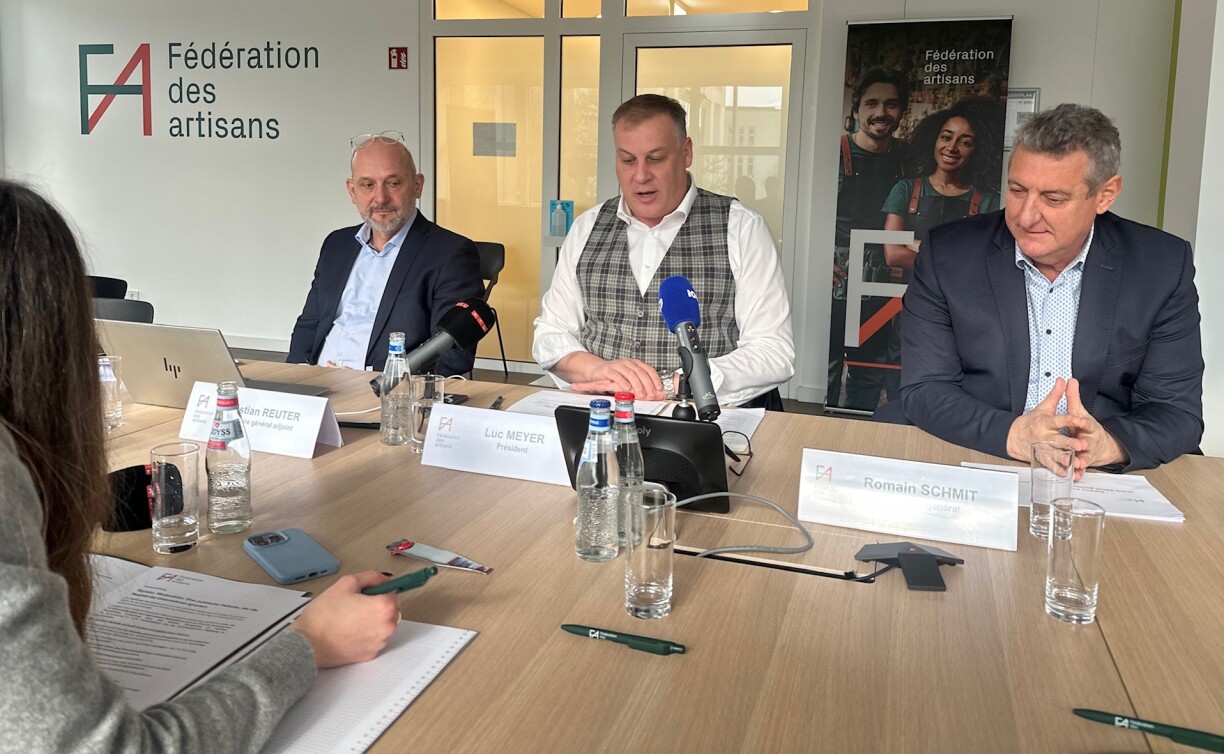
The Federation of Craftspeople has taken a firm stance against politically driven increases to the unskilled social minimum wage and is also calling for the abolition of the qualified social minimum wage altogether.
At a press conference on Tuesday, the federation argued that the unskilled minimum wage should not be raised through political decisions. It further proposed scrapping the qualified social minimum wage, which is currently set at 20% higher than the unskilled rate.
The position places the federation at odds with ongoing efforts at the European level. An EU directive recommends that member states adjust their minimum wage to either 60% of the median income or 50% of the average income. In Luxembourg, applying this formula would result in an increase of several hundred euros, raising the minimum wage to between €2,900 and €3,160, compared to the current €2,703.
However, the Federation of Craftspeople pointed out that since 2022, the minimum wage in Luxembourg has already increased by 17%. When considering only sectors such as industry, construction, and hospitality, the federation noted that the minimum wage in the Grand Duchy already exceeds the benchmarks set by the EU directive. It attributed this discrepancy to the financial sector and the civil service, which it said are pulling the income averages upward.
The federation also highlighted broader economic concerns, noting that productivity is stagnating while unemployment continues to rise. Rather than offering companies compensation for minimum wage increases, it proposed introducing tax credits to support low-income individuals directly. Additionally, the federation suggested that tax incentives could encourage companies to involve employees in the company's results through bonus schemes.
According to the federation, every increase to the minimum wage places upward pressure on the wages of skilled workers. It warned that businesses are left with only three options in response: raising prices, reducing their workforce, or accepting lower profit margins.





