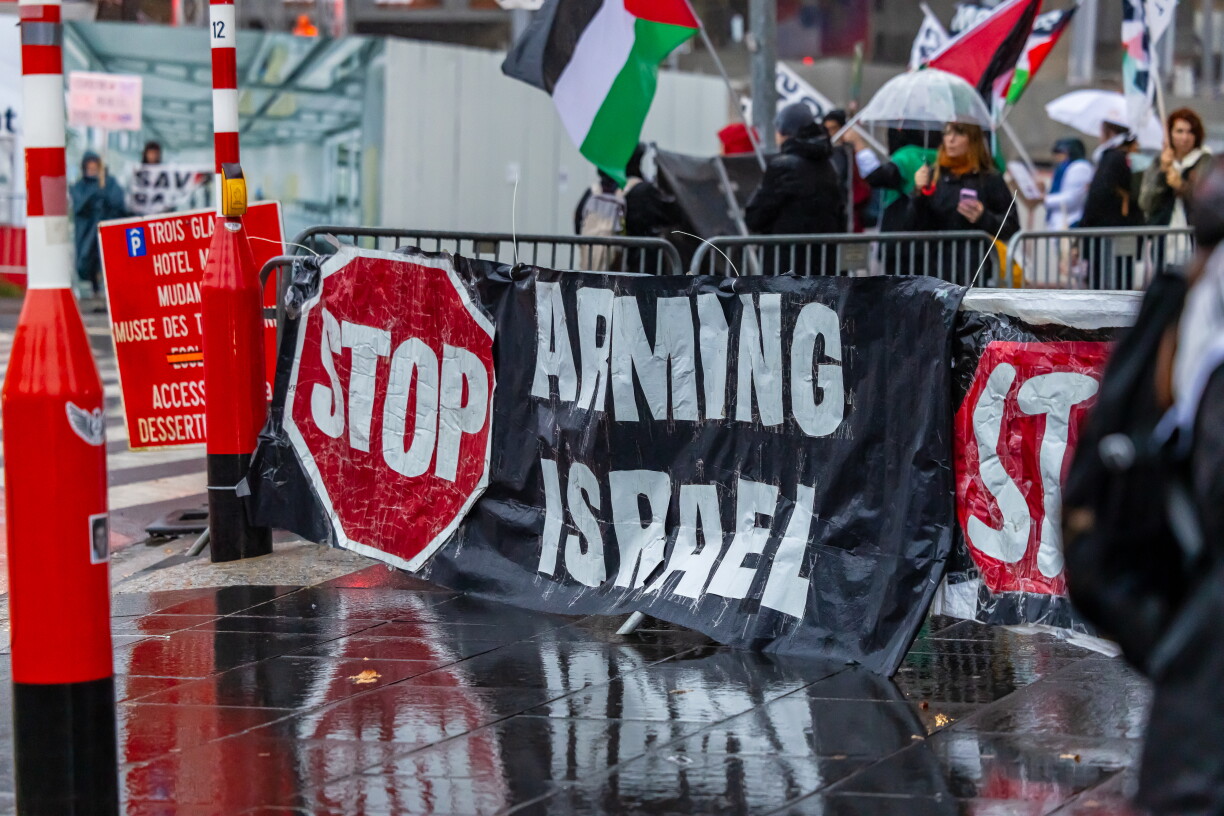
Amnesty International Luxembourg and the Committee for a Just Peace in the Middle East organised a conference on Monday focusing on the extent to which economic relations with Israel risk supporting actions that violate international law. The event also included a panel discussion centred on Israeli government bonds.
In early September last year, Luxembourg's Financial Sector Supervisory Commission (CSSF) gave the green light for the bonds to be offered on the European market. The decision has been sharply criticised by some, who argue that the money helps finance attacks and what they describe as genocide against the Palestinian population.
Henri Grün, board member of the Committee for a Just Peace in the Middle East, said economists at the conference had explained how closely the Israeli economy was linked to the occupation and the arms industry.
While it was not possible to trace a specific €10,000 or $10,000 investment to a particular piece of ammunition, he argued that, in general terms, the money flowed into Israel's war industry.
MP Franz Fayot of the Luxembourg Socialist Workers' Party (LSAP), who also took part in the panel, said this was unacceptable. He had asked the Chamber's scientific unit to analyse to what extent Luxembourg could be held responsible under international law for Israeli actions in the occupied Palestinian territories.
Fayot said the major issue was that Luxembourg, through its large financial centre, was involved in financing, whether through funds or Israeli bonds, which in effect helped enable the continuation of the war and Israeli colonisation against Palestinians.
Jean-Louis Zeien, from the Due Diligence Initiative of Luxembourg, was also invited to the panel and stressed that opening one's eyes must also lead to action. Referring to a recent statement by Foreign Minister Xavier Bettel, who had said that urgent action was needed, Zeien said this was correct, but not enough.
Once people opened their eyes and saw what was happening, he argued, action had to follow. In Luxembourg, he said, responsibility clearly lay with policymakers, who set the framework. He added that the coming months would offer Luxembourg an opportunity to move beyond words and take concrete action.
Zeien called for strong laws that would also hold the financial sector accountable, to ensure that human rights violations are not financed. One opportunity, he said, would be the transposition of the European directive on supply chains.
The full conference, including all expert contributions and the panel discussion in English, is available on Amnesty Luxembourg's YouTube channel.





