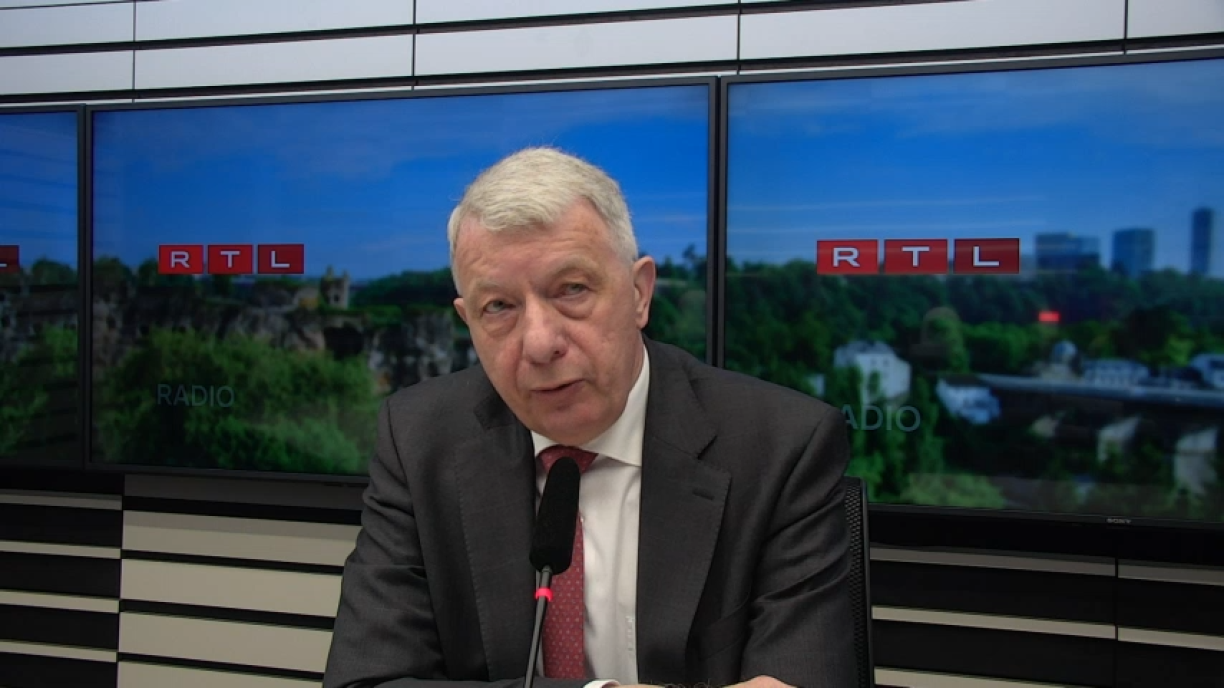
In a tense European context marked by the war in Ukraine, energy uncertainty, and shifting political alliances, MEP Fernand Kartheiser of the Alternative Democratic Reform Party (ADR) once again argued in favour of keeping channels of communication open with Moscow during an interview with RTL Radio on Monday.
Asked about the recent election results in Hungary, Kartheiser said that the country remains conservative even after Viktor Orbán. No left-wing parties had been elected, he noted, adding that there were no Greens, left-wing parties, or Socialists in the new parliament, which he described as entirely conservative.
Orbán's party, Fidesz, had faced accusations of corruption, and after 16 years there had probably also been a certain fatigue with him in Hungary, Kartheiser said.
He added that Hungary-specific factors were at play and that he did not see the country suddenly becoming a model for left-wing movements in Europe. As regards future PM Péter Magyar, Kartheiser noted that he had previously been a member of Fidesz and said he expected him to continue many aspects of Orbán's policies.
He argued that the EU currently has no strategic concept for bringing the war in Ukraine to an end, neither diplomatically nor militarily. Within the EU, opinions diverge, he said.
While the Belgian prime minister had said relations with Russia should be normalised, EU foreign policy chief Kaja Kallas had said Russia should under no circumstances be spoken to. For Kartheiser, this showed a clear split.
He said he had introduced dialogue with Russian representatives in the European Parliament. As far as he knew, it was the only initiative currently in place where some form of dialogue still existed between a European institution and Russia.
This dialogue was informal, as there was no official support for it, but Kartheiser said it was appreciated on the Russian side and that he hoped it could continue. In his view, it was the only bridge still available and, while complicated, it was working well.
Asked where he sees the line between dialogue and legitimising a regime that is waging war in Ukraine, Kartheiser said the purpose of dialogue was not necessarily to find immediate diplomatic solutions. He stressed that he had no mandate to negotiate an end to the conflict and that the limits of the exercise had to be clear.
The essence of diplomacy, he argued, is to speak to everyone, whether or not one shares the same views; to seek compromises, try to understand the other side, and also defend one's own positions.
The other side could of course use this for propaganda purposes, but in his view that was not an argument against holding dialogue. Refusing dialogue on those grounds, he said, meant not accepting diplomacy as a means of seeking peaceful solutions.
Kartheiser said he had no fear of contact in this regard. Diplomatic solutions would also suit Luxembourg better than military ones, he added, noting that the Grand Duchy had historically had good relations with Russia.
He referred, among other things, to the 1867 crisis, arguing that the idea of dismantling the fortress and granting Luxembourg neutrality had been a Russian one. History, he said, did not begin on 24 February 2022.
Following his trip to Moscow, the ADR MEP was expelled from the right-wing European Conservatives and Reformists (ECR) group. He said he did not feel isolated, as within one week he had received two offers to join another group, and has since received a third offer.
For the time being, however, he preferred to remain independent. This would allow him to retain his freedom and take diplomatic initiatives as he saw fit, he said.
Kartheiser also said positions within the ECR were evolving. He noted that the party of the Belgian PM Bart De Wever, who had spoken in favour of normalising relations with Russia, was itself part of the ECR, arguing that the group would eventually have to reassess its position.
Asked what his political line brought concretely to Luxembourg, Kartheiser said he was known in the European Parliament for advocating diplomatic solutions. He argued that this suited Luxembourg as a small country, which would not be well placed to engage primarily through military means.
He also said that the presence of an MEP organising regular, or at least relatively regular, dialogue with Russia was a challenge within the European Parliament, but that it was important to show that one could stand by one's convictions even when facing strong opposition.
Kartheiser also advocates greater sovereignty within the EU. If good policy cannot be achieved jointly at EU level, then individual countries must be able to act on their own, he said.
At the same time, he said, there are areas where cooperation is necessary, particularly the economy, because countries would otherwise be too small on the global stage. The EU also needs to recognise that it is becoming smaller, both demographically and industrially, he argued.
If Europe speaks with one voice, he said, it must be a sensible one.
Speaking about fossil fuels, Kartheiser said the issue should not be approached ideologically. EU economies are more than 80% dependent on fossil fuels, he said, and this reality had to be acknowledged.
In his view, policies such as the Green Deal offer unrealistic solutions. He also criticised what he described as excessive bureaucracy and supply chain legislation that could not be properly applied.
He argued that sanctions against Russia had cut the EU off from energy supplies, while problems with Iran and the possible blockage of the Strait of Hormuz added further risks.
According to Kartheiser, Europe was harming its own interests and making itself almost completely dependent on the US for energy, which he described as a vulnerable position.
Asked whether it was not possible both to avoid dependency and invest in renewable energy, Kartheiser said investment in renewables was possible, but that one had to remain realistic. He described renewable energies as unreliable, limited in quantity, and relatively expensive.
In his view, Europe should diversify its energy sources rather than pursue sanctions policies. Alternative energy could be part of the mix, he said, but it was not the solution to the problem.
Europe would remain dependent on fossil fuels for a long time, he argued, and should also rethink nuclear energy. According to Kartheiser, many arguments used against nuclear power date back to the 1970s and no longer reflect technological and scientific developments.





