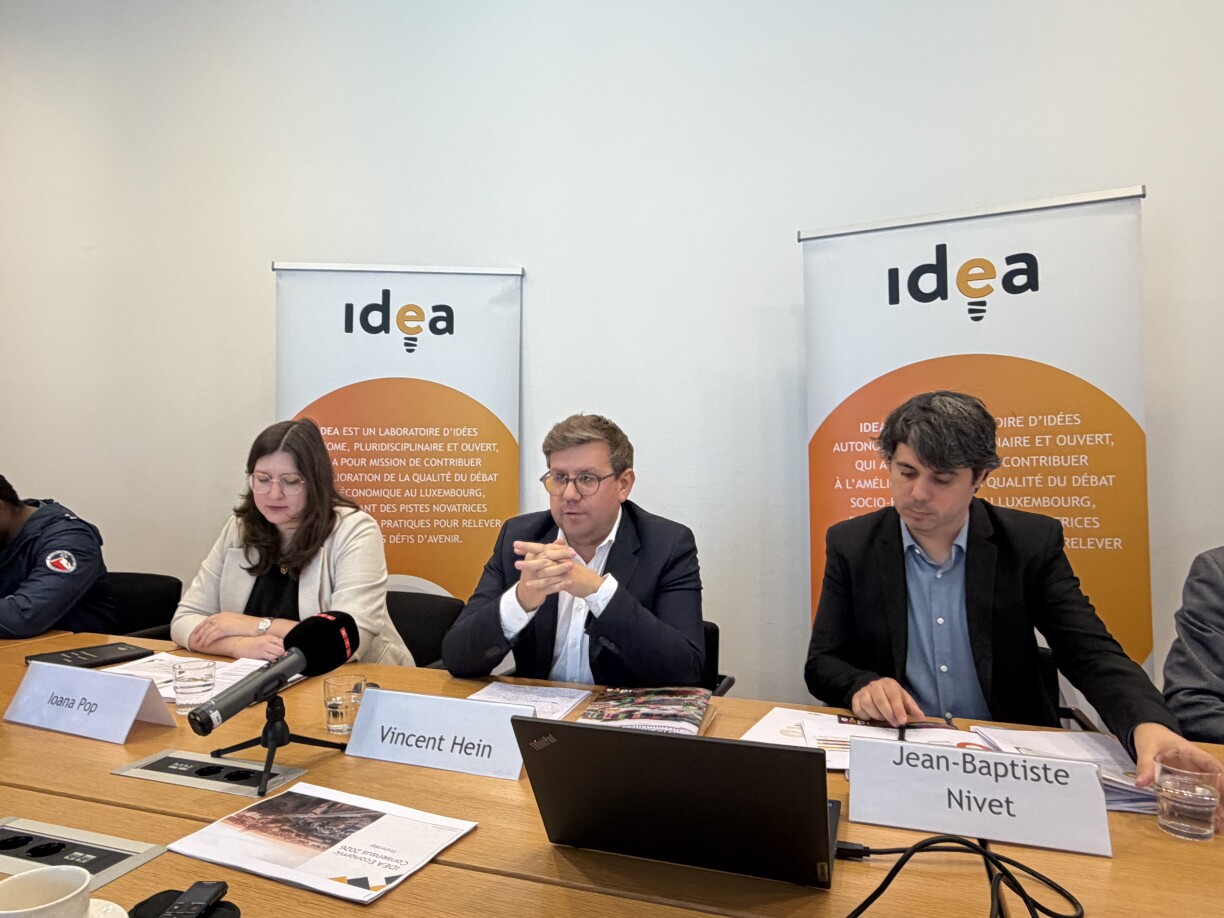
Fondation IDEA, the Chamber of Commerce think tank, said it was not yet known what effect the rising energy prices would have on Luxembourg's economy, but that there was cause for concern. The economists presented their annual report, titled 'Dissonances', on Thursday.
Luxembourg's economy was just starting to pick up again when the latest global crisis struck, affecting energy prices and potentially plunging the country into uncertainty. Vincent Hein, IDEA director, explains: "The difference between now and 2022 is we entered this crisis when the global economy was not overheating, as was the case in 2022. In 2022 we already had inflationist roots due to the post-pandemic recovery."
Despite this, the vicious circle of inflation beckons. And Luxembourg's economy never quite recovered in full following coronavirus and the outbreak of the war in Ukraine, even though it went through some optimistic phases. "We have achieved an average of 0% growth over four years, so the 2025 GDP is estimated to be the same level as in 2021."
This is a new experience for Luxembourg, as the Grand Duchy has weathered other crises, such as the banking crisis almost two decades ago, without suffering too much. But this has not been working since 2022, warns Hein. "Now it's the opposite and Luxembourg is underperforming in comparison to the eurozone as a whole."
The reason for this? "For the first time, the financial centre has not played its usual role as a lifeline for saving the Luxembourg economy during this period."
Everyone, including politicians, must now adapt to this new reality, the IDEA foundation says.
A survey conducted by the foundation among 300 economists, politicians, social partners, and researchers revealed only half of them believe the economy will recover and achieve 3% in growth over the next five years. The majority believe that Luxembourg's government debt will only increase.
Many respondents said they want less paperwork and more public investment in housing, digitalisaion, and artificial intelligence to boost the economy.
The economist Jean-Baptiste Nivet said: "Many of these results are pessimistic. In the seventh edition of our report, we could interpret this as nostalgia for Luxembourg's golden age."
But there are some positives to be drawn from the job market, says Iona Pop. "We saw a small lift in 2025, but it is in a slow phase and recovery is fragile. However there was a small increase compared to 2024, when there were just 6,000 jobs net. But it's still a long way away from the 15,000 roles posted in 2018-2019."
Three-quarters of the new jobs are not in the public sector, but the majority are with the government or linked authorities. The current unemployment rate of 6.3% is higher than the EU average.
The IDEA Foundation believes the government cannot lose sight of the green transition, alongside investments in defence or AI. But they must also focus on support amid the energy crisis.
Frédéric Meys explains: "This financial aid must be very targeted for multiple reasons but above all, for budget."
Politics are complex at the moment, IDEA acknowledges, but it is also not easy to be a citizen. This is the new Luxembourgish reality: more dissonance.





