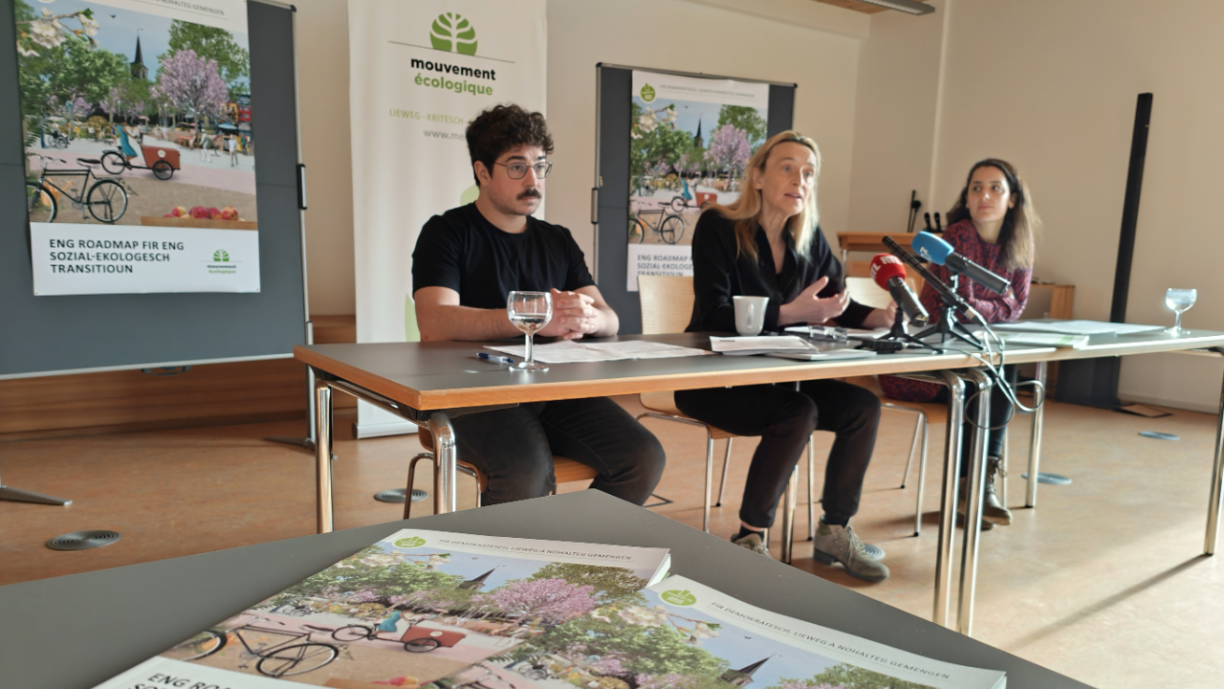
Our society is facing several paradigm shifts, which is why changes are needed, Weber said on Thursday in a presentation of the movement's demands for the municipal elections. Since the pandemic and the war in Ukraine "at the latest," a shift in values has been evident, according to Mouvéco. But for a socio-ecological transition to succeed, "we need people on the ground; and we have them in the municipalities."
These local actors must ensure that citizens are better involved in the planning process, the Ecological Movement stresses. This should not be limited to big projects, according to Weber, but should rather take the form of a proactive approach. She argues that decisionmakers should ask residents what they want to see or need in their municipality, and they should generally have the option to submit their own ideas.
To make this process more accessible, Mouvéco proposes the creation of spaces designed for meetings and discussions, which would also "actively contribute to the social cohesion of society." However, for Mouvéco, public spaces are only a small aspect of an overall concept that is needed for entire neighbourhoods. Neighbourhoods need to be redesigned, with Mouvéco member Michelle Schaltz stressing that "the focus must be on people, not cars."


The creation of "climate resilient neighbourhoods" requires, among other things, a decisive push for more green spaces, the Ecological Movement notes.
Not every municipality faces the same challenges or has the same resources at its disposal, which is why Weber calls for an end of the so-called Kierchtuermspolitik ("church tower policy"). Mouvéco specifically proposes that local autonomy be subordinated to collective national projects, and big construction projects as well as mobility concepts should be planned at the regional level. In general, communes need to think more about synergies, for instance by sharing heavy machinery or vehicles, according to Mouvéco.
When it comes to sustainability, "municipalities need to lead by example." For this reason, another demand by the movement is that only regional and organic produce should be served at canteens or drop-in centres (Maisons-Relais). "At receptions, you also don't have to have scampi on your canapés or salmon from somewhere," Weber remarked. The president of the Ecological Movement also thinks that it is important to offer vegetarian and vegan alternatives "to show residents that it doesn't always have to be meat."
The 150-page roadmap, which was written by some 100 volunteers, is available online in French and German. The German version can also be ordered from Mouvéco for €15.
Report by RTL Télé (in Luxembourgish):





