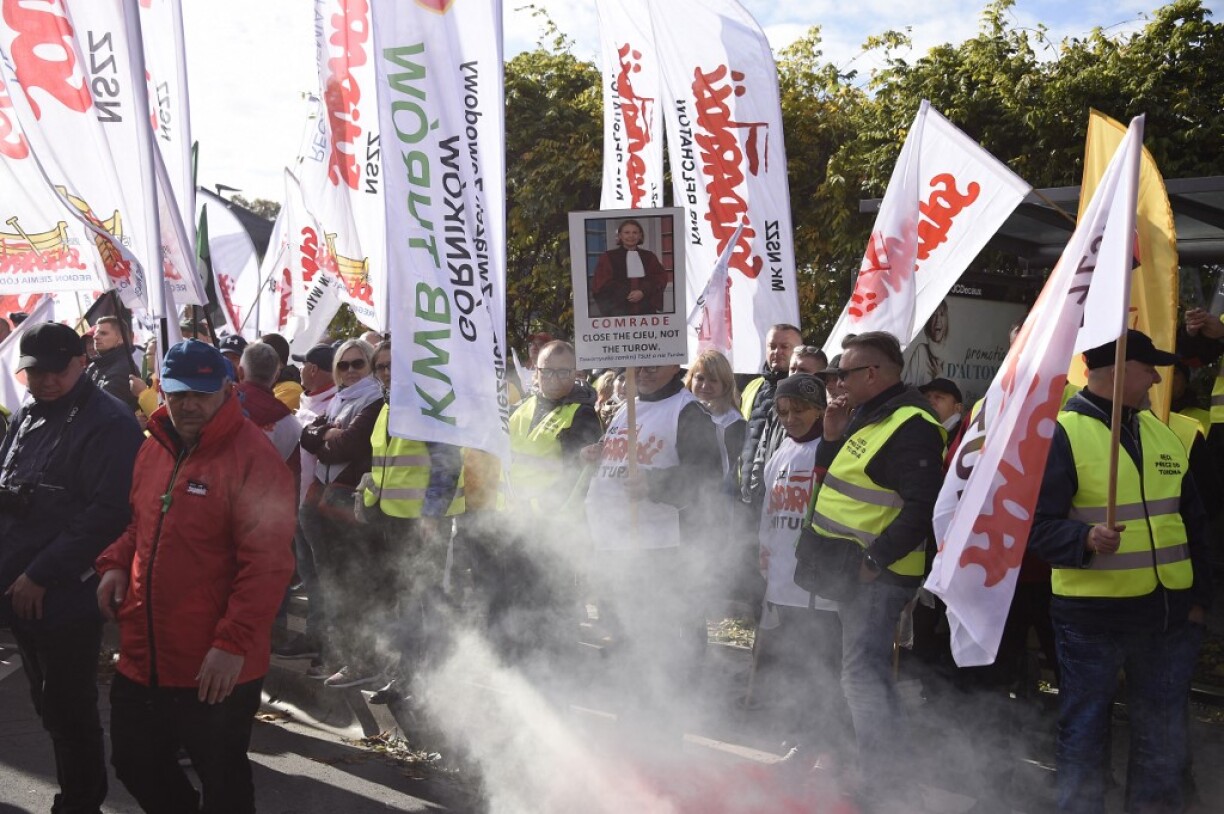
Clad in yellow vests reading "HANDS OFF TURÓW", blowing vuvuzelas, waving trade union flags and blasting siren-noise machines, the protestors came to the EU's top court to fiercely oppose the closure of the major coal mine.
Protest signs read "The CJEU sentences us to death" and "We will not give Turów away". A letter was left on the barricade in front of the court before the group marched towards the Czech Embassy to protest against the country's role in the argument.
In May, the ECJ ordered Poland to suspend mining there due to severe environmental concerns, including dropping water levels and the release of toxic chemicals. Geologists registered a 50-metre drop in groundwater levels in deeper sediments between 1985 and 1999.
But the Polish government refused, leading the Czechs to ask the ECJ to fine Poland five million euros for each day the mine remains open. On 20 September, the ECJ slapped Poland with a fine of €500,000 for each day until it is closed down.
Speaking to Polsat News, the leader of the Solidarity Union, Piotr Duda, warned the ECJ that if they did not reconsider their decision, the union and its supporters would "set fire to Europe in their hearts".
The Solidarity Union was the historic umbrella movement which helped topple Poland's communist regime. In recent times, the union has transformed into a more traditional trade union, which is supportive of the right-wing populist Polish government.
Meanwhile, Poland's largest energy group PGE, which owns both the mine and the plant, is planning to extract coal at Turów until 2044. Operating since 1904, the mine employs some 4,000 people. Some of the workers who travelled to Luxembourg expressed their fear of losing their jobs and suffering from "energy poverty" should the mine be closed down.
"We will never agree to be treated as political hostages, we are forced to assert our rights and defend our jobs in every way available to us, hence this street protest", the statement read, which was being handed out to the public. The last sentence stated: "Please understand us - we are fighting for a normal, dignified life."
Edward, who is from the northern Polish city of Gorzów Wielkopolski and not from the mine region itself, was in Luxembourg to show solidarity with the miners. But he is protesting against the Czech government, not necessarily the EU. "The European Union is OK. But the decision to close down the mine is stupid", he says. The ECJ has stepped in because both countries could not reach an agreement.
Tymoteusz, a Polish national living in Luxembourg, attended the anti-demo protest, which saw a small group gather on the steps of the Philharmonie in favour of the Court ruling, and especially in favour of the EU. He acknowledged that it was a tricky situation, with arguments on both sides, but he believes the group is targeting the wrong institution.
"The worst thing is that our government did absolutely nothing about this mess for a year, they kept lying that it's taken care of, that everything is OK. Then later, the European Union knew it had to do something and introduced this penalty. My biggest question is: Why don't you protest against our government for not doing anything about this situation?" says Tymoteusz. As we walk down the road, Polish protestors ask him how he likes life in Luxembourg, which he says he adores.
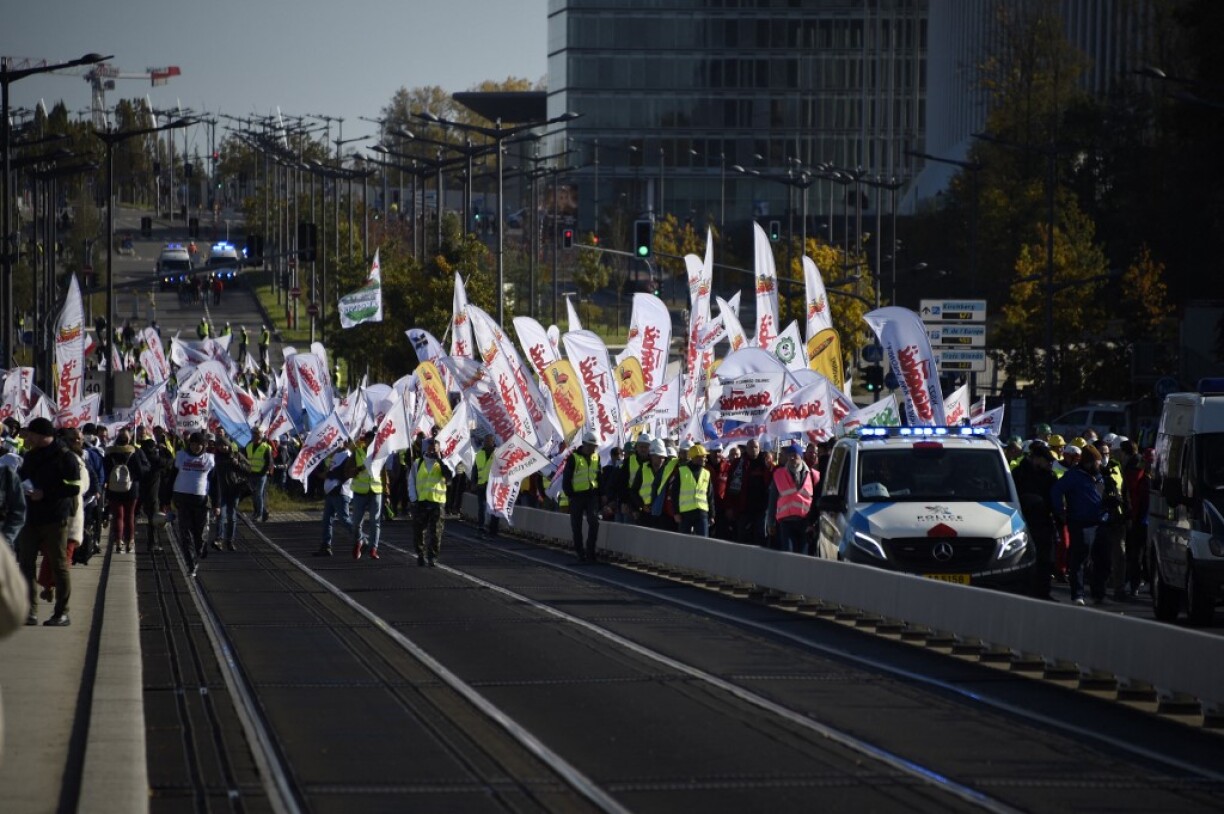
The protest was friendly. Over 800 police officers, including anti riot police from Luxembourg and Belgium, were in place around Kirchberg and the demonstration route towards the Czech Embassy. The information sheet from demonstrators apologised for any inconvenience caused.
Union leader Duda appealed to the Polish prime minister, Mateusz Morawiecki, to adopt a tough stance against the EU. Morawiecki said in September that the mine would not be shut down as it would deprive millions of households of electricity.
Jakub Kulhanek, the Czech foreign minister, had hailed the ECJ verdict, tweeting: "The main goal remains the same — access to drinking water on the Czech side must not be jeopardised."





