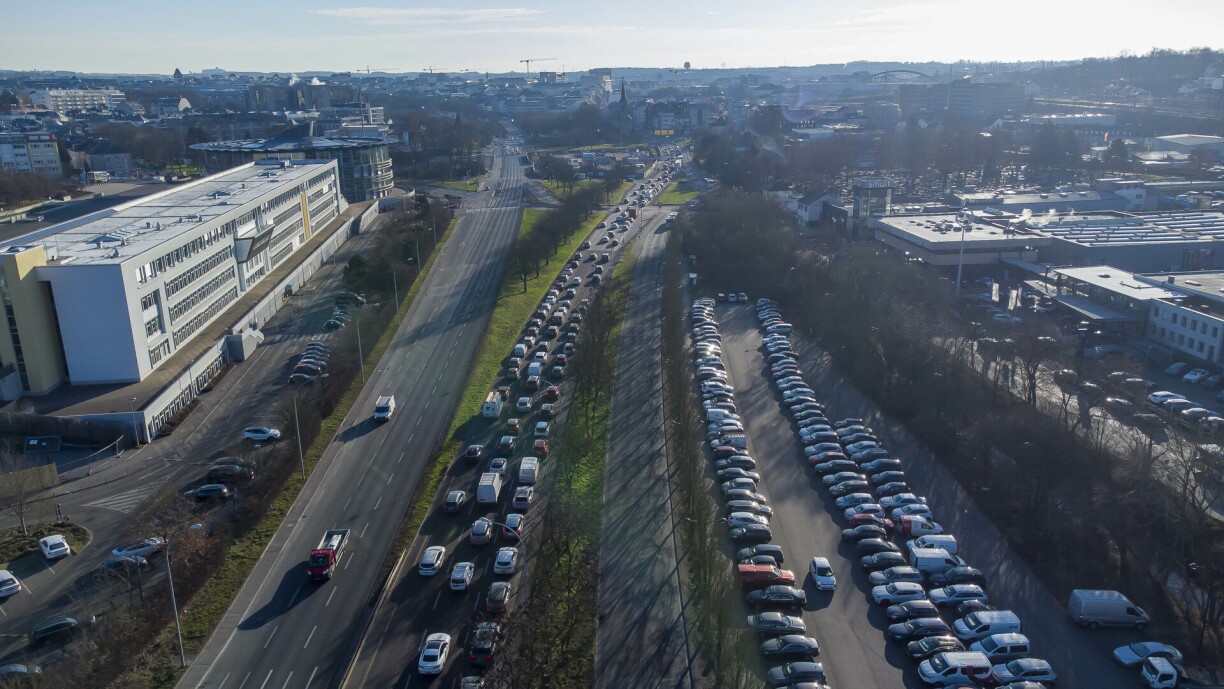
In order for Luxembourg to maintain a good quality of life, pursue its economic and demographic development (+25% population growth in ten years), and not find itself in a deadlock, there is an "urgent need to give ourselves the means, capacities, and necessary speed to build infrastructure and housing in the appropriate places", says Romain Diederich, a geographer specialised in territorial development.
The big challenge is to rethink spatial planning for the next 30 years. In its vast long-term territorial vision published on Monday, the Idea Foundation forecasts 1.1 million inhabitants, 995,000 jobs, including 503,000 cross-border commuters by 2050.
Read also: What will Luxembourg look like in 30 years?And, in order for all these people to be able to move around without spending more time stuck in traffic than they already do, the predicted scenario requires "major changes to the mobility system", according to Diederich.
"The solution is not simply to switch from diesel or petrol cars to electric ones. What is clear is that private cars will have to become less important altogether", argues Diederich.
There are various ways to achieve this, says the geographer. The first is that "people drive a little less thanks to teleworking. Another is that they do not commute alone."
All put together, teleworking, carpooling, soft mobility, and the net reinforcement of the public transport offer should make it possible to contain "the volume of additional border cars needed by 2050 to 41,000 units for the increase of 293,000 border commuters", indicates the study by the Idea Foundation.
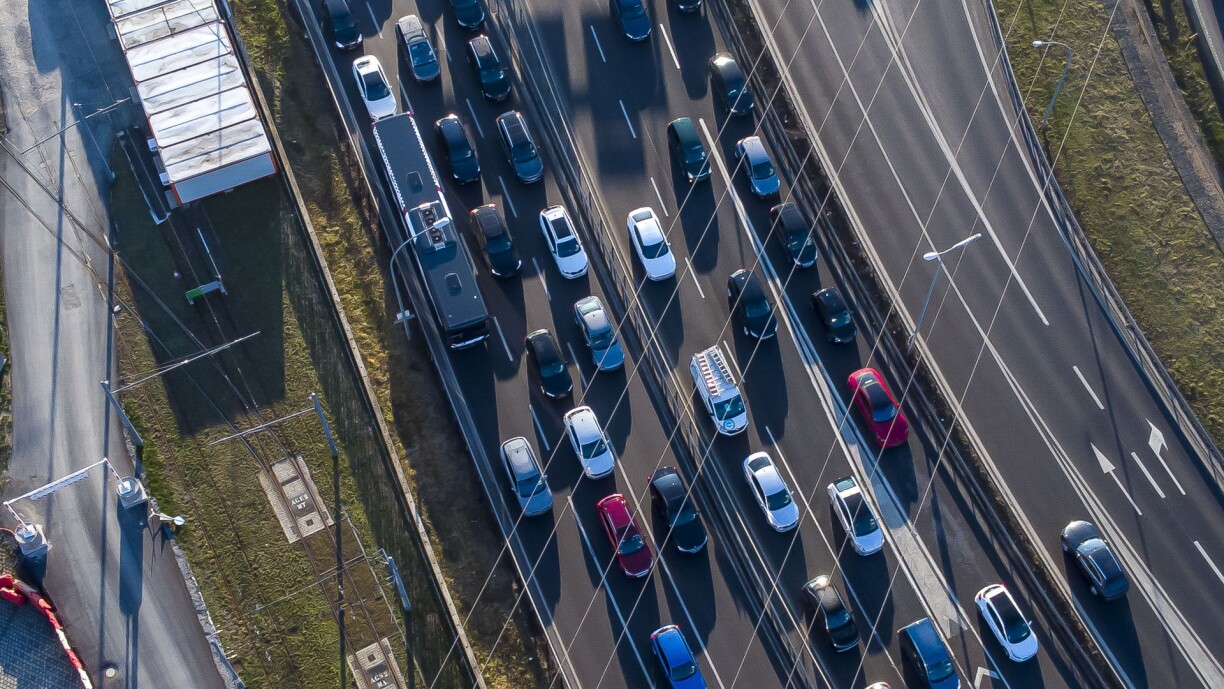
If telework continues developing and expanding and the share of private cars actually decreases, the scenario projects that mobility will be 45% cars, 30% public transport, and 25% active mobility by 2050. In comparison, the distribution in 2017 was 69% cars, 17% public transport, and 14% active mobility.
The Idea Foundation expects major road networks to become intelligent and computerised. Autonomous driving and artificial intelligence management systems will "undoubtedly make it possible to make better use of the road network's capacities in the future, but a greater percentage of users will have to take public transport, walk, or cycle", summarises Diederich.
The scenario also envisages the entire motorway network being expanded to three lanes, with the exception of the Nordstrooss and the A13 motorway. In this scenario, at least one lane would always be reserved for public transport and carpooling.
In order to have new capacities in public transport "we will have to develop the networks and dare to create new things, new modes of transportation. We propose the urban cable car," announces Diederich.
He says the urban cable car makes it possible to travel "at a height of tens of metres. This means that we are not too limited by the lack of space on the ground. It is fast and has a high capacity since it can carry up to 6,000 passengers per direction per hour. And it costs less than a tram thanks to fewer spatial difficulties."
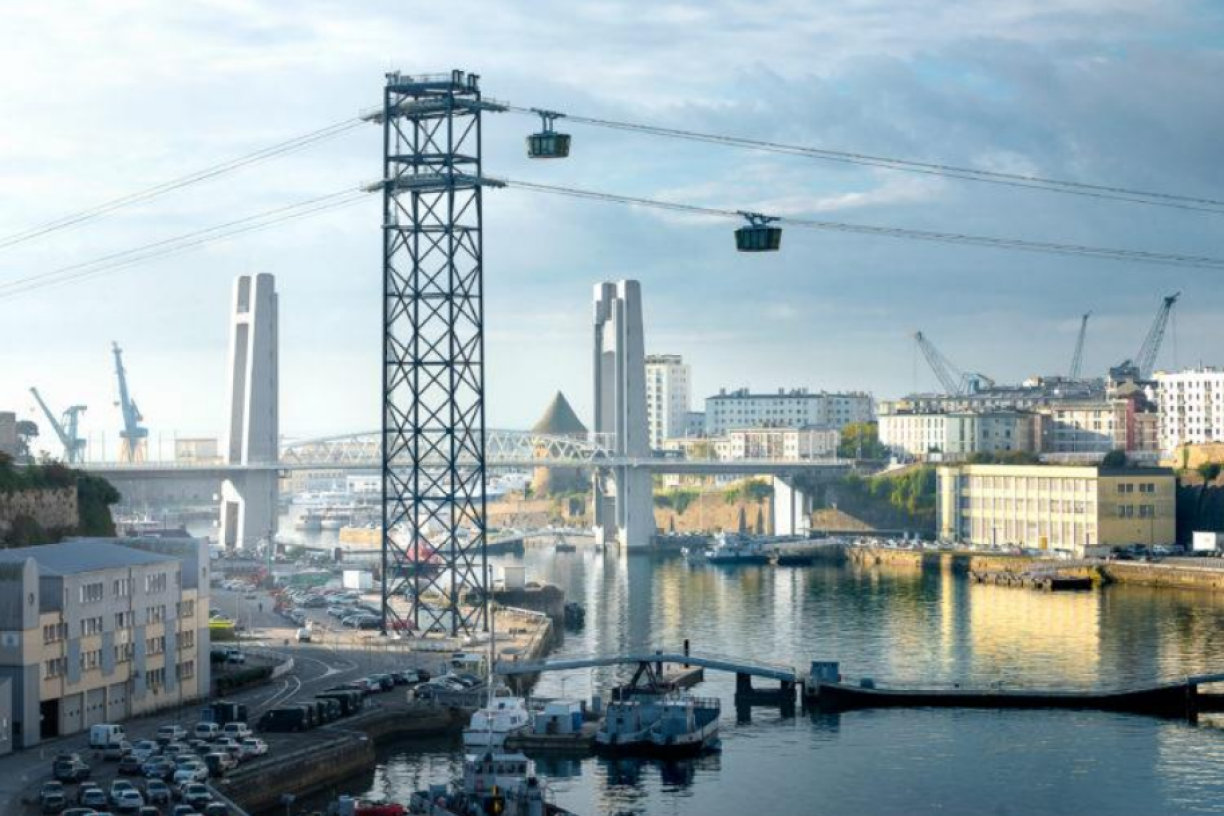
A cable car would be able to, for example, "link the Gare central station to the Place de l'Europe in Kirchberg or its surroundings in about ten minutes". An extension might be envisaged "in the direction of the Ban de Gasperich or Cloche d'Or" development centre, which "might have nearly 40,000 jobs and 15,000 to 20,000 inhabitants by 2050". The Idea Foundation would like to see a third urban cable car "about 2 km in length between the Dommeldange station and the north-eastern sector of the Kirchberg plateau", near RTL.
Idea's experts "are not against the tram", but estimate that the urban cable car "is a means to complete the versatility of public transport in an intelligent manner and one that can be financed".
Another "new idea" is to build trams on stilts in densely urbanised areas where there is not enough space available on the ground. "This could be an interesting concept for southern Luxembourg," Idea writes, before mentioning "certain segments between Rodange and Dudelange." In the Bertrange-Strassen sector or on certain segments of Route d'Arlon, putting a tram on stilts would facilitate passage when it "faces traffic congestion."
It should be noted that the study makes no indication of how much its proposals would cost the state.
Some of them could be very costly. For example, the construction of a tunnel under Findel Airport for vehicles and the tram in order to connect car traffic from the Remich area to the Höhenhof, which will eventually have a high-capacity P&R car park, and to extend the tram to Contern and Sandweiler. Or the construction of subways under certain key junctions such as Place de l'Étoile or Place Dargent in Luxembourg City.
The scenario proposed by Idea calls for the construction of two bypasses to connect certain important railway lines without passing through the capital's central station. The first bypass would allow trains coming from Trier to connect directly to the Northern line. This bypass would save passengers travelling to the Kirchberg plateau "about 20 minutes."


The second bypass would allow trains to travel directly from Arlon to Thionville, connecting the future development centre of Ban de Gasperich to that of Porte de Hollerich. This bypass could save a significant amount of time "for international trains heading to France and Belgium, particularly with regard to the Brussels-Luxembourg-Strasbourg international link."
The Idea study also recommends "modernising all existing lines so that their frequency, especially that of the main lines (Thionville, Esch/Alzette, Arlon, and also Pétange) approaches that of the RER lines at peak hours." The opening of the new railway line between Bettembourg and Howald may also "allow the reopening of the direct line between Thionville and Esch/Alzette."





