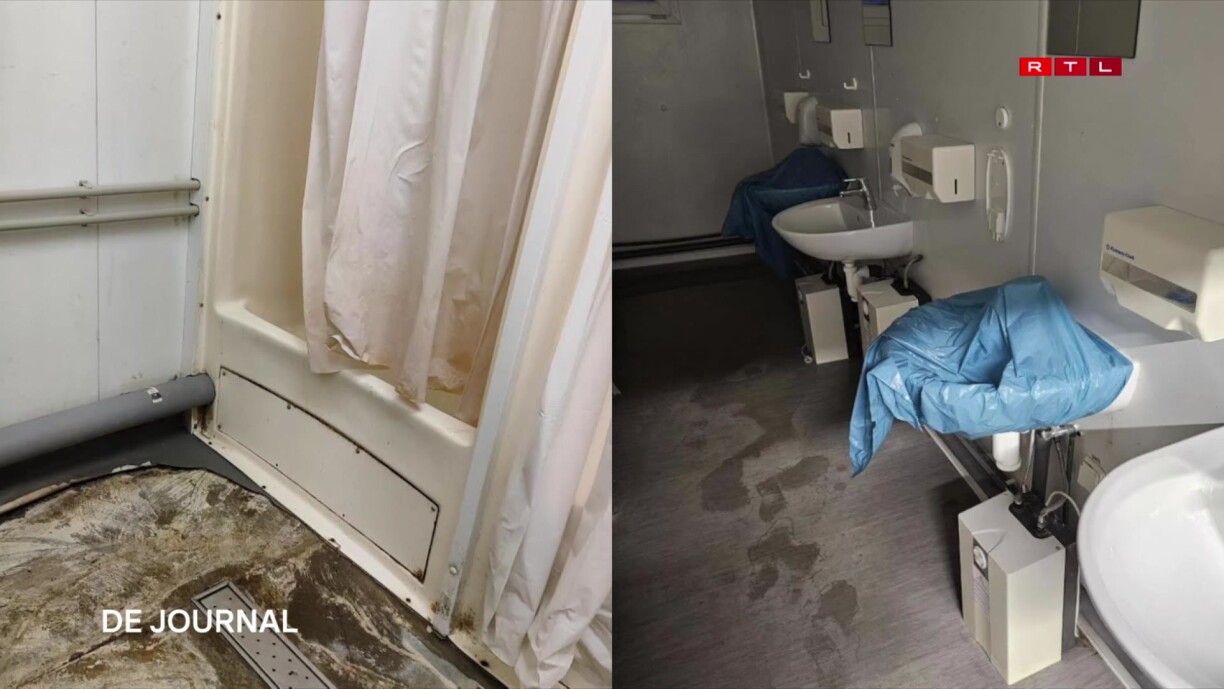
Sinks so badly blocked that they are filled to the brim with water; toilets equally blocked, spewing out what should be in the sewerage system; and filth in areas where people are supposed to sleep. It may be hard to believe but this is the reality for refugees in Luxembourg at the Tony Rollman Reception Centre in Kirchberg. The facilities have since been cleaned, according to residents, but the question remains: for how long?
This is not the first time hygiene problems have been reported in refugee accommodation. The Tony Rollman Reception Centre where refugees who have just arrived in Luxembourg are housed, has already made headlines in the past. While people are grateful to be in a country where they no longer have to fear Russian bombs, there is more to a safe environment, says Galina, who is staying at the Tony Rollman Centre with her three children.
"For me, safety does not just mean being far from the war. It is also about dignity and clarity, and I want to protect my children", she shared.
Oleksandr shares that view. He has been living at the centre with his wife and their children, aged three and six, for almost five months.
At the beginning of January, their youngest child was admitted to hospital for five days due to gastroenteritis. The doctor confirmed in writing that the poor hygienic conditions at the facility were to blame for the boy’s illness. The parents were also told that their son was not the only young patient from the Tony Rollman Centre to fall ill.
However, people often hesitate to complain about the conditions at the facility. This is partly because they struggle to express themselves, but other reasons hold them back too. Serge Kollwelter, who has been campaigning for refugees and their rights for decades, confirms this.
"While their files are still being processed, their situation is precarious, and it's difficult to speak up, although their circumstances, as one can see from the photos, would absolutely justify criticism. The government therefore needs to act", he said.
Meanwhile, nothing is happening, and there is no pressure, Kollwelter states.
The only measure under consideration was to remove the provisions from the Commodo legislation, which deals in particular with safety and sanitation. As a result, the Inspectorate of Labour and Mines (ITM) would no longer be responsible for inspections. Instead, the National Reception Office (ONA), would effectively be inspecting itself. However, the relevant regulation had already been removed from the Council of State’s agenda.
"All the ONA structures would, if the Grand Ducal Regulation were adopted, be exempted from the provisions and, I would also say, from the guarantees of the Commodo legislation", according to Kollwelter.
The problems are not limited to the centre in Kirchberg. Serge Kollwelter also pointed to the Don Bosco as well as the Soleuvre facilities. In addition, RTL has received videos from Ettelbruck showing similar issues.
"Firstly, it is important to note that ONA facilities have not been covered by the ITM nomenclature from 2012 until recently, and this has never been disputed during that period.
In fact, the opposite is true. This flexibility has allowed the ONA to respond to challenges and emergencies in recent years, such as the Syrian crisis in 2015 and the Ukrainian crisis in 2022, when many additional beds had to be mobilised at very short notice.
Although the ONA’s structures were recently incorporated into the Commodo legislation, an in-depth analysis showed that this approach does not meet the ONA’s needs and would severely limit its capacity to act, particularly in situations of mass influx of refugees, when the ONA must respond quickly and flexibly. Even today, given the high level of saturation in the network, every available bed is needed.
That said, the safety of residents and staff remains the top priority. All newly built facilities meet the highest standards of safety and hygiene. In existing structures, each site has a safety plan in place. Qualified staff are on duty 24 hours a day, awareness-raising and training activities are carried out for both staff and residents, and ONA’s technical services are available at all times to resolve any issues.
As for the Grand Ducal Regulation itself, it is following the normal procedure. Once the Council of State’s opinion is available, it will be analysed in the usual manner."
Regarding criticism from residents about serious hygiene problems, the Ministry of Family Affairs, Solidarity, Living Together and Reception of Refugees added in writing:
"The main priority of the National Reception Office (ONA) is to guarantee the safety and cleanliness of its facilities at all times. To this end, external service providers, including professional cleaning companies, are deployed seven days a week across all facilities.
At the Kirchberg reception centre specifically, three staff members are on site for a total of 25 hours per day to maintain hygiene and cleanliness. Despite these efforts, it cannot be ruled out that acts of vandalism and damage may still occur frequently".





