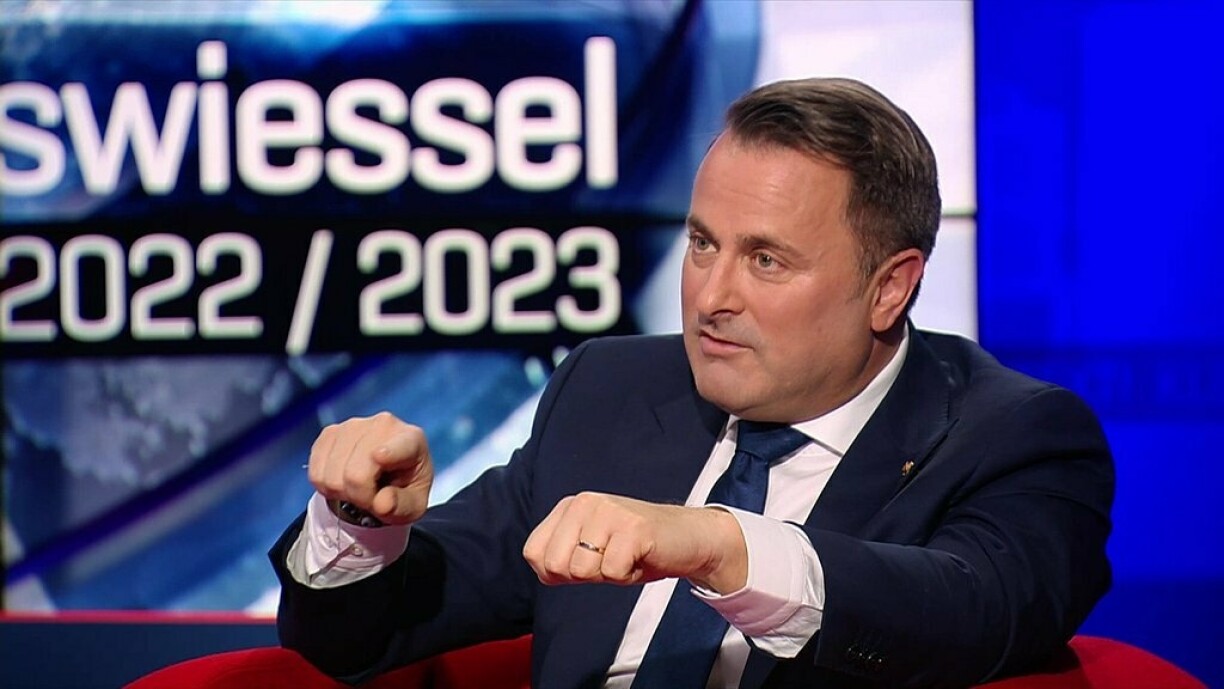
Both a political review and outlook, Bettel defended his policies over the last years and hopes the mood in the "government family" will not be negatively affected by the election campaign. This however did not stop the PM from issuing some critique of his coalition partners, in particular the socialist party LSAP.
Read a summary of the interview here
Bettel underlined that neither he nor his party were in favour of shortening the working week. The job market is already facing a scarcity of labour, and reducing working hours only exacerbates the problem: More people are needed, resulting in congestion and traffic jams.
Instead, he argued in favour of a more flexible approaching to working hours, which should be part of a 'menu' of adaptations to work which can be assembled in accordance with different situations.
This is something that LSAP Labour Minister Georges Engel approves of - however, he emphasised that flexibility must benefit both employers and employees, which he said is something that must be kept an eye on. A study was commissioned last year to investigate the advantages of disadvantages of reducing working hours. The results are expected early this year, but Engel does not yet know when the study will be published.
Bettel could not say whether a limitation on the current indexation mechanism would be an important subject for the upcoming elections, while emphasising that trade unions were strongly opposed to such a limit.
LSAP Vice-Prime Minister Paulette Lenert meanwhile is also against placing an upper ceiling on the current tool, but is open to a discussion on whether and how the index instrument could be reconsidered, as at least two wage indexations will be triggered in early 2023.
The LSAP minister also emphasises that the wage index should not be viewed in isolation and must go hand-in-hand with a tax reform. To redistribute wealth from top to bottom, she advocates for new tax brackets.
Read more:These things will change in Luxembourg in 2023
Although she has not announced her official run, Lenert had said that a priority for her as a potential Prime Minister would be administrative simplification. Bettel disagrees: "We have different priorities now. We have an energy crisis, we have a war. But I can tell you that if I remain Prime Minister, administrative simplification will not be a priority. Yes, it must happen...but we have other priorities now."Bettel criticised the pension fund for not having invested enough in the country's housing over the past decade. As he did not sit on the relevant committees, Bettel says he had no influence in the decision.
LSAP Minister of Social Security Claude Haagen emphasises upon request by RTL that the fund would also invest in housing and the construction of administrative buildings, holding up the Cité de Sécurité sociale as one positive example. Haagen says he has requested a Chamber debate on the investment policy of the pension fund.
Green housing minister Henri Kox also received criticism by the PM. The change in rental law was sharply criticised for pushing rent prices up and construction attractiveness down. Bettel says the communication was "not the most appropriate", especially as interest rates were extremely high.
Kox did not comment on Bettel's statements.
"Of course a liberal PM is not green", says Green party co-president Meris Sehovic. He responded to Bettel's comments that a transition to green finance and a more sustainable industry must be taken step by step, as a fast evolution could make investors turn their backs on the Grand Duchy.
Although the Prime Minister did not mention the Greens, his statements seem to be aimed at the smallest coalition partner. The Greens underlined that politics should take proactive responsibility for setting an economic framework. Above all, investments should be made in innovations so that Luxembourg is climate neutral by 2050, the party argues.
Full interview in Luxembourgish:





