The health crisis has aggravated existing inequalities. Pupils who were already at a disadvantage need special support, according to the latest National Education Report.
When it comes to the pupils' overall performance, the pandemic did not have too much of an impact, except for the German listening comprehension of students in Cycle 3.1.
Dr Thomas Lenz, the report's coordinator, explained that while the pupils' skills in reading comprehension and mathematics remained more or less on the same level, their listening comprehension, i.e. the skill which is more difficult to teach remotely, has suffered.
As for secondary schools, students enrolled in classic secondary studies ("Secondaire Classique") maintained a relatively stable performance, even showing improvements in French reading comprehension. However, this is in stark contrast to students enrolled in general secondary studies ("Secondaire Général") and especially those in preparatory courses ("Préparatoire"), who saw a decline in their school performance.
Read also: More pupils dropped out of school due to the pandemic
Dr Lenz pointed out that the report also revealed that students from more favourable socio-economic backgrounds received slightly more support from parents and/or siblings during the first phase of the pandemic.
Inequalities have also widened beyond Covid-19. The next education report will show whether public international schools can counter this. A recurring point of criticism in this context is also Luxembourg's focus on German as the language through which children are expected to achieve literacy, which the report once again criticises as "too one-sided".
Digitalisation was another key point in the report. While the fact that the Grand Duchy's schools are well equipped with digital tools and material has allowed Luxembourg to cushion the consequences of the pandemic, there is still room for improvement in pupils' digital skills.
Regarding sustainable development, the report determined that there are "good projects" in this area. However, the Ministry of Education has yet to introduce a "large-scale programme" in schools.
Minister of Education Claude Meisch announced that giving children and young people fair educational opportunities remains a priority, including a wider range of schooling in six public international schools. A seventh will open in 2022 in the capital. A first evaluation of this international school system can be presented at the end of 2022.
Meisch also stated that as of the 2022/2023 school year, monitored study sessions are to be guaranteed "systematically". The ministry's intention is to allow "every child" to do their homework "in peace" and receive help if necessary.
Read also: Minister Meisch presents ambitious goals for the future
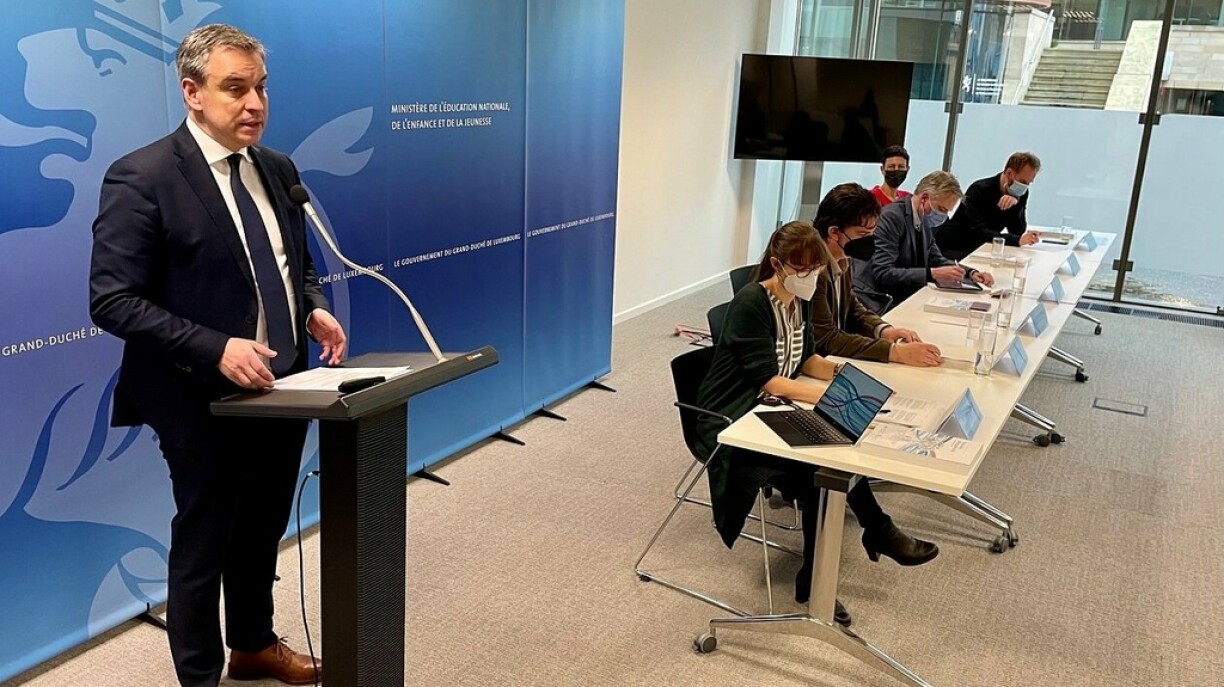
The National Report on Education is drawn up every three years by the University of Luxembourg at the request of the government. This is the third such report, which was presented on Thursday.
"Is Luxembourg's school system ready for the future?": The analysis focused this time on digitalisation, sustainable development, as well as the pandemic and its consequences on the school system.
More than 70 researchers contributed to the report.
Watch the full report in Luxembourgish below:





