Launched at the end of December, vaccination is now one of the main approaches being used to combat the coronavirus epidemic in Luxembourg.
The campaign started at a brisk pace with numerous healthcare professionals being invited over three days (1,251 people). The process then continued more slowly for a week (only 453 in the first week of January) before accelerating (2,053 injections the week of January 11th and 3,956 the week of January 18th). 18 January also marked the date when the first people began receiving their second dose of the vaccine: 1,244 doses out of the 3,956 mentioned above.
A number of internet users have since pointed out the supposed "slowness" of Luxembourg's vaccination campaign, which appears to be dragging behind its European neighbours. One person expressed this sentiment in a comment under an article on our sister site RTL 5 Minutes: "1 month = 1% of the population! Cool, we should all be vaccinated in... 8 years and 4 months! End of lockdown planned for the end of May... 2029". Another took a guess that everything should be back in order for "phase 18 in April 2028".
Are these gloomy projections reliable? On Thursday 28 January, exactly one month after the start of the vaccination campaign, Luxembourg had indeed vaccinated 9,890 people, 1,483 of whom had received their second injection. This represents about 1.57% of the country's population. At this rate, it would therefore theoretically take just over 63 months, or 5 years and 3 months, to vaccinate the entire population. Mathematically, the vaccination campaign would therefore be completed by the beginning of 2026.
However, it is very risky to make this kind of projection. As Minister of Health Paulette Lenert explained, Luxembourg has divided the vaccination plan into several phases. Six, to be precise. For the time being, these phases determine who will have access to the two doses of the vaccine, but not when. The reason why the Ministry of Health refrains from announcing a timetable, is because it is still impossible to know when the purchased doses will be supplied by the respective pharmaceutical groups. Although the contracts negotiated by the EU specify certain deadlines, there is always a possibility for production contingencies or an acceleration of production.
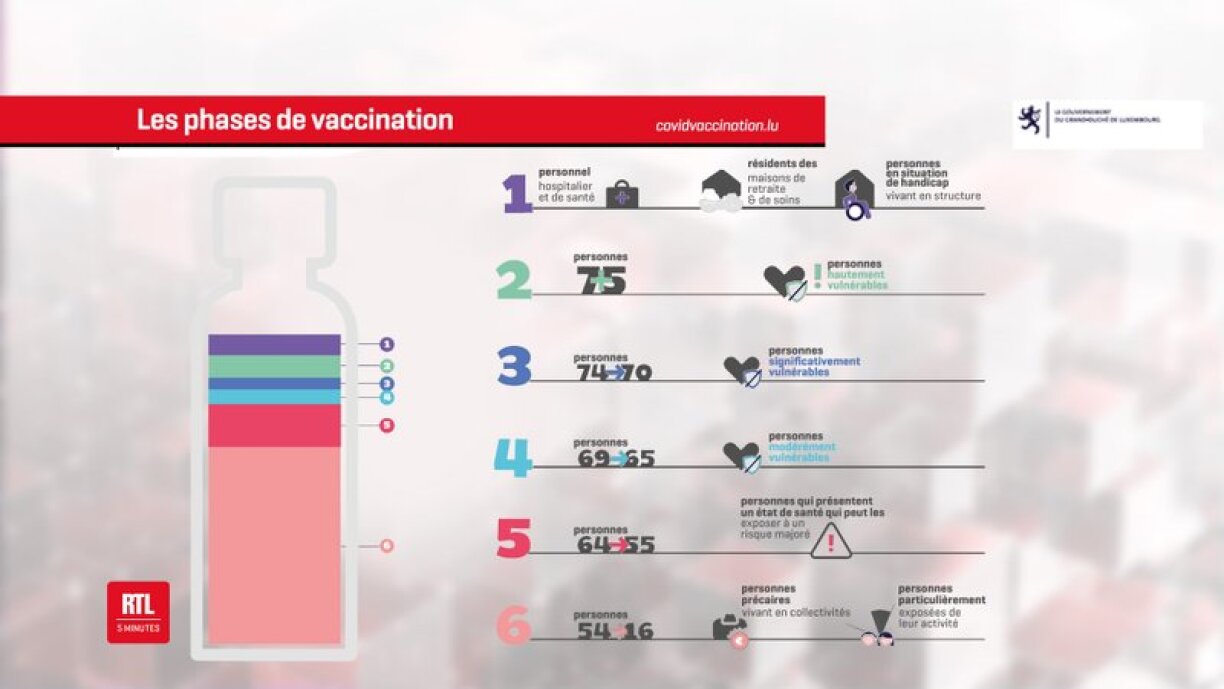
At this stage, it is expected that the first phase of the vaccination campaign, reserved for healthcare workers, will be completed by the end of March, or potentially even "sooner than expected", according to Lenert. By this date, Luxembourg should have received just over 86,000 doses from Pfizer/BioNTech and Moderna alone.
In addition to these products, it is the AstraZeneca vaccine – which has just been authorised in Europe – that should make it possible to increase the Grand Duchy's capacities in a few days.
More generally, the protection of the population does not depend solely on vaccination. Above all, vaccination is neither compulsory nor recommended for all residents. Those under 16 years of age, for example, are not included in Luxembourg's plan.
Several studies have estimated that people infected with the virus produce an immune response that can last for several months. A study carried out between November and early January estimated that around 7% of Luxembourg residents, i.e. around 44,000 people, had developed these antibodies. Twice as many compared to summer 2020. However, the duration of this protection is still uncertain. Until then, it is therefore imperative to hold up the social distancing measures recommended by the government in order to continually ensure the best possible protection from the coronavirus.





