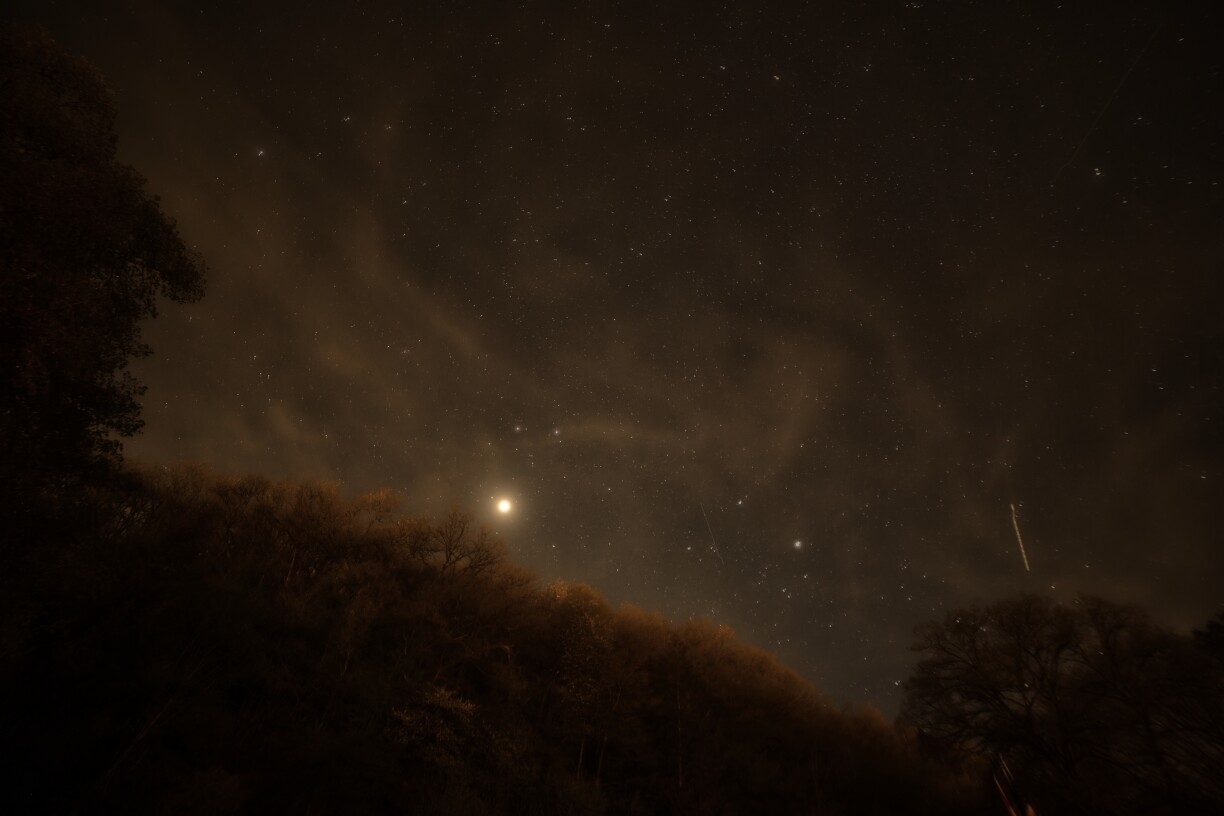
The spring constellations now take over completely. Leo stands proudly in the south, Virgo stretches across the evening sky, and Boötes climbs higher each night with brilliant Arcturus leading the way.
Above them, Ursa Major remains ideally placed, while the first signs of summer begin to appear later at night, especially in the east.
The slightly warmer evenings and gentler nights seem to invite longer sessions under the stars. In reality, however, the nights are shortening quickly, and true darkness is beginning to retreat.
But that is part of May's charm. It is the last full month of the year that still offers a real taste of dark skies before summer twilight starts to take over.
It is a time for looking up at the right moment.
May opens under the light of the Full Moon on 1 May, traditionally known as the Flower Moon. It is a fitting name for a time of year when the landscape is fully alive again, and under clear skies the Grand Duchy can take on a soft silver glow from dusk until dawn.
While the bright Moon washes out the sky for a few nights, it remains a beautiful target for photography. A full Moon rising above Luxembourg's Ardennes, southern fields or rolling hilltops is never wasted and can easily become the centrepiece of a striking composition.
Once the lunar glare begins to ease, attention turns to the month's first major event: the Eta Aquariid meteor shower, which peaks on the night of 5 to 6 May.
This shower is produced by debris left behind by Halley's Comet, which already makes it special. From Luxembourg, however, the radiant rises only modestly before dawn, so expectations should remain realistic.
Even so, under a darker rural sky and with a clear eastern horizon, patient observers may still catch a number of fast, elegant meteors in the small hours.
The first part of May is also the last truly comfortable stretch for enjoying the spring sky before the nights begin to shrink more noticeably.
The shift is particularly noticeable in the central part of the month. The New Moon on 16 May brings the darkest skies, but as the days get longer, the window of true darkness shrinks.
That said, this remains the best time of the month to leave the town behind and seek out darker areas in the north of the country.
Under a good sky, Leo, Virgo, and Boötes form the backbone of the evening scene, while the Beehive Cluster in Cancer remains an excellent binocular target before it sinks lower in the west.
Ursa Major is well placed, hosting some of the most striking galaxies visible through binoculars and small telescopes. Later in the night, the Hercules Cluster begins to rise, hinting at the richer skies of summer still to come.
Meanwhile, in the early hours of 14 May, a waning Moon passes close to Saturn, low in the eastern dawn sky. It's a rewarding sight for anyone awake early enough to catch it. Saturn is still rather low and softened by morning twilight, yet the pairing is attractive, especially through binoculars.
Another conjunction happens on the evening of 18 May, when the young crescent Moon appears close to Venus in the fading twilight, perhaps with some earthshine still visible. This should be one of the loveliest naked-eye sights of the month.
On the evening of 20 May, the Moon moves on towards Jupiter. The pairing is again striking, with Jupiter shining steadily nearby.
The last third of May is when the month becomes especially photogenic.
By now, spring is beginning to give way to the first hints of summer. Leo starts to drift westward, Virgo dominates the south, and Arcturus shines high and warm above the landscape.
Later in the night, the eastern sky begins to fill with the first clear arrivals of the summer season.
May then closes with another full Moon on 31 May. It is the second full Moon of the same calendar month: a Blue Moon. This one is also a Micromoon, meaning the Moon is near the more distant part of its orbit and therefore appears slightly smaller than average.
The difference is subtle to the eye, but it adds a satisfying astronomical twist to the month's finale.





