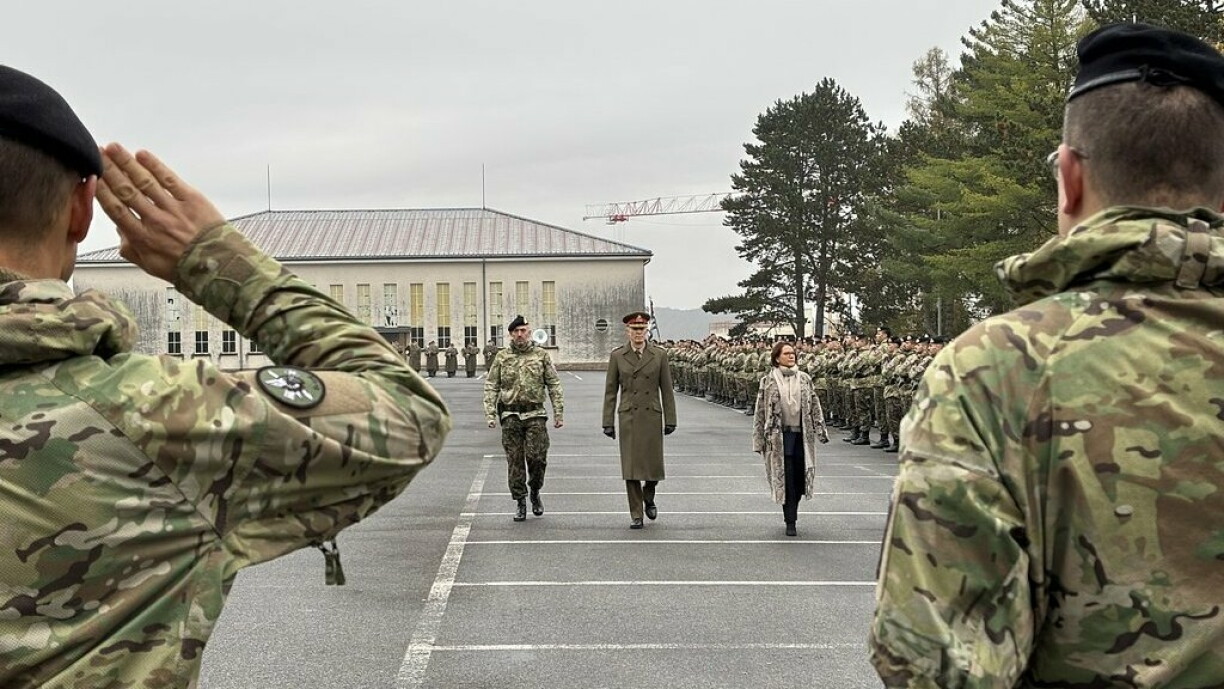
Defence Minister Yuriko Backes presented a new trajectory for Luxembourg's defence spending on Wednesday, laying out a more modest path than the ambitious targets the country had previously committed to.
At the 2025 Hague NATO summit, Luxembourg, the only NATO member to measure defence spending by gross national income (GNI), pledged to raise core defence spending "in the strict sense" to 3.5% of GNI by 2035, with an additional 1.5% in related security investments, bringing the total to 5%. Until Wednesday's announcement, however, the means of achieving this target had remained largely unspecified.
Prime Minister Frieden had laid the groundwork in his State of the Nation speech on Tuesday, calling for credible funding to underpin credible deterrence and suggesting that a budgetary path through to 2029 would shortly be set out, especially with the NATO summit in Turkey due in July.
What the government has now decided, as explained by the president of the Chamber's Defence Committee and Democratic Party (DP) MP Marc Hansen is an increase of 0.1% of GNI per year in 2027, 2028 and 2029, at which point NATO itself will conduct a midterm review. "The credible trajectory now foresees that 0.1% will be added in 2027, again in 2028, again in 2029, and then we would assess the path forward together with NATO", Hansen declared.
The approach is also designed, Hansen acknowledged, not to bind the next government, to be elected in 2028, to a pace it may not be able to sustain. The Christian Social People's Party (CSV) MP Nancy Arendt understands the approach, noting that the commitments made are firm and that the expense progression need not be strictly linear.
Green Party (Déi Gréng) MP Sam Tanson offered a mixed assessment. She acknowledged the fiscal reality bluntly: if the current trajectory is maintained, Luxembourg will reach 3.5% of GNI in defence spending by 2041, not 2035 as promised. "That is a fact that must be acknowledged", she said. At the same time, she admitted to finding the scale-back a positive change: "We find it rather positive that we are waiting a little longer and not simply pouring massive amounts of money into an arms industry. That had really worried us."
Luxembourg Socialist Workers' Party (LSAP) MP Liz Braz suggested that investing such large sums in so short a time would in any case have been difficult, pointing out that by 2029 pure defence spending will already exceed €1.6 billion per year. She also hinted that the government may be quietly counting on geopolitical change. "I sense that they are probably factoring in that by 2029 or 2030, changes may be coming from the other side of the Atlantic, and that NATO is speculating, not just in Luxembourg's case, that a future change of president in America will bring changes within the alliance."
Alternative Democratic Reform Party (ADR) MP Tom Weidig shared the suspicion that the government is banking on a change in the White House, but warned that Luxembourg's new trajectory may raise eyebrows for NATO member countries. He also broadened the defence debate beyond military spending. "What is most important is that we have a strong and flexible economy, a rational energy policy, energy self-sufficiency and low energy prices, and a strong sense of national identity, something that makes people say this freedom is worth fighting for. Those three things matter enormously, and I see the government here moving in the wrong direction."
Whether the slower defence spending trajectory will free up meaningful resources for the government's other priorities this legislative term remains to be seen.





