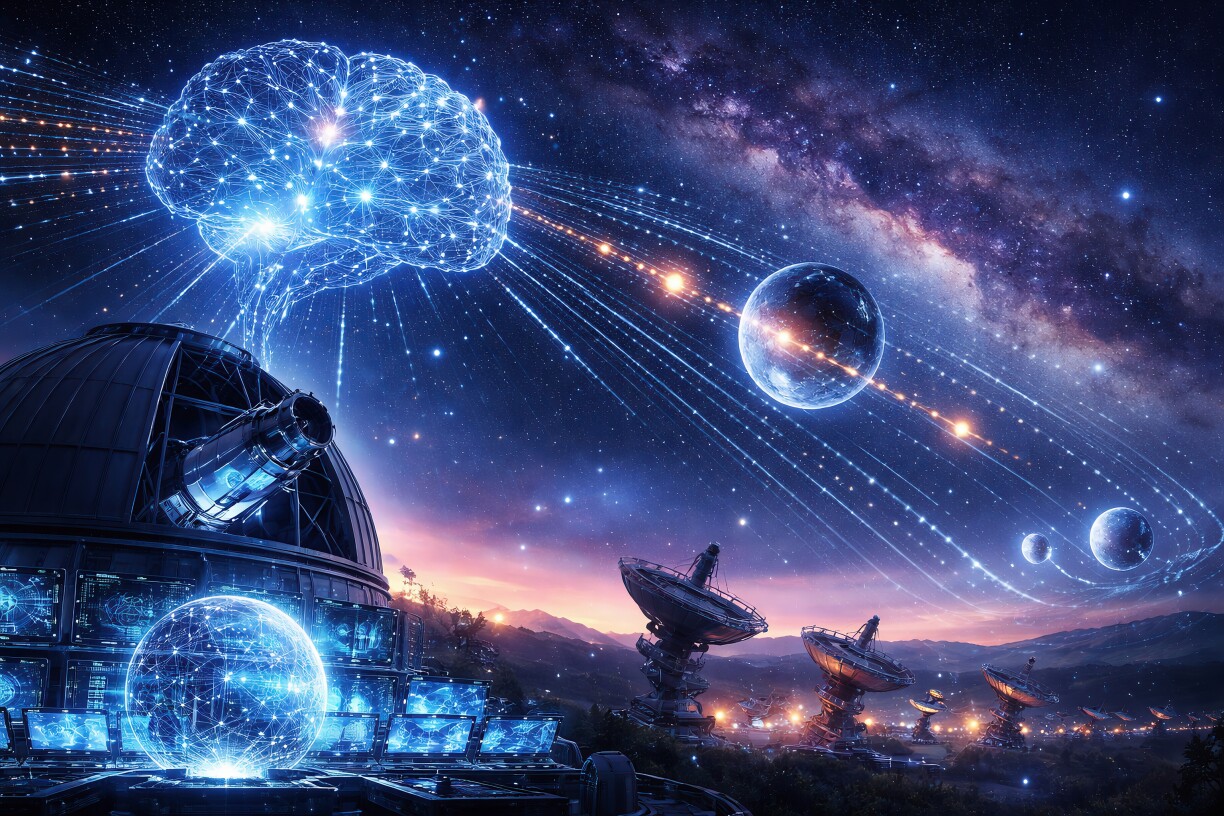
For most of the history of modern astronomy, discovering a new planet was a slow and methodical task. Scientists had to examine graphs, images and spectra with extreme care, often analysing the data by hand. Today, however, a quiet revolution is underway.
Artificial intelligence is increasingly taking on this work. Trained algorithms can detect exoplanets, classify galaxies and spot exploding stars before a human researcher has even opened the data file.
More and more often, machines are no longer simply assisting astronomers. They are leading the very first step of discovery.
During their survey of the night sky, modern telescopes generate torrents of data.
The upcoming Vera C. Rubin Observatory in Chile, for instance, will produce around 20 terabytes of data every night once its Legacy Survey of Space and Time begins full operations.
Over the course of a decade, it will repeatedly image the entire southern sky, creating one of the largest astronomical datasets ever assembled.
Similarly, the European Space Agency’s Euclid mission, launched in 2023, is mapping billions of galaxies across more than a third of the sky in an effort to better understand dark matter and dark energy.
No human team could manually inspect this volume of information; the scale is simply too vast. And as technology advances, the volume of data will only continue to grow.
This is where artificial intelligence becomes essential.
Machine learning systems are trained to recognise patterns within enormous datasets. In astronomy that might mean distinguishing a galaxy from a star, identifying the subtle dip in brightness caused by a planet passing in front of its host star, or flagging the sudden flash of a distant supernova.
For now, however, these systems do not truly “understand” what they are observing. They simply detect statistical patterns within the data, but in many cases that is already enough to reveal something worth investigating.
One of the most powerful applications of AI in astronomy is in the search for exoplanets.
Space telescopes such as Kepler and TESS measure tiny variations in a star’s brightness to detect the passage of a planet in front of it, which causes a small, periodic dip in light.
But stars are noisy objects. They flare, they pulsate, and the instruments themselves introduce their own imperfections.
Artificial neural networks are now trained on thousands of known examples of planetary transits. Once trained, they can scan new light curves and identify promising candidates with remarkable speed.
In recent years, AI systems have reanalysed archival Kepler data and uncovered previously missed exoplanets hidden within the noise. In other words, planets had been sitting there in the data for years, waiting for better algorithms to reveal them.
The Rubin Observatory will push this transformation even further.
It is expected to detect millions of transient events, supernovae, variable stars, potentially hazardous asteroids. Its automated systems will issue alerts within about 60 seconds of detecting something new or changing in the sky.
No human could react that quickly to every event. AI systems will decide which alerts are scientifically urgent and which are routine.
Astronomy is becoming real-time and algorithm driven.
However, there is a catch.
Artificial intelligence systems are only as good as the data used to train them. If they are trained mainly on certain types of stars, galaxies or planetary systems, they may struggle to recognise unusual or rare phenomena.
This is known as algorithmic bias.
In astronomy that could mean systematically overlooking exotic objects that do not resemble anything previously seen. The very discoveries that might lead to breakthroughs could be filtered out as statistical “outliers”.
There is also the problem of false positives. Machine learning systems can misclassify instrumental noise as a planet or a supernova, which is why human verification remains essential.
In this sense, AI does not replace astronomers: it reshapes their role. Researchers increasingly act as supervisors of algorithms, validating candidates, refining models and interpreting results.
The telescope is no longer the only instrument that matters. The code matters just as much.
Artificial intelligence in astronomy is not just an American story. In recent years, the European Space Agency has ramped up its investments in data processing, machine learning and large-scale surveys.
Missions such as Euclid rely heavily on advanced algorithms to process immense datasets and extract cosmological information with unprecedented precision.
European astronomers and data scientists are also at the forefront of developing AI tools for cosmology, galaxy evolution and planetary science.
Astronomy is becoming as much about mathematics and machine learning as it is about lenses and mirrors.
The next decade will see even more powerful surveys, larger datasets and more sophisticated AI systems. The challenge will be balance.
Scientists must trust algorithms enough to manage the data flood but remain critical enough to question their assumptions. Speed should not sacrifice scientific rigour.
And perhaps most importantly, we must ensure that curiosity remains human.





