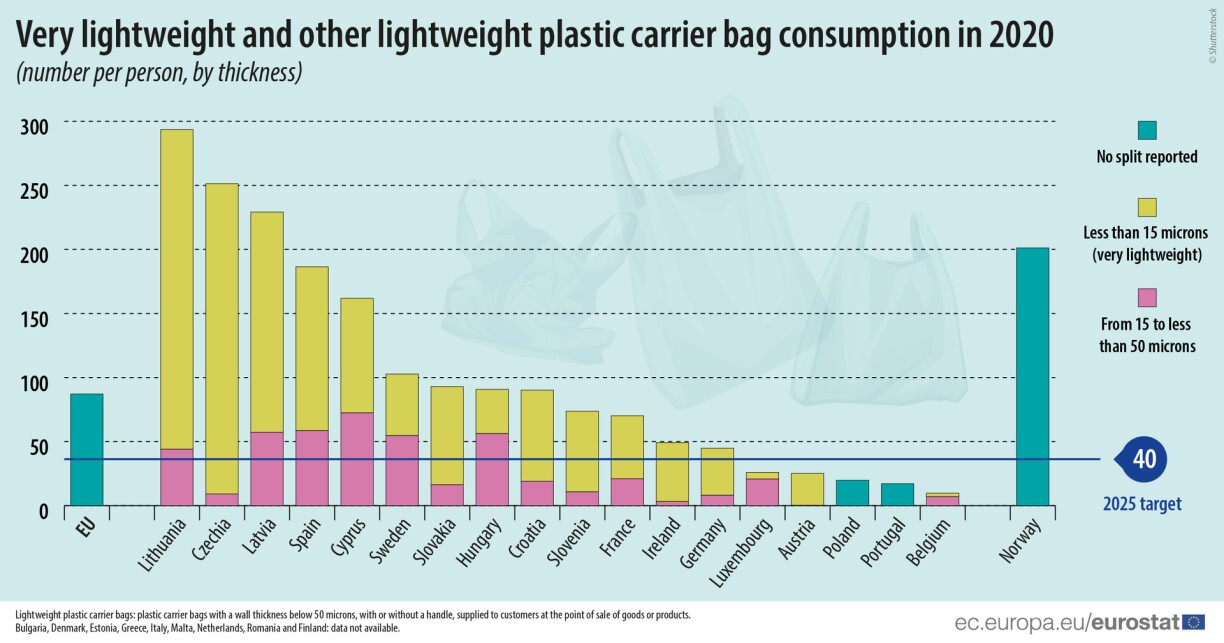
All shops in the Grand Duchy have been banned from distributing free single-use plastic bags as of 31 December 2018, and checks have been carried out to ensure that this rule is followed. This rule change appears to have had an impact as, according to Eurostat, the Luxembourg residents used 58.5% fewer plastic bags in 2020 than the year prior - and an impressive 76.5% since 2018, the last year before the ban was implemented.
Eurostat divide single-use plastic bags into two categories, namely those of a thickness of 15 microns or less, and those between 15 and 50 microns. The former, more light-weight bags have seen the biggest drop in use in Luxembourg: from 40 per person in 2019 to just 5.2 in 2020, a drop of 87%. Use of thicker bags also decreased, albeit more marginally from 22.7 to 20.8, a decrease of just over 8%.
Read also - Luxembourg Insider: Sustainable, ethical, and local shoppingLooking at the change from 2018 - the last year before the ban came into effect - to 2020, there was a drop of 93% (from 74.4 to 5.2) in the use of light plastic bags per person, and 42.5% (36.2 to 20.8) for thicker plastic bags.
Looking across the EU, the use of the lighter plastic bags has actually increased from 2018 to 2020: 14 billion bags were used across the union in 2018, and 14.7 billion in 2020. Use of the thicker bags have decreased however, from 22 to 19.9 billion.
On average, EU residents used 87 plastic bags (total of both types of bag defined above) in 2020, compared toLuxembourg's 26.
Overall, across countries that provided data, Luxembourg ranked 5th best in terms of limiting use of single-use plastic bags. The Grand Duchy was beaten by our neighbour Belgium (ranked 1st at 10 bags), Portugal (17), Poland (20), and Austria (25).
Read also - Do's and Don'ts: Reducing waste, plastic and otherwiseOn the other end of the spectrum are Lithuania (294 bags per person in 2020), Czechia (251), and Latvia (229).





