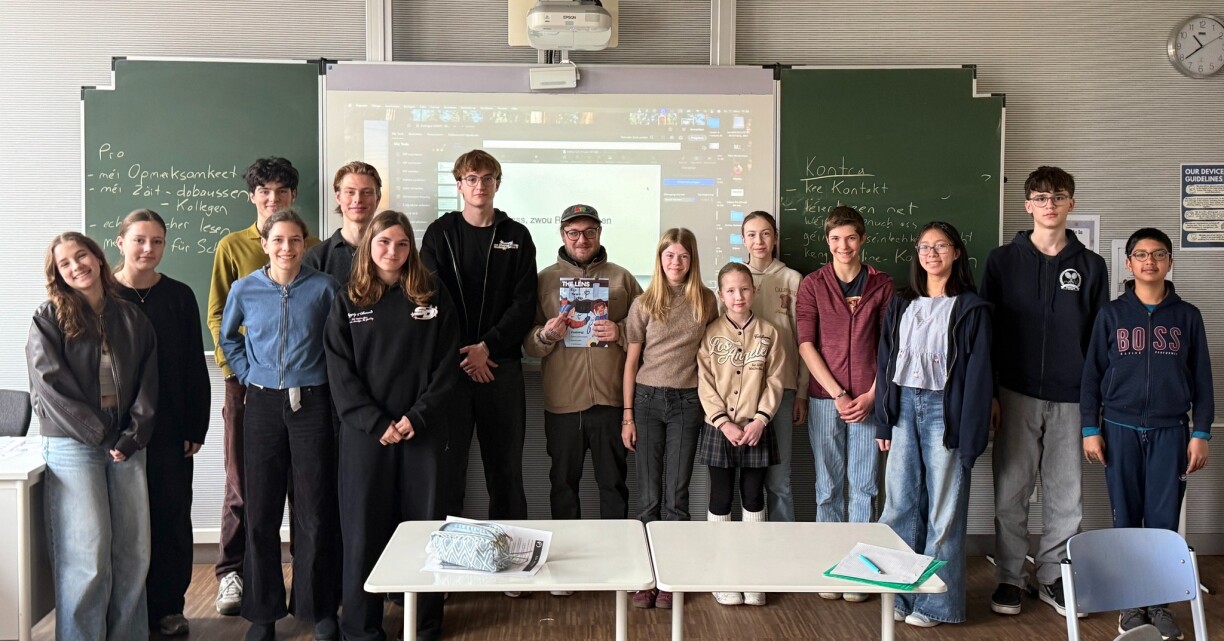
One of our colleagues from RTL.lu recently visited the Junglinster secondary school to discuss fake news, artificial intelligence, and other online dangers with students.
For several years, a number of RTL journalists have been travelling to school classes across the country as part of the Lie Detectors programme. The initiative aims to educate students about fake news while demonstrating how journalists work in a challenging media environment.
On 11 March, RTL.lu journalist David Winter visited the International School of the Lënster Lycée, specifically a class involved with the student newspaper The Lëns. Because the students had already gained prior experience in writing articles and were familiar with some of the challenges journalists face, their interest and curiosity on the day were particularly high.
The main focus was on identifying fake news through examples and exploring the tools available to recognise such content. In recent years, AI has become increasingly important in these courses, primarily because it is growing ever more difficult to determine with the naked eye whether something is authentic. While fakes were still somewhat recognisable two years ago, they are now sometimes completely indistinguishable from reality. Using concrete examples, students were shown how easily fake news can spread, and conversely, how difficult it is to detect, expose, and retract such misinformation.
Alongside the tools taught to debunk fake news, the challenges of journalism in this context were also highlighted and discussed. Through exercises, it was demonstrated how quickly journalists can make mistakes and, in doing so, "unintentionally" put false information into the world. Although there is a difference between targeted misinformation and unintentional journalistic errors, the end result for the consumer is unfortunately the same.


As part of the session, the class was asked to divide into two editorial teams. Both teams wrote about the same topic but for different audiences. During the simulation, it quickly became clear how differently the subject matter was ultimately treated and how easily a text can be steered in a particular direction.





