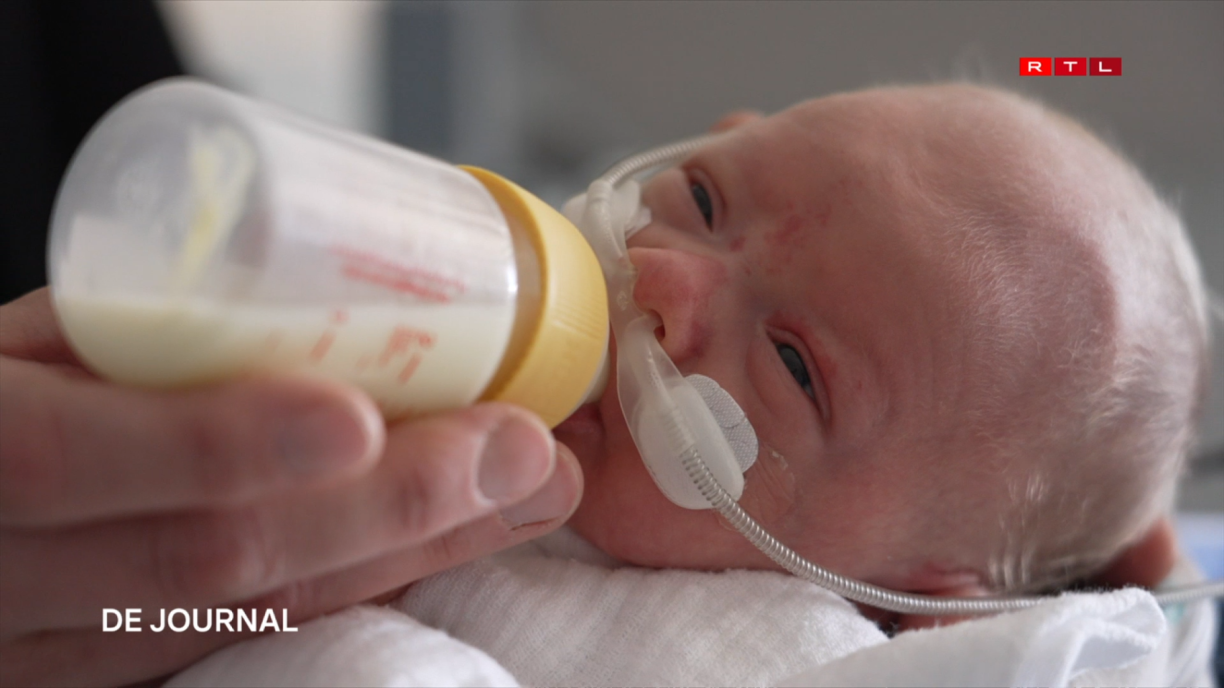
Breast milk is considered essential for newborns, and in Luxembourg the breastfeeding rates are among the highest in the region: almost 95% of women breastfeed in the maternity ward, and over 60% are still doing so four months after giving birth. But what happens when a mother cannot breastfeed, particularly after a premature birth?
Susanne Theewald experienced this first hand. After delivering prematurely, the psychological stress of the situation meant she was initially unable to breastfeed. For the first few days, her baby received milk from a breast milk bank.
"Breast milk is simply the most important thing", she said. "For a premature baby, in terms of immune system development and intestinal maturation, the immaturity means it is extremely important that there are no gaps and that the baby receives the most valuable nutrition available. That is why we made this decision."
The breast milk bank at the Mutterhaus Clinic in Trier collects donated milk from mothers who produce more than their own baby needs, making it available to premature babies and other vulnerable newborns.
Paediatrician Dr Kathrin Lorenz explained who benefits most. "A large part of development takes place outside the womb for premature babies, and they are the most sensitive and stand to gain the most from breast milk. They are the first to receive access. But it is also available for babies with serious conditions, such as severe oxygen deprivation at birth, also known as asphyxia, intestinal problems, malformations or severe intestinal inflammation. Children born with severe heart defects are also included."
Not every lactating mother can donate as strict criteria apply. According to medical specialist Bianca Mayer, potential donors complete a detailed questionnaire and undergo a blood test screening for HIV, hepatitis, and cytomegalovirus (CMV), in a process similar to blood donation. If cleared, donations are checked again for appearance and temperature before being accepted.
In Trier, women can donate from two weeks after giving birth until their child's first birthday, after which the composition of the milk changes, Mayer continued. At that point, the milk becomes saltier, richer in electrolytes, altering in its macronutrient profile, and making it less suitable for premature babies.
Donating mothers can either pump milk directly at the clinic or bring it frozen, provided it has been stored for no more than three months. Before use, all donated milk is pasteurised and decanted into small 50ml bottles to minimise waste. As medical specialist Bianca Mayer explained, premature babies consume very little per feed, and using larger bottles would result in wastage given that thawed milk keeps for only two days.
So far this year, 21 premature babies in Trier have already benefited from donated breast milk.
In response to a request for information, the Health Ministry explained that it is currently not possible in Luxembourg for a woman to donate breast milk to another's child.
Establishing such a system requires a sufficiently large and consistent pool of donors, mothers who breastfeed for an extended period and are willing to donate , in order to guarantee the stable and permanent supply needed for a milk bank to function reliably and fulfil its purpose.
That said, Luxembourg does invest exceedingly in supporting and encouraging breastfeeding. Hospitals and postnatal services are committed to maintaining high breastfeeding rates, particularly in the first six months. Labour law also enshrines the right to breastfeeding breaks and a suitable environment in the workplace.
The National Committee for the Protection, Promotion and Support of Breastfeeding, established in 1996, brings together key stakeholders and tracks developments through studies such as ALBA's study on nutrition for newborns. The figures reflect a positive trend: in 2023, 94% of women in maternity hospitals breastfed their babies, and 64% of mothers were still exclusively breastfeeding at four months.
By comparison, in 2015, the rates stood at 90.2% in maternity hospitals and just 33.1% at four months, suggesting that awareness-raising and support measures are having a meaningful impact.
The ministry noted that in the first six months of life, breast milk plays a particularly important role in the health and development of babies, especially those born prematurely or with a low birth weight.





