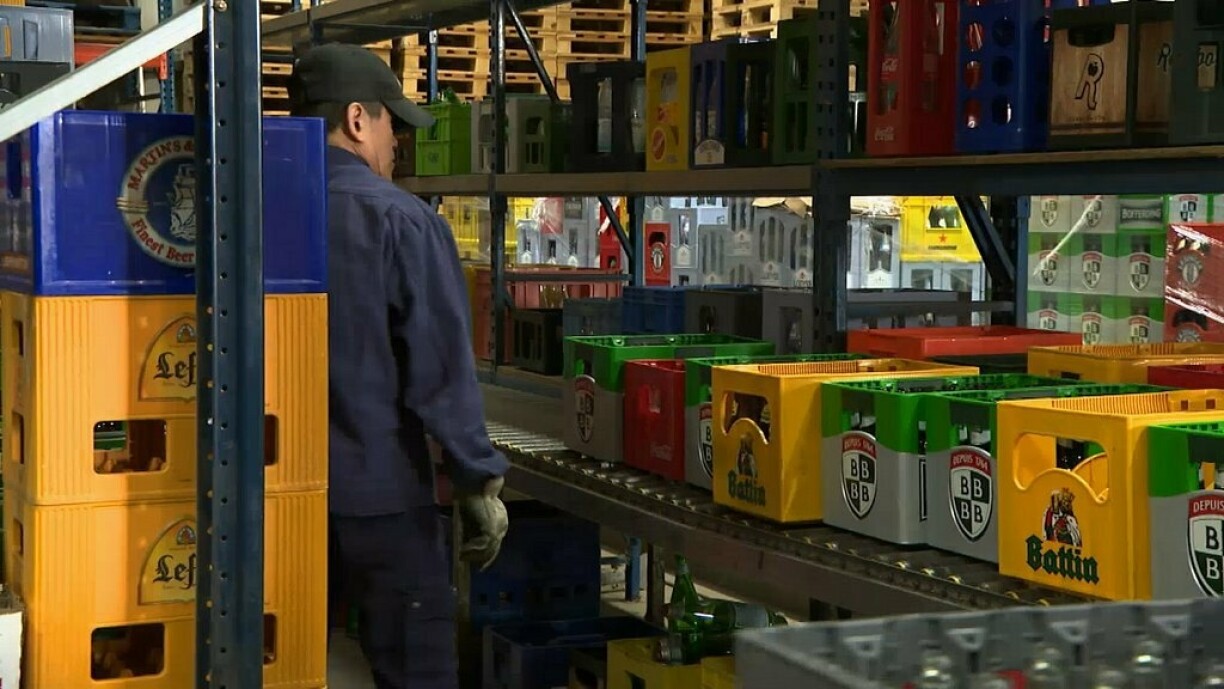
Rinse, fill, label, and return it to the supermarket – until the customer returns their empty bottles and the whole process starts again: That is the basic principle behind the deposit system in Luxembourg. At a brewery in Bascharage, all of this happens automatically and with enormous speed.
Each hour, around 27,000 beer bottles are filled. According to production manager Maurice Treinen, the company can fill up to 300,000 bottles on a good day. The rinse system alone, which is required when working with deposits, cost roughly €1.5 million - and yet it pays off financially.
According to Treinen, a bottle currently costs between 20 and 25 cents. "We have bottles that are over ten years old, so you can calculate for yourself how much money we save by doing this instead of always buying new ones," he says.
Approximately 80% of the brewery's beer products are sold with a deposit, either in reusable bottles or kegs that are rinsed and reused. The brewery's water brand, launched a few years ago, is sold only with a deposit. Before a bottle is returned to a supermarket, it is thoroughly inspected.
But before the used bottles arrive at the brewery, they must first be sorted in a different stage of the cycle. This happens in Ehlerange at one of the largest drinks suppliers in the greater region. Workers process around 10,000 crates a day. However, as logistics manager Fabien Stanczyk says, not every bottle makes it all the way to the end because it is not always easy for customers to distinguish which bottles come with a deposit and which do not.
Of course, not all bottles come from local producers. Foreign brands, such as San Pellegrino, also work with a deposit system. Those bottles have to travel long distances to be refilled. If a new delivery arrives from Italy, the lorry will take the empty crates with it on its return. This is an attempt at slightly reducing the impact on the environment, according to Stanczyk. As far as that is concerned, the situation has improved in recent years.
In general, it would be best to work locally and keep the distances as short as possible. That's where a deposit system makes the most sense.
But why doesn't the deposit system in Luxembourg go further? In Germany, for example, single-use plastic bottles and cans are sold with a deposit, with the goal being that less packaging ends up in nature and encouraging recycling. There have been demands for a similar system to be introduced in Luxembourg for years, but it is not so easy to implement, especially given that the majority of drinks sold in the Grand Duchy are imported from Belgium, as Claude Turping of Valorlux points out.
One problem with Luxembourg unilaterally introducing a deposit system is that the products that are made in Belgium and consumed here would have to have the respective specific marking that makes them recognisable to the deposit machine. Turping cautions that this could lead to people from other countries coming to Luxembourg with their bottles and exchanging them for the deposit value.
At the same time, cross-border business may suffer because it would no longer be cost effective for cross-border commuters to buy in Luxembourg if they had to bring the bottles back. In addition, there is the financial component of a deposit system - and this does not just include the expensive deposit machines.
Claude Turping: "Another aspect of the deposit that many people may be unaware of is the so-called financial clearing. This means that if a business sells a lot of products, at the end of the day it has the deposit in its cash register. Meanwhile, another business, has perhaps processed a lot of returns, and these deposits are then missing from their register. This must be financially balanced at the end of the year."
Nevertheless, Turping acknowledges that the benefits should not be dismissed either: less littering and more recycling. But he believes that a concept would have to be developed in collaboration with Belgium.
The Environment Agency confirms that it is already in contact with all concerned actors in the Benelux area to find the best possible solution. However, nothing specific has been decided yet, with the Environment Agency stating that it would like to wait and see what will be determined at EU level.





