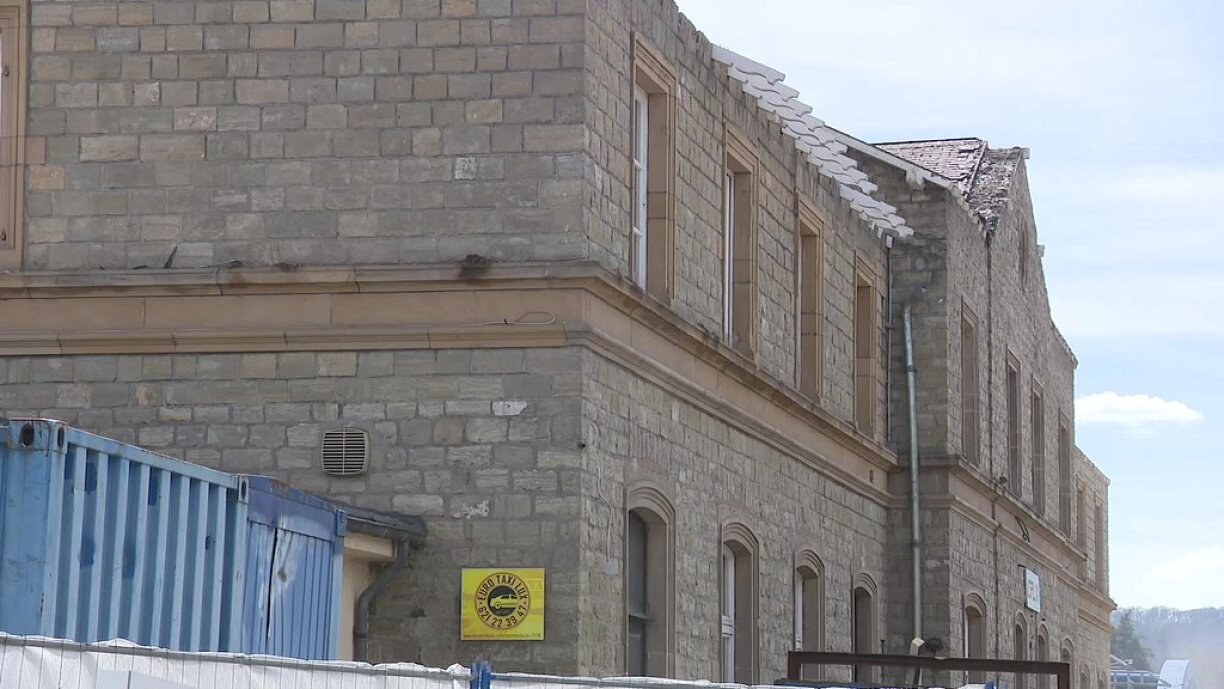
At the end of February, the Ministry for the Environment, Climate and Sustainable Development halted the operation temporarily as it still lacked the necessary authorisation in regards to environmental protection laws.
A new project was completed to ensure that swallows, which used to build nests in the building, now have an alternative and work on the building can continue.
The station building, which dates back to 1862, is expected to have completely vanished by July. Despite protests from preservationists, it had to make room for a new building, which is scheduled to be completed by 2030. Nevertheless, integral parts of the former building, including its stones, are set to be taken over by the future railway museum in Pétange.
Alessandra Nonnweiler from CFL's communication services provided insight into the relocation attempt: "Not far away from the station, we set up sound traps next to the Alzette, which mimic the voice of swallows and thereby help lure the birds to the new location."
The desired destination is a four-metre-high tower, about 250 metres air-line distance from the former train station building. A modern penthouse in an idyllic river-side location, ensured Nonnweiler: "We also saw to it that there is enough material so that birds can build their nests."
Our colleagues from RTL spoke to an expert about the likelihood of this somewhat artificial nesting area succeeding. Patrick Lorgé from the Ornithology Centre explained that much has to do with the males' ability to build nests that the females consider satisfactory.
He elaborated: "Building a nest is part of the mating ritual. Males can show their potential and the females then demonstrate their approval by choosing a certain nest to mate. The artificial nests that are being set up on location look promising, particularly due to the height."
Swallows are considered to be loyal to their breeding grounds. After coming back from Africa, they always choose the exact same spots. Whether or not the sound traps will be enough to attract them to the new location remains to be seen.
Lorgé noted: "It is not easy to resettle them. We already tried it a few times here in Luxembourg, but were never really successful. Still, successful attempts with nesting towers have been recorded abroad."
Over the past couple of years, the swallow population in Luxembourg has decreased between 20 and 30%. With the disappearance of old stone buildings, which are often replaced with modern and fully isolated alternatives, the birds have fewer nesting grounds. Furthermore, there are fewer insects on which the birds feed.





