
Here's 5 things you should know at the end of this week:


Despite an expected deficit of approximately €350 million by the end of the 2022 budget year, the central government reported revenue of €6.2 billion for Q1 2023.
Spending increased by 18.5% year-over-year to €6.3 billion due to a combination of factors, including financial aids for households and businesses worth €750 million, wage indexations, public investments, and the hiring of additional staff.
Government debt - The government debt currently amounts to €22 billion, which represents just over 27% of Luxembourg's GDP, slightly below the government coalition's 30% threshold. A loan repayment is scheduled for July, which is expected to reduce the public debt to approximately 24% of GDP.
In 2022 - 17,000 new jobs were created in Luxembourg, contributing to an increase in tax revenue for the government.
Tripartite measures - Despite difficult economic and geopolitical circumstances, the government and the social partners managed to agree on "measures related to jobs, purchasing power, and inflation that will strengthen the country," Backes said. The measures will cost a total of €425 million in 2023 and another €900 million in 2024. According to Yuriko Backes, this money is well invested.
Paying the price - "Yes, these measures come at a price, but this price is not too high," she stressed, pointing out that "the price of doing nothing would have been much higher, both socially and economically speaking."
'Structural challenge' - Backes also mentioned that the surplus in Luxembourg's social security system is gradually shrinking owing to demographic changes. "We are still expecting a surplus of over €1 billion in 2023, but this will drop to about half by 2027," Backes warned.
Artificially high prices - Regarding housing, the Minister stated that while the state wants to invest in housing projects, it is not its responsibility to guarantee profit margins to developers. "I'm not willing to use taxpayer money to artificially keep housing prices at a high level," she said, declaring that "solidarity is not a one-way street!"

Minister of Labour Georges Engel presented the study on Tuesday afternoon.
The study conducted by the Luxembourg Institute of Socio-Economic Research (LISER) also indicates that, depending on how a reduction in working time is implemented, it will have a wide range of effects.
Those include worker well-being, employment and unemployment, and the competitiveness of Luxembourg's businesses.
Decision not to attend - However, the representatives of the country's employers were absent for fears that relevant decisions have already been taken beforehand, which will prevent underlying discussions on the matter from taking place.
On Wednesday, UEL President Michel Reckinger accuses Minister of Labour Georges Engel of "pushing through the OGBL's agenda."
The employers' representatives did not attend the presentation of the study on the reduction of working time, arguing that the invitation arrived too late and that they did not receive any documents to prepare themselves. Reckinger criticised that there is no real dialogue with the Minister, pointing out that the latter said himself in a recent interview with RTL that he does not have to consult anyone to draft laws.
No need for further studies - According to the president of the Luxembourg Confederation of Christian Trade Unions (LCGB) Patrick Dury, there is no need to carry out further studies as this is already common practice in some collective contracts. He further said that social partners should have been included in the ministry's analysis as they are experienced in the rearrangement of work time and end up being the ones to implement them in practice.
Ambigious report - Before the presentation, Minister of Labour Georges Engel admit that the findings are "very ambiguous" in numerous respects and "not as clear as we had hoped."
The report does highlight, however, that care must be taken to ensure that a reduction in working hours really is a reduction in working hours and that people are not forced to cram the work done in eight hours into seven hours or fewer, or that they end up working overtime, Engel explained.
Who is in favour? - In his last interview with RTL, Xavier Bettel said quite clearly that there will be no 35-hour week with him as the next prime minister, even calling it a "no-go." In its last election programme, the LSAP called for a 38-hour week.
Other countries work less - Engel argued that "we have to address this question and not bury our heads in the sand," especially because people in neighbouring countries already work less. In Luxembourg, people work 1,701 hours a year, in Belgium 1,495, i.e., 25 days less than in the Grand Duchy.
Flexibility is needed - "We should not be discussing the reduction of working time, but the flexibility of working time," Michel Reckinger stressed, stating that he thinks this would be "in the interest of Luxembourg's competitiveness and attractiveness." For the same reason, the UEL president advocates for a modernisation of the labour law.
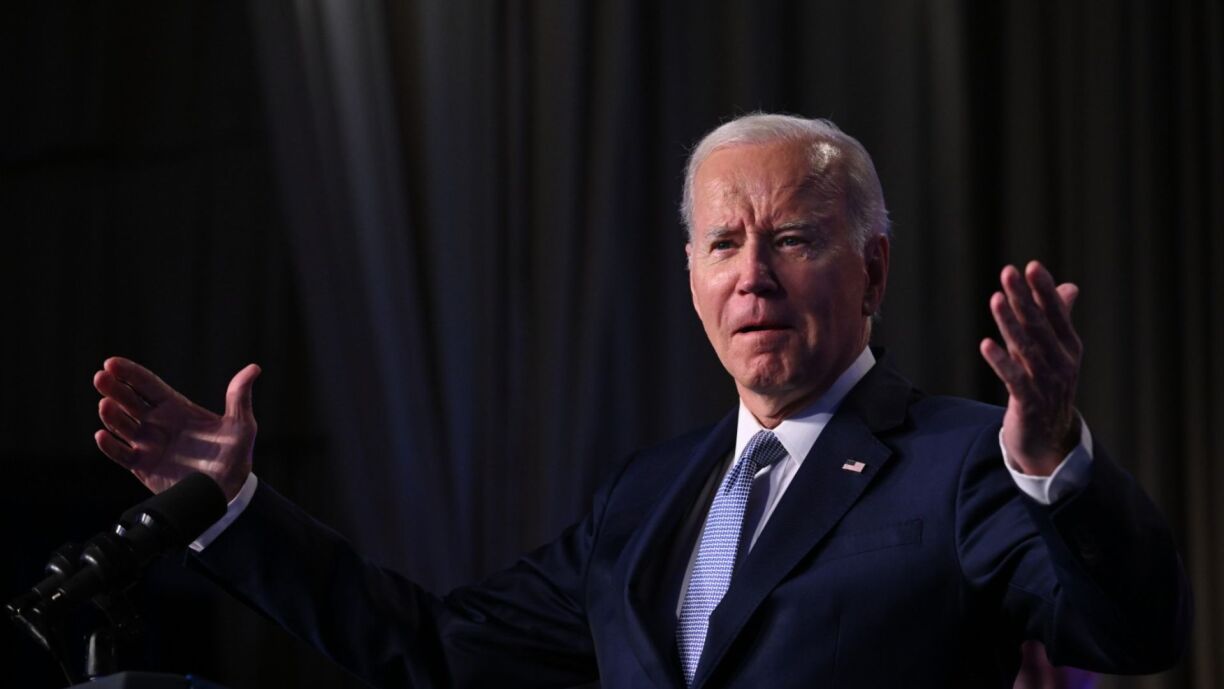
US President Joe Biden announced Tuesday his bid "to finish the job" with re-election in 2024, plunging at the record age of 80 into a ferocious campaign that could set up a rematch against Donald Trump.
After a series of big domestic legislative wins, a strong economic recovery from the Covid pandemic, and momentous foreign policy struggles, Biden has no real challenger from within the Democratic Party.
Video pitch - On the fourth anniversary of the day he first began his 2020 challenge against Trump, Biden said he was still fighting to save American democracy from Republican "extremists."
Is Biden too old? - He made no reference to the age issue in his video, although a segment near the end showed him grinning and jogging into a public event.
Biden likes to answer those concerns by saying, "watch me" -- meaning voters should focus on his policy wins at home and his marshaling of an unprecedented Western alliance to help Ukraine defend itself against Russia's invasion.
Kamala Harris in the spotlight again - Vice presidents are often an afterthought in Washington, but with Biden smashing previous age records in the Oval Office, the three-decades-younger Harris will go into the election under searing scrutiny.
Reminder - In November 2021, when Biden went under anesthesia for a routine colonoscopy, the United States had its first female acting president for 85 minutes.
Polarizing Americans - Harris, 58, has already brought a wind of change to the White House. She's not only the first woman ever in the job but the second person after Barack Obama to hold either of the top two executive spots who was not white.
On the Republican side - Trump, despite becoming the first former or serving president to be criminally indicted -- and still facing probes into his attempt to overturn his loss to Biden in the 2020 election -- is the overwhelming Republican frontrunner.
Read also: Joe Biden - racing against a time to 'heal' a broken nation & Defiant Trump warns of 'anarchy' if US relects Bidenhttps://today.rtl.lu/news/world/a/2055960.html
The European Commission has designated 19 large online platforms that will fall under stricter regulatory rules for content and battling disinformation and hate speech.
A new supervision system will be set in place to track failure in compliance.
Who is concerned?- 19 platforms that have more than 45 million monthly users are going to be subject to the new laws. Most of the companies on the list are US-based (Twitter, Instagram, Amazon, Microsoft, Google, Meta, and many more), but Chinese giant TikTok and e-commerce site AliExpress also feature.
What is going to happen? - Those platforms now fall under a new EU law, known as the Digital Services Act (DSA), one of two major laws the EU passed last year to rein in digital platforms to protect EU users. It imposes measures such as annual audits and a duty to effectively counter disinformation and hate content.
A supervision system will be set in place to check company compliance. These rules will apply from February 17, 2024.
The second law, the Digital Markets Act, prohibits anti-competitive behaviour by so-called "gatekeepers" of the internet. This means that business users who depend on gatekeepers to offer their services in the single market will have a fairer business environment.
The goal - The major objective of the new regulations is to force platforms to better protect children, strengthen transparency around digital services, prohibit the sale online of unsafe goods and allow users to have greater choice when online in the EU.
Furthermore, the rules allow the EU to impose fines of up to six percent of the platforms' annual global sales for repeated non-compliance.
Deadline- By August 25, 2023 the 19 platforms must have an independent compliance system in place and give their first annual risk assessment to the European Commission. This includes a plan on how they handle content on mental health and gender-based violence.
Throwback - Since November 2022, Chinese giant TikTok, has been facing increasing Western backlash after the company admitted some staff in China can access the data of European users. Thus the European Commission has banned the app on work devices in February 2023. As of today, Luxembourg has not followed this lead. The new DSA laws help to smoothen this discrepancy through improved data transparency.

Chinese President Xi Jinping spoke with his Ukrainian counterpart Volodymyr Zelensky by phone on Wednesday, the first known call between the two leaders since the start of Russia's invasion.
Beijing says it is neutral in the Ukraine conflict and Xi has never condemned the Russian invasion, but the Chinese leader has come under increased pressure from Western nations to step in and mediate.
Communication - Zelensky has said repeatedly he would be open to talks with his Chinese counterpart, and Wednesday's telephone call "was initiated by the Ukrainian side", Yu Jun from China's foreign ministry told a press conference.
'Only way out' - Chinese state broadcaster CCTV reported that during the call -- which was initiated by Kyiv -- Xi told Zelensky that "talks and negotiation" were the "only way out" of the war.
'Messing up' - In reaction to Wednesday's call, the Russian foreign ministry said, "the Ukrainian authorities and their Western minders have already shown their ability to mess up any peace initiatives".
Is China neutral? - Many pointed to the fact that Xi had met with Putin but not even called Zelensky as evidence that China was not the impartial observer it claimed to be.
Read also: Can China bring peace to Ukraine?
Business & Tech - The EU on Wednesday is to unveil a long-awaited proposed reform of legislation governing pharmaceutical drugs to make them cheaper, prevent shortages and speed up delivery of new compounds.
Science & Environment- Australia's media watchdog has rapped the climate coverage on Rupert Murdoch's Sky News, finding multiple inaccurate and unfair statements that led to breaches of broadcasting rules.
Entertainment- Jury selection began Monday in a trial to determine whether British pop star Ed Sheeran plagiarized American music legend Marvin Gaye's "Let's Get It On" in his 2014 hit "Thinking Out Loud."
'Totally lying' - Jury selection started Tuesday in a civil trial pitting Donald Trump against a prominent former American columnist, who says he raped her in the 1990s.
Border region - Following the success of a pilot project in Trier, the German federal state of Rhineland-Palatinate intends to install "Monocams" - mobile speed cameras that can detect if drivers are using their smartphones - across its territory.
Cable television news - Fox News star host Tucker Carlson is leaving the influential conservative TV network, it was announced Monday, in a surprise move days after the outlet was forced to pay a huge financial settlement to end a defamation case.
Survey results - On Monday, Minister for the Civil Service Marc Hansen presented the results of a recent survey that outlines people's satisfaction levels around public services offered by the Luxembourg government.

Your Weekly Recap is published every Friday at noon. Read earlier versions here.
If you have any comments, questions, concerns on improving the Weekly Recap - contact me at alannah_meyrath@rtltoday.lu





