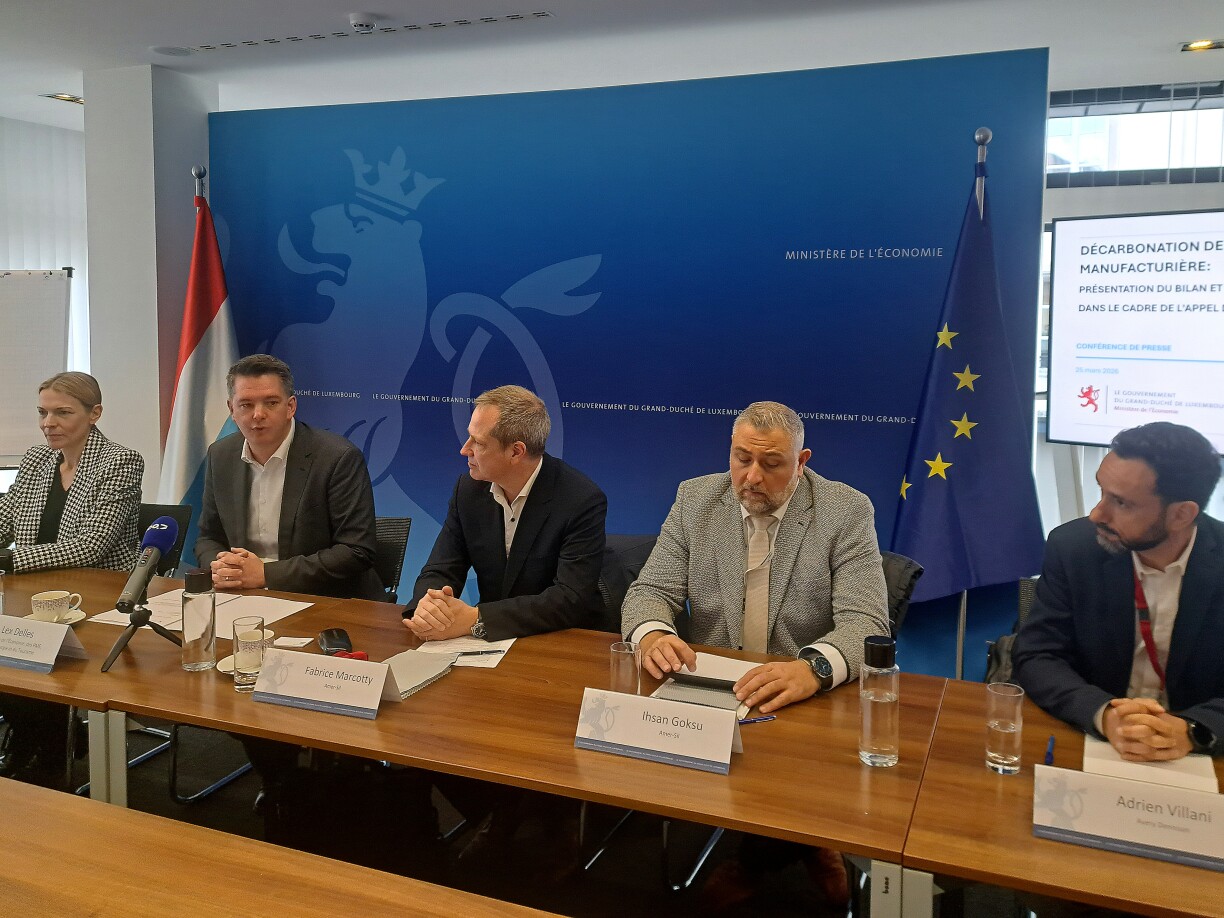
The Luxembourg Ministry of the Economy launched a call for projects in 2025 to support companies in their decarbonisation efforts. The initiative targeted manufacturing firms based in Luxembourg, with six projects ultimately selected and awarded a total budget of over €102 million. The aim is to significantly reduce CO2 emissions while strengthening industry resilience to energy price fluctuations.
In Rodange, Avery Dennison is already putting this transition into practice. The company produces labels used on bottles and other packaging, with nearly one in two supermarket products featuring its labels. As part of the project, some gas-powered heating systems will be replaced with electric alternatives.
Adrien Villani, Director of Digital Transformation at Avery Dennison, said that one production machine will switch from gas to electricity, reducing CO2 emissions by around 1,600 tonnes per year. The installation is intended as a pilot, with the potential to extend electrification to other parts of the production process in future. The company considers these changes part of a broader industry-wide strategy.
For Avery Dennison, decarbonisation is an environmental priority as well as a business opportunity. Villani said customer expectations are increasingly driving demand for lower-emission production. Electrification could also reduce dependence on volatile fossil fuel prices and improve security of supply, Villani added.
In total, seven companies responded to the call, with six projects selected based on their potential to reduce emissions and make efficient use of public funds. The projects are expected to cut emissions by around 27,000 tonnes of CO2 per year, roughly equivalent to the annual emissions of 12,000 cars. Over a ten-year period, this could rise to nearly 277,000 tonnes.
Economy Minister Lex Delles said the initiative creates a two-fold opportunity to reduce emissions as well as strengthen Luxembourg's energy independence in the context of unpredictable global energy supply chain shocks. The minister also noted the importance of supporting businesses by reducing their reliance on international oil prices or geopolitical tensions.
The government is focusing on a combination of electrification and renewable energy development to ensure long-term supply.
Companies have three years to implement their projects, with subsidies tied to results. Financial support may be reduced if targets are not met. The approach is designed to guarantee that public funds are invested effectively in sustainable projects.
For companies like Avery Dennison, decarbonisation is both an obligation and an investment in the future. The shift is key to protecting the climate, competitiveness and energy independence, putting the Grand Duchy well on its way towards an industrial transition.





