Does the field of forensics resemble what is shown on TV with shows like CSI Miami? Or is it completely different ? To answer this question, we started our own investigation and spoke to forensic expert, Anne De Bast.
Anne De Bast is a legal expert specialising in DNA identification, and works in Dudelange at the National Health Laboratory (LNS). During criminal investigations, when the police discover evidence that could potentially reveal the identity of the perpetrator, the Forensic Genetics Service, where Anne De Bast works, is often called upon to analyse markers found at the crime scene.
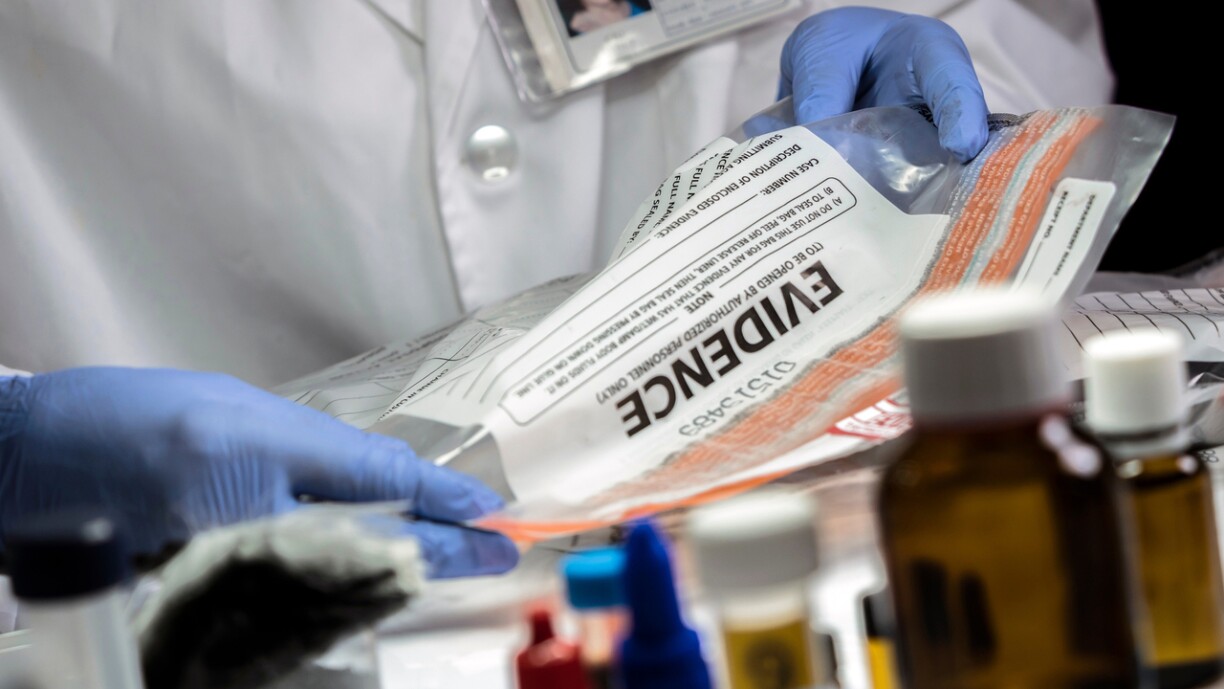
In some cases, evidence can take the form of bloodprints, pieces of clothing, and other items that we cannot mention here. All of this is sent to the laboratory for analysis and Anne's role is to extract as many DNA leads as possible from the collected evidence and establish a DNA profile. This profile becomes a crucial tool in hinting at a concrete identity.
Such an analysis is ordered by the Public Prosecutor's Office.
Indeed, with their work in DNA identification and forensic analysis, Anne and her colleagues play a crucial role in solving cases and bringing justice to light – they are an important piece of the puzzle that is criminal investigation.
Their role extends beyond establishing identity profiles through DNA analysis. Forensic experts also receive evidence and proof from suspects for comparison with the not-yet identified materials found at the crime scene.
It is crucial to emphasise that forensic experts do not have the authority to make definitive judgments. Determining guilt or innocence is the responsibility of the police. Forensic experts only focus on establishing a DNA profile and assessing the degree of correlation between a person's DNA and the discovered evidence.
Every DNA profile generated at the National Health Laboratory is systematically recorded in a centralised database managed by a specific police department in Luxembourg. Anne highlights that "this is an advantage. Everything is kept in the same place, which means that an unknown profile can be compared with every single catalogued profile in Luxembourg."
Such procedures can even potentially trigger a cascade effect. The analysis of a single piece of evidence has the potential to contribute to the resolution of 10 or 15 cases. This efficacy can be attributed to the likelihood that perpetrators tend to leave DNA traces at multiple crime scenes.
In Luxembourg, cases can even be solved through the exchange of DNA profiles between European countries. If a criminal commits a crime in another country (such as breaking in to steal money), the information can be shared among various countries.
Luxembourg is also part of the Prüm Convention, a collaborative agreement among various European countries aimed at enhancing cross-border crime fighting and cooperation. Currently, there are 23 signatory countries involved. The extensive collaboration and the wealth of data available for comparison enable authorities to potentially establish profiles of criminals who may not have been identified within Luxembourg.
The work of forensic analysts carries significant responsibilities, and the margin for error is non-existent. "We have to be very careful when handling evidence, and avoid contamination. In a criminal investigation this can have enormous consequences. One simple mistake can lead to innocent people being wrongfully sent to prison and to guilty people walking away freely. Mistakes simply cannot be made."
This is the reason why everything is documented. The commitment to precision in forensic operations extends to every detail, including the coming and going of staff members. You have to go to the lab as an external worker for cleaning or repairs? Then you must leave a small DNA sample. This precautionary measure is in place to enable the traceability of DNA back to the specific employee or worker, ensuring accountability in cases of potential cross-contamination. Carefulness is essential, given that the traces of DNA discovered on crime scene evidence are limited.
"Very often, it’s already very hard to work with the limited amount of material we have. If there is cross-contamination from a staff member, our work becomes even more difficult and complex."
While the majority of the evidence processed by the team pertains to criminal activities, specific analysis such as paternity tests are quite rare.
Currently, most cases involve break-ins, theft, or a combination of both. However, as Anne highlights, there has been an increasing frequency of cases involving physical violence.
LNS biologists exclusively examine repeated DNA sequences. [Editor's note: These are also called non-coding sequences, meaning they do not code for physical characteristics in an individual like eye colour, hair colour, height, etc.] Coded sequences are not analysed. The selection of analysed sequences adheres to international standards, allowing for profile comparisons without divulging additional information.
Despite the wealth of information that DNA analysis can offer (such as underlying illnesses, etc), strict privacy laws govern the use of such data. The LNS is obligated to comply with these laws, ensuring that information catalogued in the police database remains confined to its designated purpose and cannot be used elsewhere.
For a long time, this wasn’t the case in the USA. The evidence was completely taken apart and everything was analysed and documented. Insurance companies would then use the information to withhold services to the person because they had access to the information about the person’s predisposition for certain illnesses.
In Luxembourg and in other countries, the aforementioned law exists to prevent such situations.
In Luxembourg, even the use of photofit pictures, permitted in other countries, is prohibited. These pictures typically use DNA information to create a composite portrait of a suspect, and include details like hair colour, eye colour, and skin colour.
As you can see, not everything depicted in TV shows or movies holds true to reality.





