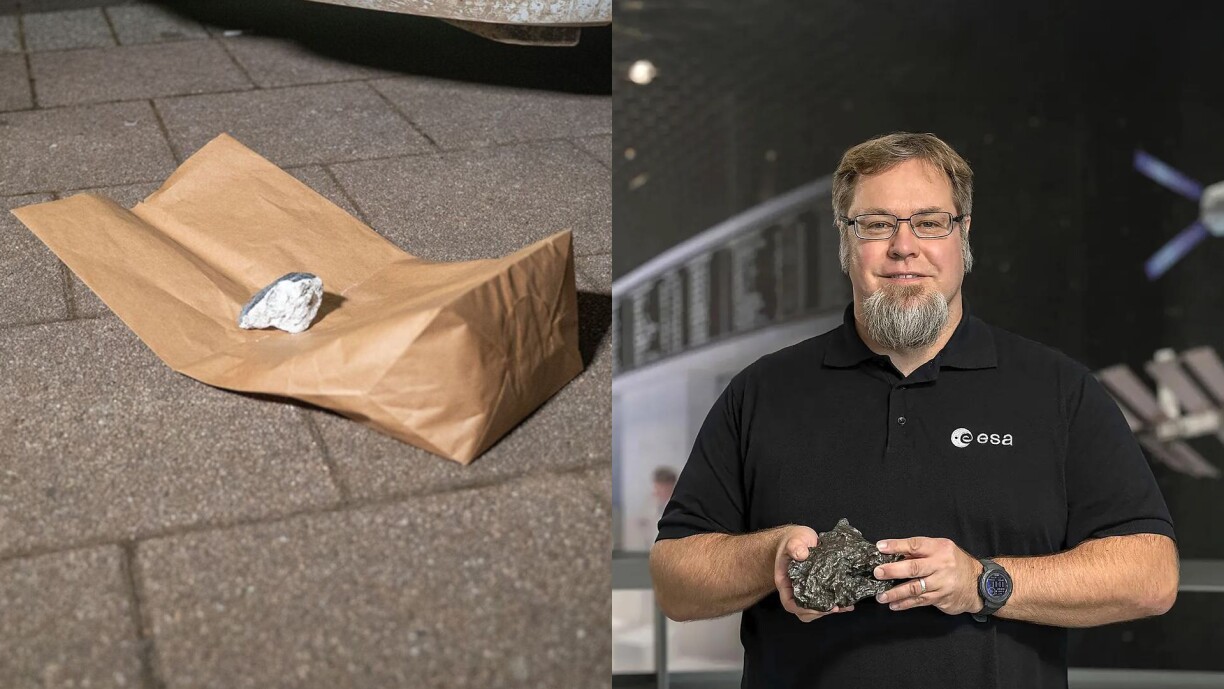
Dr Richard Moissl, Planetary Defense Officer at the European Space Agency, said the meteorite which was spotted across Luxembourg and Germany on Sunday night was not of insignificant size: "Through the visible trail, the condensation trail in the sky, the long duration of light and the reports of audible effects, it quickly became clear that this was not a small meteorite. A colleague of mine said he has seen fireballs in the sky before, but this was much bigger. We estimate the object was over a metre long, in the low single-digit metre range in diameter."
A meteorite like Sunday's falls roughly once a year, or every few years. The size of it alone means it is relatively rare. However, in spite of the excitement, in Koblenz pieces of the meteorite landed on a building. Is this dangerous and should the public be warned?
"We classify them as dangerous when they're more than 10 metres – that's when these meteorites can cause significant damage to buildings, when they are larger masses. The time and direction from which this meteorite came made it difficult to find, as it was after sunset and from a south-westerly direction. We need to clarify if we could have found it, or if it came too far from the daylight-side of the Earth, which means we weren't able to spot it in time due to the sun's rays."
A similar example occurred in Russia in 2013, when a meteorite landed in Chelyabinsk that February. No one saw that one coming either.
If experts had seen the meteorite coming they could have sent a message to the public. The ESA is currently in the process of developing an early warning system for space under the name 'Neomir'. This will consist of a space telescope which will patrol between the Earth and the sun, to detect objects travelling towards Earth, said Dr Richard Moissl.
Dr Moissl said he was not a legal expert but in theory, if the meteorite is accessible, then it belongs to whoever finds it. If it is buried in the ground, however, then it belongs to the owner of the land, according to German law.





