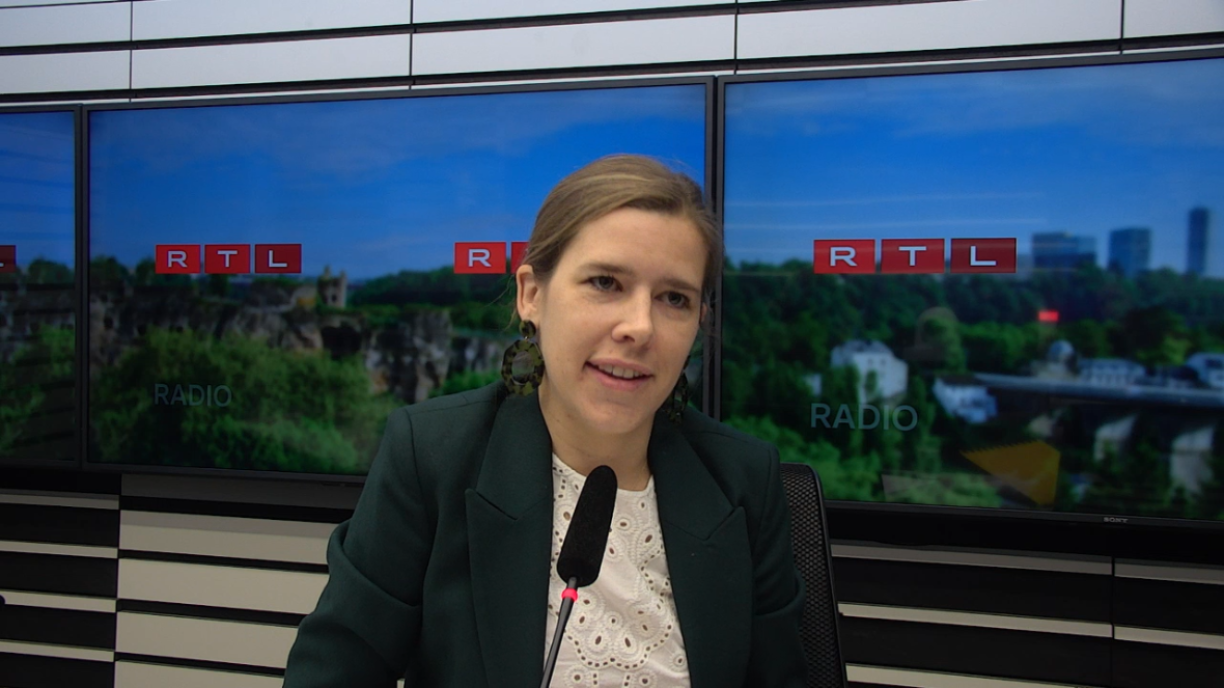
Over the last two years, the Grand Duchy's prison population has steadily grown, resulting in the need for action, Margue said. She pointed out the continuous recruitment in the sector, as well as plans for construction to address the issues.
On Monday, the president of Association of Prison Officers of Luxembourg (AAP) highlighted problems with understaffing, as full prisons and stretched staff have led to attacks and other security issues. Margue said 60 additional hires had been planned for 2024 to 2026.
Margue said the penitentiaries in Schrassig and Uerschterhaff were not "full" but that the number of prisoners has been steadily increasing in recent years. She attributed this to the increase in police recruits, leading to more investigations and arrests.
As for safety, the new prison laws will give prison officers more means to address issues such as drugs in prison. One major issue is the supply of spice (a synthetic cannabis variant) to prisons via post. The use of pepper spray is also to be implemented soon, provided officers receive the necessary training. Association president Samir Djennas told RTL on Monday that prisons had pepper spray in stock but were waiting to use it while they gathered dust.
Margue explained there had been a technical issue with training materials which led to the delay, but it would shortly be rectified and the pepper spray plans could continue.
When asked for comment on the recent stabbing in a school - in which a 14-year-old girl ended up in adult prison after attacking a classmate with a knife - Margue said: "No one is happy when a young person is put in prison". The Unisec juvenile centre in Dreiborn has just 12 spaces, so it fills up very quickly. In exceptional cases, especially when a young offender is violent, they are placed in Schrassig. But special care must be taken to ensure they have the necessary supervision.
Margue explained the justice ministry was waiting impatiently for the Council of State opinion on the amendments submitted for the youth protection and juvenile criminal laws. "We are waiting, a bit confused and with some desperation, for this project." The amendments were submitted to the Council of State last May.
"It really needs to be a priority because we need to be able to work differently, especially with young offenders, as we have no juvenile criminal law. We need other guarantees. The juvenile criminal law provides other punishments and guarantees."
The new laws foresee alternative measures, with incarceration as a last resort. It would also mean that the age of legal responsibility would be definitively set at 13. The site in Dreiborn is also set to be converted into a juvenile prison, alongside another construction project which hopes to add 30 spaces by 2031.
The CSV-DP coalition manifesto promised immediate appearance, a procedure in which a suspect would be immediately taken to court following their arrest, resulting in a quick verdict. The aim of this sped-up procedure is to provide a quick response to crimes, but also respect the "rights of the defence". In April, another meeting between the justice authorities and the Luxembourg bar council will take place, prior to submitting a bill.
"The idea is not to get offenders in court within two days, as I believe that would be difficult in terms of respecting the rights of the defence. But to get it sorted within a few weeks." This will notably be used in instances of theft or drug offences.
However, submitting a bill for this is not the only measure to accelerate procedures, Margue explained. At the end of last year, a bill was passed for "mini-instruction". "This means one does not always have to open an investigation, but that the public prosecutor's office can order searches without full investigations," Margue said.





