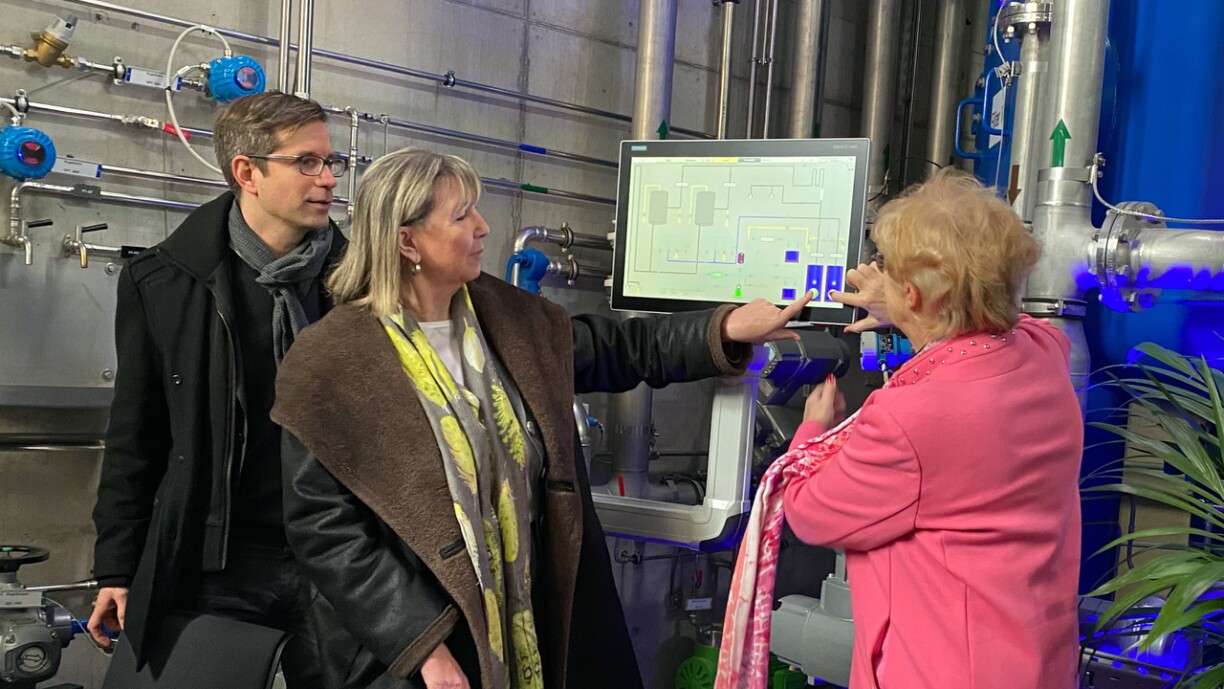
A growing population in Luxembourg City means that the capital's water requirements are simultaneously going up. A new pumping station, located right next to the Cessange water tower, was formally inaugurated on Monday and is hoped to ensure that the expanded quarters of Gasperich and Cloche d'Or have an adequate water supply in the future.
The new installation is able to pump potable water up to the City from depths of about 140 metres.
"And from there we fill water right into the tower", explained Luxembourg City Alderwoman Simone Beissel, who is in charge of the capital's water management. "There everything is mixed and then we have enough in case something happens. This way we have secured the entire Gasperich area."
At present, 63% of drinking water in the City comes from its own 72 sources, of which 40 are currently active. The rest is supplied by the Esch-sur-Sûre Water Dam Union (SEBES). Water with a lower concentration of calcium carbonate and nitrates from the barrier lake thus helps improve the water quality in the centre of the Grand Duchy.
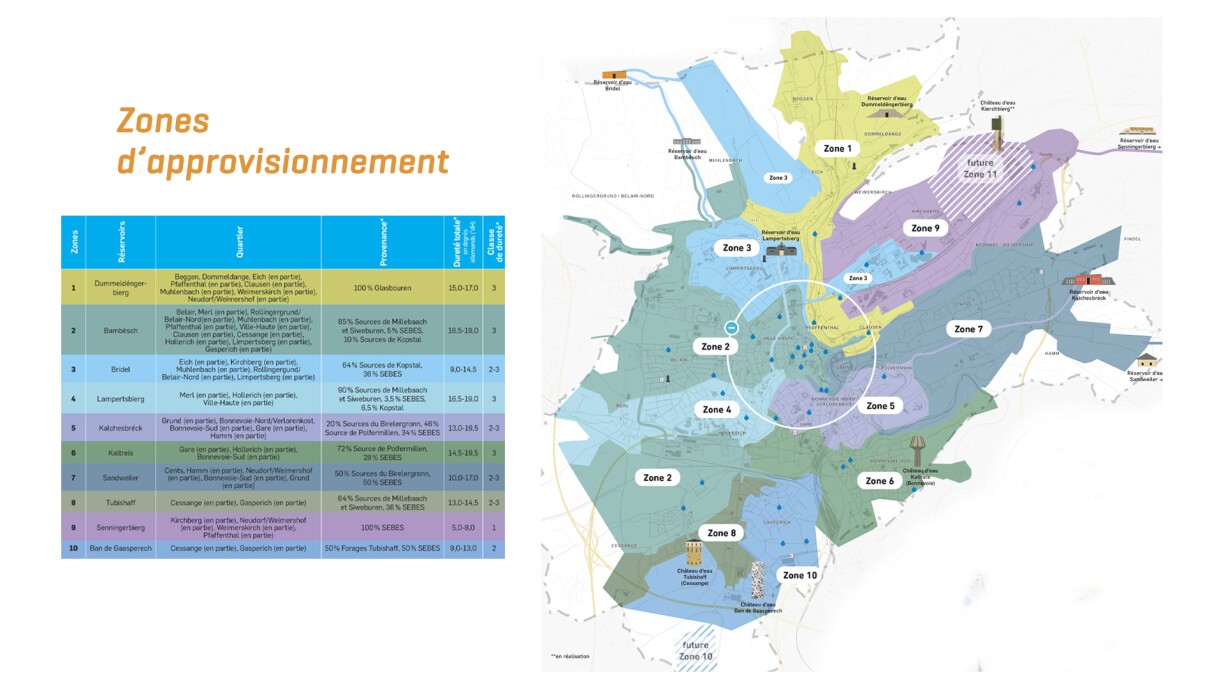
Although the City population has increased by 32% over the last ten years, water consumption has not necessarily increased accordingly, says Beissel: "We were at seven million cubic metres annually for a very long time. Ten years ago, it was 7.5. Despite substantial growth, we are now at 8.1 million cubic metres. People have become aware to the fact that water is important."
The average Luxembourg City resident uses 161 litres per day, down from 196 daily litres averaged ten years ago. The current EU average is 144 litres per day.
A second reason for why less water is being consumed is that fewer leaks occur in the capital. In 2012, 8% of the close to 600 kilometres of water pipes had small to large cracks. Today, this rate is down to 0.9%.
Patrick Licker, who is responsible for the canalisation of the capital, explained that around 3 kilometres of pipes on the water network are replaced every year: "We know that part of our canalisation is very old, so we try to replace the pipes whenever we can coordinate it with other works. Of course we focus on areas where the canals are older. It adds up to around 3 kilometres per year, but we are aiming to increase this to 5 kilometres, which is roughly where it should be."
The sewage treatment plant in Beggen is currently the site of extensive construction works, as it is the largest in the country and built to serve around 210,000 people. However, the growing number of residents and employees in the capital has pushed the plant to its limits. The ongoing construction will expand the capacity to 450,000 inhabitants.
Licker explained: "The treatment plant in Beggen discharges into a relatively small body of water in the Alzette river, which is strongly affected by the water from the plant. This is why we need to reduce the concentration of the drainage. A fourth clarification level will also be added."
This additional level will ensure the reduction of micro-pollutants in drinking water, reducing pharmaceuticals and industrial residue. The expansion is set to complete in 2030.





