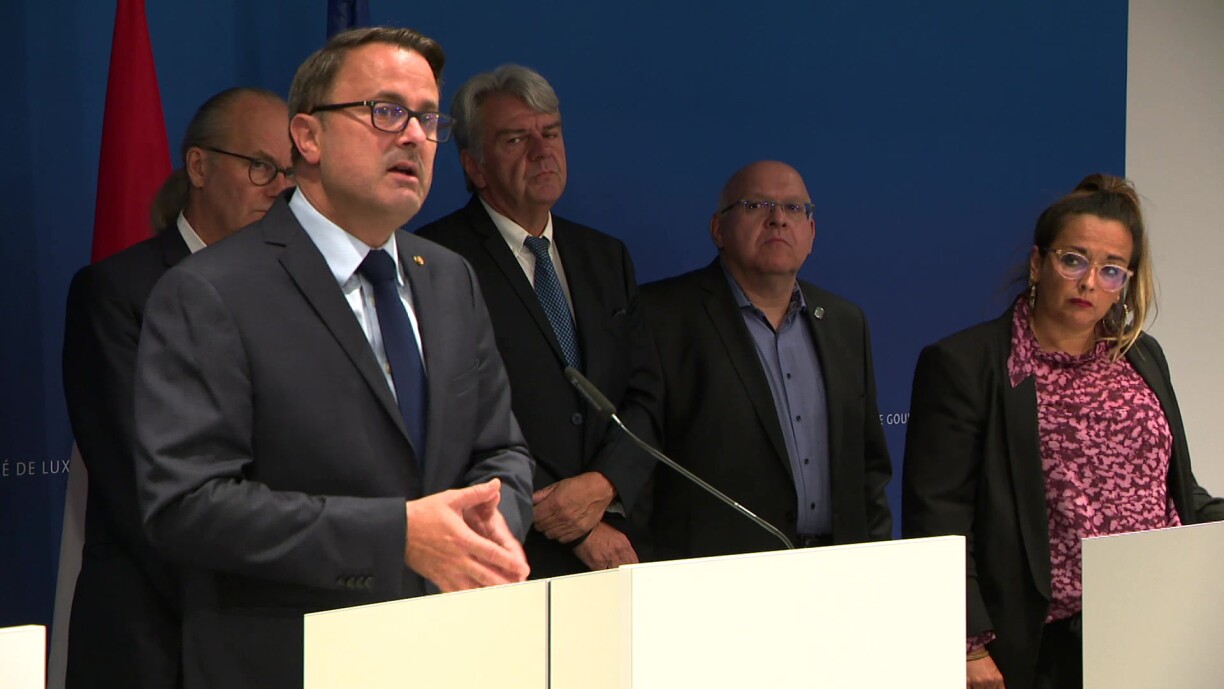
In a way, the tripartite has already started: In preparation for the official meeting on Friday, the government will meet separately with employers and trade unions on Tuesday.
The representatives of the employers will be received first, followed by the trade unions. Last week, the Prime Minister indicated on Twitter that preparations for the tripartite meeting were underway, so that "this time too, within the framework of social dialogue, we can take measures that will benefit households and businesses."
Employer representatives will likely focus on the payment of the third wage indexation this year, which the State has promised to take charge of. On a related note, the Chamber of Commerce proposes to cap the wage indexation system.
While the upcoming tripartite meeting was convened in anticipation of a potential third wage indexation at the end of the year and to avoid the projected price shock in 2024, the negotiations may well touch on another issue related to purchasing power: the adjustment of the tax table to inflation.
The trade unions are already united in their call to end the non-indexation of the tax table, stressing that "the issue affects everyone, from resident workers to cross-border commuters and pensioners." The trade unions argue that without an adjustment of the tax table, "purchasing power is only compensated at the gross level with each wage indexation, while it continues to decrease at the net level."
The three governing parties, the Democratic Party (DP), the Luxembourg Socialist Workers' Party (LSAP), and the Green Party (déi Gréng) discussed the issue during a meeting last Tuesday.
According to information obtained by RTL, the trade unions' demand has little chance of success. Especially given the cost of the measure: an adjustment would cost the state around €1 billion per year in tax revenue, or €500 million in 2023. In an interview with our colleagues from RTL Radio last Monday, Minister of Finance Yuriko Backes (DP) described the adjustment as "irresponsible."
Following a similar line of argument as the CSV-LSAP majority when it abolished the automatic adjustment in 2012, the DP refuses to index the tax table for budgetary reasons. The government also does not want to offset the measure by raising the top tax rate or decreasing state spending.
Backes believes that adjusting the tax table would mainly benefit the highest earners. However, the LSAP, the Chamber of Employees, and the trade unions have all presented their own models in which the indexation would be done in such a way that it would mostly benefit low-income earners. The Minister of Finance, meanwhile, replied that these models would be even more expensive.
RTL sources suggest that timing is another issue with adjusting the tax table. The measure would have to be applied retroactively to 1 January 2023, or it would have to go into effect after the elections, on 1 January 2024. Furthermore, if it is not implemented in a linear manner, issues about the principle of taxpayer equality may arise.
This does not mean, however, that no measures will be taken during the tripartite.
Interviewed by RTL three weeks ago, DP MP Carole Hartmann said that tax credits are less "complex" and would allow the government to take action in a targeted or selective manner.
The energy tax credit, which will expire in April, at the same time when the indexation that was deferred in 2022 will be paid out, was targeted and, in most cases, provided more relief to lower income groups than to the higher ones. It would even have overcompensated, as the government proclaimed last March.
It is therefore likely that the coalition parties will agree on the introduction of new tax credits limited to one or two years.
On a historical note: Fourteen years ago, the CSV and LSAP decided on a 9% indexation for 2009 – in an election year. In the opposition, the DP lobbied... in favour of adjusting the tax table.





