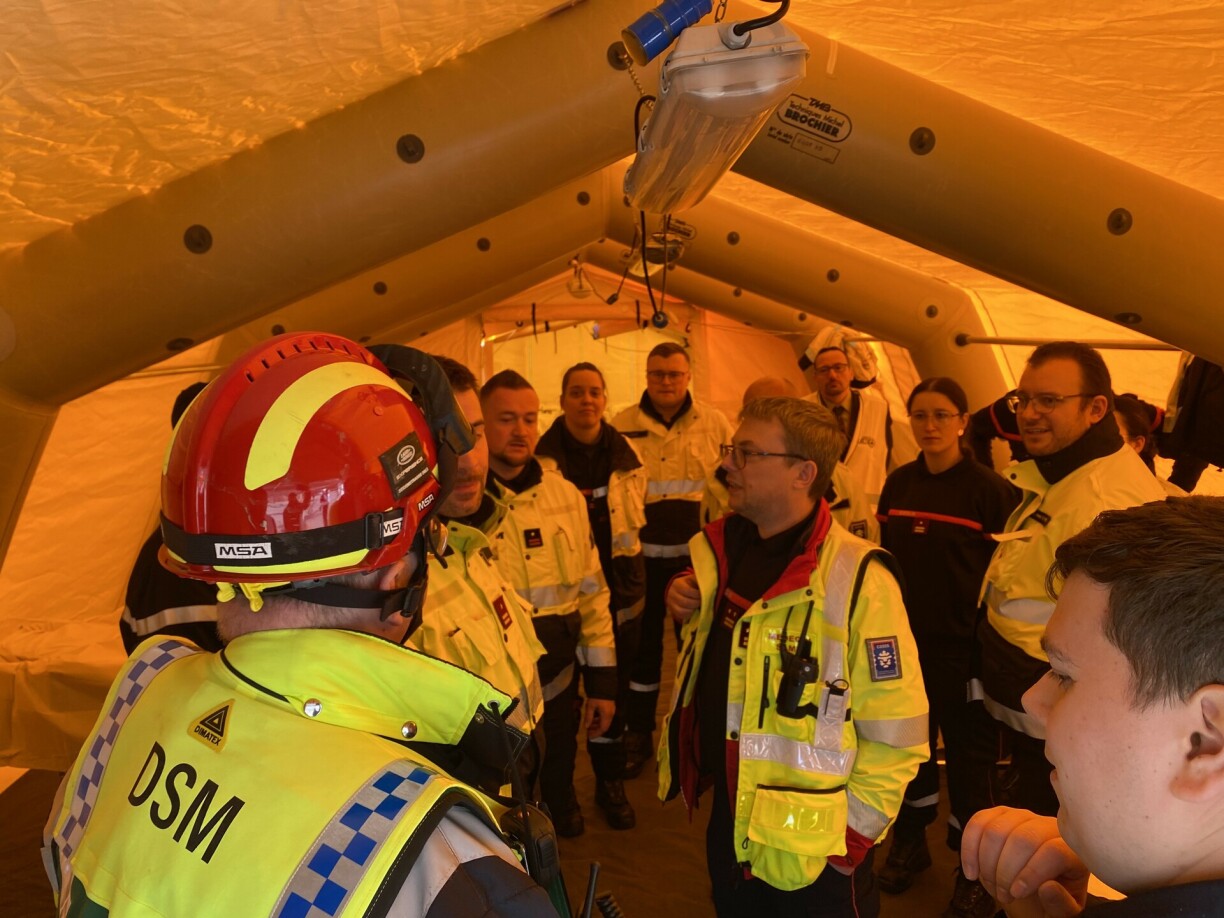
Healthcare workers and paramedics need to be prepared for the worst, whether it is a severe explosion or train accident. That's way CGDIS, CFL, and the Centre Hospitalier du Nord (CHdN) simulated a train accident on Saturday morning to give their teams the opportunity to work on their skills.
The training simulation is supposed to be as realistic as possible in order to push the paramedics to their limits. The simulated accident happened at the train station in Ettelbruck. After 10 minutes, the first ambulance arrived.
"When an accident like this occurs, there's a lot of demand but low resources", Yves Damy, head of a CIS Nordstad centre, explains. "These workers need to start by staying calm and surveying the accident. One cannot focus on only one situation and become stuck in it."


The crucial element is to remain calm and structured, although chaos and fear constantly threaten to overshadow these aspects.
The first ambulance to arrive at the scene faces the biggest challenge.
"How many victims are there? How severely are they hurt? The teams need to be divided into categories by the first responders and the first emergency doctor who arrives at the accident," elaborates Yves Damy.
"After triaging, which is identified through different colours, the people are led to a meeting point where a first report of all the injured people is compiled. As soon as that has been set up, nurses and doctors reassess in detail the state the victims are in. During a second phase, the victims are carried to hospitals which have free spaces, according to the triage."
While some paramedics take care of injuries inside the train or next to the tracks, a lot of organisation and planning goes on behind the scenes.
Around 80 people, mostly CGDIS volunteers, participated on Saturday morning. But in severe cases, regardless of their scope, up to 120 paramedics and rescuers are involved.
The national railroad company CFL also have to react rapidly when a train accident happens.
Doris Horvath who works at CFL's security service states, "We want to avoid further accidents in a case like this. We protect and secure the surrounding area by alerting our trains. That also includes disabling the power lines over the rails. We secure the railroads so that the rescue can be continued safely."
Shortly afterwards, the hospital in Ettelbruck is flooded with the arrival of the victims. Every minute a new ambulance arrives at the emergency room. As established in the 'Numerous victims plan', doctors and staff are called in. An array of services within the hospital are shut down. If necessary, planned surgeries are postponed to free up operation rooms.
It is essential to logically distribute the victims. Paul Wirtgen, general manager of CHdN states, "We have a couple of hospitals in Luxembourg whose scope and organisation enables them to take in gravely-injured victims. Yet we cannot accept dozens. If there are 20 gravely-injured people, one hospital does not suffice."
In that instance, every hospital is evaluated to see how many beds and resources are available, so that they can step in if worse comes to worst.
By replicating real-world chaos in a controlled setting, these exercises ensure emergency teams are better prepared if disaster strikes.





