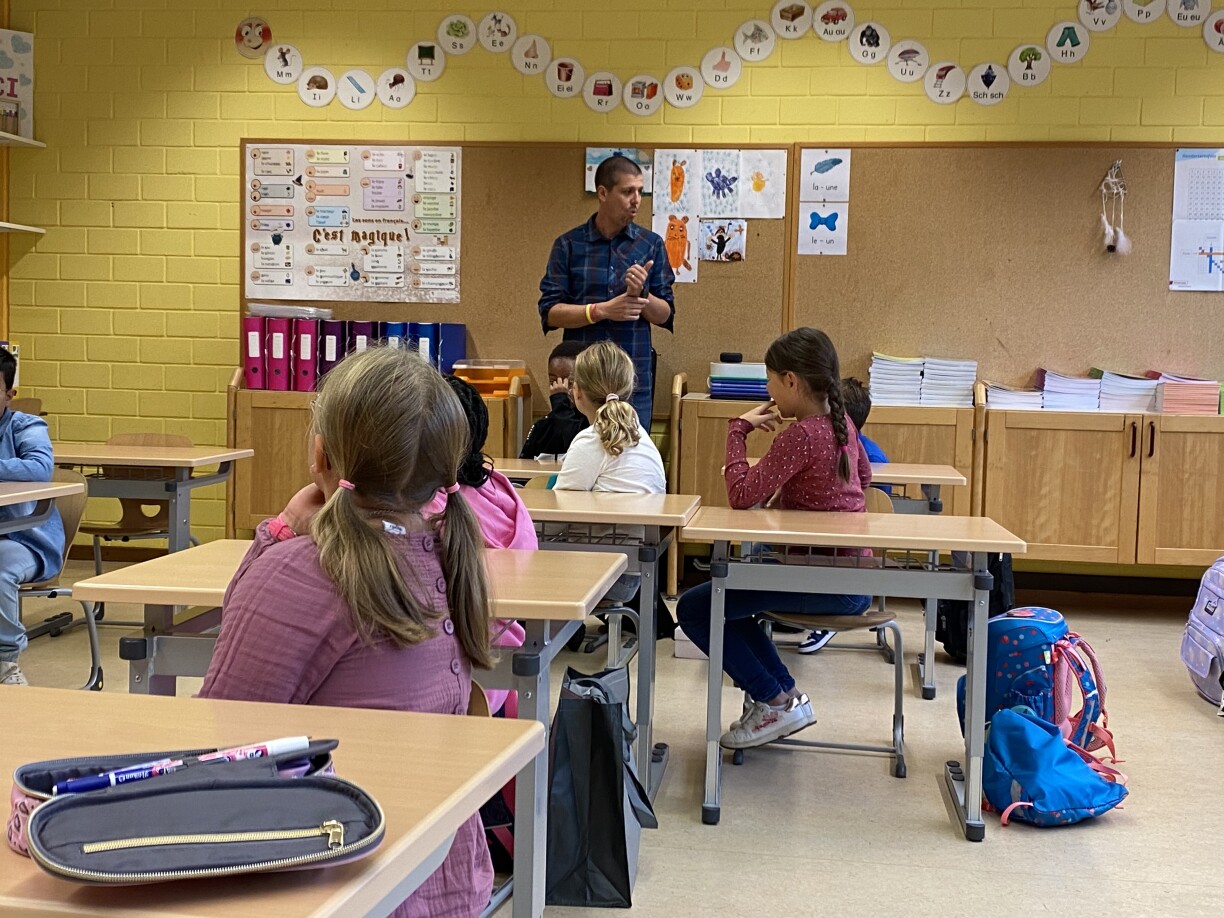
Minister of Education Claude Meisch presented his new curriculum plan for primary schools at the beginning of February. On Tuesday, he answered questions from MPs on the Parliamentary Education Committee regarding the proposed changes.
The new curriculum, which introduces seven cross-cutting themes to be integrated into existing lessons rather than taught as separate subjects, has been widely praised for its adaptation to contemporary societal realities. This integration was among the key clarifications provided during Tuesday morning's session.
The cross-cutting themes include media and artificial intelligence, emotional and sex education, and financial education, among others. Meisch noted that while the ministry has already run "excellent" projects in these areas, participation had previously been voluntary. By embedding these topics into the curriculum, the ministry aims to ensure consistency across schools. "It will truly become a requirement for every student to encounter these themes during their time at school," Meisch stated.
While welcoming the work accomplished, MP Paul Galles of the Christian Social People’s Party (CSV) questioned why the curriculum had not drawn more heavily on examples from Scandinavian countries, which consistently top international education rankings. "The advantage for children in these countries is that they learn empathy early on," Galles observed. He asked where themes such as empathy, human coexistence, and what is distinctly human in the face of advancing technology and AI appear within the proposed cross-cutting framework.
In response, Meisch pointed to the "Life and Society" subject, which dedicates two hours per week to helping students explore their identity and place within the community. The subject addresses fundamental questions including "Who am I? What am I? How am I with others?" – all of which, the minister suggested, touch upon the theme of empathy.
A new curriculum for secondary education is also in development. During Tuesday's committee meeting, MP Francine Closener of the Luxembourg Socialist Workers’ Party (LSAP) raised the question of whether plans exist to establish a "common thread" guiding students from early childhood through to the end of their secondary schooling. She noted that participants in prior consultative meetings had pointed out that such continuity is currently lacking.
Luc Weis, director of the Service for the Coordination of Pedagogical and Technological Research and Innovation (SCRIPT), responded by stating that while Closener may refer to it as a common thread, he prefers the term "coherence". Weis emphasised the importance of ensuring that learning builds progressively from the youngest to the oldest students, with subjects logically following on from one another.
He affirmed that this principle of coherence will be central to the second consultation process for the new secondary education curriculum. "It is clear that this must be based on what comes from primary education," Weis stated. By way of example, he noted that if students achieve a B1 language level by the end of primary school, it would be incoherent to begin secondary education at a C2 level.
The new primary education curriculum is set to take effect from the upcoming academic year for cycles 1 and 2, with cycles 3 and 4 following the year after. To support teachers in adapting to the changes, 16 information meetings will be organised across the country in the coming months.
Additionally, the curriculum will be launched in September 2026 via a digital platform. While primarily designed for teaching staff, the platform will also be accessible to the general public.





